Conceptual Foundation & Intuitive Analogy
🧭 Conceptual Foundation & Pattern Intuition
Depth-First Search on binary trees is an expression of mathematical induction. A binary tree is not a flat list of nodes—it is a recursive fractal structure where every non-null node is itself the root of two independent, smaller binary trees. Bottom-up divide-and-conquer DFS solves problems by making a "Leap of Faith": assume that your recursive function already works perfectly on the left and right subtrees. Your only responsibility at the current node is to combine those two child answers with the current node's value.
🏟️ The Analogy: Two Auditors Comparing Org Charts
Imagine two auditors, each holding a copy of a company's org chart, tasked with certifying the two charts are identical. Does either auditor read every name on both charts at once? No. Each auditor looks only at the current box on both charts: do the two boxes hold the same title, and are both either empty or both filled? If so, Auditor Left recurses into the left-hand reports on both charts, and Auditor Right recurses into the right-hand reports on both charts. The certification only succeeds if every single delegated comparison, all the way down, also succeeds.
🔑 Why It Works
The elegance of post-order divide-and-conquer is that no node needs to know anything about the global tree structure. By delegating to children and combining their boolean returns with AND, structural and value equality emerges naturally at the root in time and stack memory.
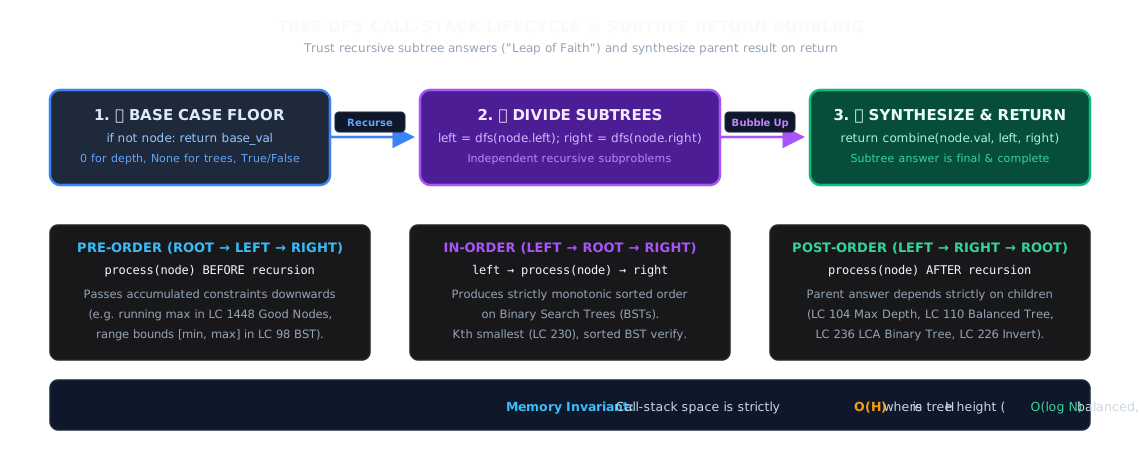
Subtree Independence Invariant: Left and right subproblems are disjoint. When a frame returns, the subtree answer is complete and memory is freed.
Subtree bottom-up aggregation: a node combines child subtree solutions upon backtrack; top-down invariants pass accumulated state down the path.
Base case: if not node: return base; recursive calls on left/right child nodes.
The 4 Mental Models of Depth-First Search
Select the recursive return contract and information direction before writing a single line of code.
1Bottom-Up DFS
Leaves ➔ Postorder Child Return ➔ Parent CombinePostorder DFS (Bottom-Up Recursion)
| 1 | from typing import Callable, Optional, TypeVar |
| 2 | |
| 3 | R = TypeVar("R") |
| 4 | |
| 5 | class TreeNode: |
| 6 | def __init__(self, val: int = 0, left: Optional["TreeNode"] = None, right: Optional["TreeNode"] = None): |
| 7 | self.val = val |
| 8 | self.left = left |
| 9 | self.right = right |
| 10 | |
| 11 | |
| 12 | def bottom_up(root: Optional[TreeNode], empty: R, combine: Callable[[TreeNode, R, R], R]) -> R: |
| 13 | """Bottom-Up DFS: the answer for the tree at root, built from the answers of its |
| 14 | subtrees. |
| 15 | empty is the answer for an empty subtree. combine(node, left, right) builds node's |
| 16 | answer from its children's answers. |
| 17 | Precondition: a node's answer depends only on the node and on the answers of its two |
| 18 | subtrees. |
| 19 | Same Tree, Symmetric Tree, Merge Two Binary Trees and Subtree of Another Tree walk |
| 20 | two trees at once, so they do not fit. |
| 21 | N = number of nodes. H = height. T = the cost of one combine call. |
| 22 | Time: O(N * T) | Space: O(H) recursion stack |
| 23 | """ |
| 24 | def solve(node: Optional[TreeNode]) -> R: |
| 25 | # 1. Base case: the answer for an empty subtree |
| 26 | if not node: |
| 27 | return empty |
| 28 | |
| 29 | # 2. Divide: solve each subtree on its own |
| 30 | left = solve(node.left) |
| 31 | right = solve(node.right) |
| 32 | |
| 33 | # 3. Combine: this node's answer comes only from its children's answers |
| 34 | return combine(node, left, right) |
| 35 | |
| 36 | return solve(root) |
A node's answer depends only on its subtrees' answers, so call maxDepth on root.left and root.right first and combine the two results on the way back up. Each call returns a finished answer for its own subtree, so the parent never looks deeper than those two numbers, and every node is visited exactly once. The trap is the base case: if not root: return 0 must be the value the combine step expects from an empty subtree. A base case that doesn't fit the combine, such as treating a missing child as a leaf in Minimum Depth of Binary Tree (LC 111), returns wrong answers.
Gotcha 1 of 4
- The trap
Gotcha 1: Taking
1 + min(left_depth, right_depth)with a missing childMistakereturn 1 + min(left_depth, right_depth)Fixif not root.left or not root.right: return 1 + max(left_depth, right_depth) return 1 + min(left_depth, right_depth)What happens: Minimum Depth of Binary Tree (LC 111) counts nodes down to the nearest leaf. A missing child returns 0 from the base case.
minthen picks that 0, so a node with one child is counted as a leaf. When one child is missing, the depth must come from the other child.Example: Minimum Depth of Binary Tree (LC 111): root = [2,null,3,null,4,null,5,null,6]Mistake: returns 1Fix: returns 5
Binary Lifting (Kth Ancestor / LCA)
| 1 | class TreeAncestor: |
| 2 | """Kth Ancestor of a Tree Node: up[j][v] is v's 2^j-th ancestor, so any k is a few |
| 3 | jumps. |
| 4 | Time: O(N log N) to build, O(log N) per query | Space: O(N log N) |
| 5 | """ |
| 6 | |
| 7 | def __init__(self, n: int, parent: list[int]) -> None: |
| 8 | self.LOG = max(1, n.bit_length()) # k <= n, so bits 0..LOG-1 cover every k |
| 9 | self.up = [parent[:]] # up[0][v]: v's parent (-1 for the root) |
| 10 | for j in range(1, self.LOG): |
| 11 | prev = self.up[j - 1] |
| 12 | # Two jumps of 2^(j-1) make one jump of 2^j; past the root stays -1 |
| 13 | self.up.append([-1 if prev[v] == -1 else prev[prev[v]] for v in range(n)]) |
| 14 | |
| 15 | def getKthAncestor(self, node: int, k: int) -> int: |
| 16 | for j in range(self.LOG): |
| 17 | if k >> j & 1: # Bit j of k is set: jump 2^j levels up |
| 18 | node = self.up[j][node] |
| 19 | if node == -1: |
| 20 | return -1 # Past the root: stop before up[j][-1] wraps around |
| 21 | return node |
Store, for every node, where 2^j steps up lands: self.up[0] is the parent list, and each next level is two jumps of the level before, prev[prev[v]]. Then any k is a sum of powers of two, so getKthAncestor jumps once for each set bit of k: node = self.up[j][node] whenever k >> j & 1. This is correct because the jumps add up: 2^j steps followed by 2^j more is exactly 2^(j+1), and the bits of k add up to k, in any order. self.LOG = max(1, n.bit_length()) levels are enough, because k <= n. The trap is the root. A node with fewer than 2^j nodes above it has -1 in level j, and -1 must stay -1: check prev[v] == -1 before reading prev[prev[v]], and return -1 as soon as node == -1. In Python, prev[-1] is not an error but the last node's entry, so an unguarded table quietly turns "no ancestor" into a real node.
Gotcha 1 of 5
- The trap
Gotcha 1: Reading
prev[prev[v]]without checkingprev[v] == -1Mistakeself.up.append([prev[prev[v]] for v in range(n)])Fixself.up.append([-1 if prev[v] == -1 else prev[prev[v]] for v in range(n)])What happens:
-1means that the node has no ancestor that far up. Python readsprev[-1]as the last entry of the list, not as an error. So an uncheckedprev[prev[v]]turns a missing ancestor into a real node. The table then holds wrong jumps.Example: Kth Ancestor of a Tree Node (LC 1483): n = 7, parent = [-1,0,0,1,1,2,2], getKthAncestor(1, 3)Mistake: returns 2Fix: returns -1
3Top-Down DFS
Root ➔ Preorder Argument Passing ➔ Descendant EvaluationPreorder DFS (Top-Down Recursion)
| 1 | from typing import Callable, Optional, TypeVar |
| 2 | |
| 3 | S = TypeVar("S") |
| 4 | R = TypeVar("R") |
| 5 | |
| 6 | class TreeNode: |
| 7 | def __init__(self, val: int = 0, left: Optional["TreeNode"] = None, right: Optional["TreeNode"] = None): |
| 8 | self.val = val |
| 9 | self.left = left |
| 10 | self.right = right |
| 11 | |
| 12 | |
| 13 | def top_down(root: Optional[TreeNode], start: S, next_state: Callable[[S, TreeNode], S], visit: Callable[[S, TreeNode], R], combine: Callable[[R, R, R], R], empty: R) -> R: |
| 14 | """Top-Down DFS: combine visit(state, node) over every node, where state describes |
| 15 | the path above node. |
| 16 | start is the state above the root. next_state(state, node) is the state handed to |
| 17 | node's children. |
| 18 | combine(here, left, right) joins a node's own result with its subtrees' results, for |
| 19 | example a sum or a max. |
| 20 | empty is the result of an empty subtree. |
| 21 | Precondition: every node is visited, so the template cannot remove nodes from the |
| 22 | tree. |
| 23 | N = number of nodes. H = height. T = the cost of one next_state, visit or combine |
| 24 | call. |
| 25 | Time: O(N * T) | Space: O(H) recursion stack |
| 26 | """ |
| 27 | def dfs(node: Optional[TreeNode], state: S) -> R: |
| 28 | if not node: |
| 29 | return empty # Empty subtree: the neutral result |
| 30 | |
| 31 | here = visit(state, node) # Decide with the state passed down |
| 32 | child_state = next_state(state, node) # Update the state for the children only |
| 33 | |
| 34 | return combine(here, dfs(node.left, child_state), dfs(node.right, child_state)) |
| 35 | |
| 36 | return dfs(root, start) |
A node's answer depends on what lies above it, so pass that knowledge down as an argument (max_so_far) instead of searching back up the tree. Each call decides using only its argument and node.val, then hands the updated state (new_max) to both children; because arguments belong to one call, siblings never see each other's changes. Start the state at -inf, so the root counts as good without a special case.
Gotcha 1 of 4
- The trap
Gotcha 1: Starting
max_so_farat0instead of-infMistakereturn dfs(root, 0)Fixreturn dfs(root, float('-inf'))What happens: The root has no ancestors, so it is always a good node. Node values can be negative. With a start of
0, a negative root failsnode.val >= max_so_far, so it is not counted. Starting at-inf, or atroot.val, makes the root count.Example: root = [-1,-2,-3]Mistake: returns 0Fix: returns 1
4Tree Traversals
Tree ➔ Stack Walk (Pre, In or Post) ➔ Nodes In That OrderTree Traversals (Recursive and Iterative)
| 1 | from typing import Callable, Literal, Optional |
| 2 | |
| 3 | class TreeNode: |
| 4 | def __init__(self, val: int = 0, left: Optional["TreeNode"] = None, right: Optional["TreeNode"] = None): |
| 5 | self.val = val |
| 6 | self.left = left |
| 7 | self.right = right |
| 8 | |
| 9 | |
| 10 | def traverse(root: Optional[TreeNode], order: Literal["pre", "in", "post"], visit: Callable[[TreeNode], None]) -> None: |
| 11 | """Depth-First Traversal with an explicit stack: visit(node) is called once for |
| 12 | every node, in the chosen order. |
| 13 | "pre" visits a node before its two subtrees, "in" between them, and "post" after |
| 14 | both. |
| 15 | Precondition: visit needs only the node itself, and it does not change the tree. |
| 16 | N = number of nodes. H = height. T = the cost of one visit call. |
| 17 | Time: O(N * T) | Space: O(H) stack |
| 18 | """ |
| 19 | # Nodes the walk has pushed and not popped yet; the deepest node is on top |
| 20 | stack: list[TreeNode] = [] |
| 21 | # The node popped most recently; "post" reads it to see that a right subtree is |
| 22 | # finished |
| 23 | last: Optional[TreeNode] = None |
| 24 | node = root |
| 25 | while node or stack: |
| 26 | # 1. Dive Left: |
| 27 | # Push every node on the way down the left edge. "pre" visits each node here, |
| 28 | # before both of its subtrees. |
| 29 | while node: |
| 30 | if order == "pre": |
| 31 | visit(node) |
| 32 | stack.append(node) |
| 33 | node = node.left |
| 34 | |
| 35 | # 2. Finish The Right Subtree First ("post" only): |
| 36 | # "post" visits a node after both subtrees. If the right subtree is not |
| 37 | # finished, walk it before popping. |
| 38 | top = stack[-1] |
| 39 | if order == "post" and top.right and top.right is not last: |
| 40 | node = top.right |
| 41 | continue |
| 42 | |
| 43 | # 3. Pop The Node: |
| 44 | # The walk is done with the left subtree, and for "post" with the right subtree |
| 45 | # too. "in" and "post" visit the node now. "pre" and "in" then move to the right |
| 46 | # subtree. |
| 47 | stack.pop() |
| 48 | if order != "pre": |
| 49 | visit(top) |
| 50 | last = top |
| 51 | if order != "post": |
| 52 | node = top.right |
The walk reaches every node three times: on the way down, after the left subtree is finished, and after the right subtree is finished. The order name says which of the three times calls visit. Preorder visits on the way down, inorder after the left subtree, and postorder after the right subtree. So one stack serves all three orders, and only the line that calls visit moves. The inner loop pushes every node on the way down the left edge, so the node that stack.pop() returns has a finished left subtree, and node = node.right walks its right subtree next. Every node is pushed once and popped once, so it is visited once. Postorder is the one order that comes back to a node twice before it leaves, so the template pops a node only when top.right is empty or top.right is last. The trap is where the visit line sits. In inorder, result.append(node.val) goes right after stack.pop(). Next to stack.append(node), it runs on the way down and returns the preorder: [1, 2, 3] instead of [1, 3, 2] on [1,null,2,3].
Gotcha 1 of 5
- The trap
Gotcha 1: Appending
node.valwhennodeis pushedMistakewhile node: result.append(node.val) stack.append(node) node = node.left node = stack.pop()Fixwhile node: stack.append(node) node = node.left node = stack.pop() result.append(node.val)What happens: A pushed node has not yet had its left subtree visited. The pushes go from the root down the left edge, so every value is appended before the smaller values that belong in front of it. The list that results is the preorder. On
[1,null,2,3], the walk appends 1, then pushes and appends 2, then pushes and appends 3. The result is[1, 2, 3]. The inorder is[1, 3, 2], because 3 is the left child of 2.Example: Binary Tree Inorder Traversal (LC 94): root = [1,null,2,3]Mistake: returns [1, 2, 3]Fix: returns [1, 3, 2]
Built on the mental models above
- Construct Binary TreeTree Construction (Build from Preorder + Inorder)
The recursion works on index ranges of the two traversals, and the next preorder value is the root of each range.
- Tree Diameter DPTree DP (Max Path Sum / Diameter)
The function returns one downward leg, and a separate
global_maxrecords the best path that bends at each node. - Two Tree WalkTwo-Tree DFS (Walking a Pair of Nodes Together)
The call takes a pair of nodes, one from each tree, and combines the pair with the answers of its two child pairs.
- Tree State DPTree State DP (Return Several States per Node)
Each call returns one best value per state of the node, such as taken and skipped, so the parent never looks at grandchildren.
- RerootRerooting a Tree (Answer for Every Root)
A second pass walks down and hands each child the answer for everything outside its subtree, so every node gets the answer as if it were the root.
- Tree As StringTree as a String (Serialize and Canonical Key)
Each call returns a string built from its children's strings, so equal subtrees give equal strings that can be counted or compared.
- Rewire TreeRewire Tree (Return the Node That Stays)
Each call returns the node that stays in its place, which may be None, and the parent stores that return value as its child.
- Greedy Tree DPGreedy Postorder Tree DP (Distribute Coins, Minimum Fuel Cost)
Each subtree returns one signed number, what it holds minus what it needs, and the parent counts that many crossings of the edge above it.
- BST BoundsBST Property / Range Validation
The value passed down is a pair
(low, high), and the BST rule picks the single branch to follow. - Root-to-Leaf PathsRoot-to-Leaf Path Backtracking
The path above is a shared list: append before the recursive calls, pop after them, and copy it at a leaf.
- BST InorderInorder Traversal as a Sorted Stream (Kth Smallest in BST, BST Iterator)
An inorder walk visits a BST in ascending order, so it can stop as soon as it has the value it needs.
The DFS Decision Rule
When facing an unseen binary tree or recursive graph problem, ask these questions in order:
Update global maximum with 2-legged summit (node.val + left + right); return strictly 1-legged branch (node.val + max(left, right)) upward.
Return one best total per state of the node, e.g. (rob, skip), and combine the children's tuples in the parent.
Bubble each child's status or surplus up from the postorder call; the parent acts only when a child needs it and counts what crosses each edge.
Propagate open intervals (low, high) downward or steer recursion down a single branch based on directional comparison.
Walk with an explicit stack and change only the line that calls visit: on the way down for preorder, after the left subtree for inorder, after the right subtree for postorder.
Walk inorder (left, node, right), iteratively with a stack when you must stop early, and count on the pop.
Mutate a single shared buffer on entry (append), snapshot deep copies at true leaves (list(path)), and pop on exit to restore state for sibling branches.
Pass accumulated constraints downward via arguments: dfs(child, max(ancestor_max, node.val)).
Call the recursion on a pair of nodes, one from each tree: pair p.left with q.left (or with q.right for a mirror), return p is None and q is None when a node is missing, and combine the pair with its two child pairs' answers.
Return a string from every call, built from the node value and the strings of its two children, with a marker for a missing child: equal subtrees give equal strings, so count or compare the strings.
Return from every call the node that should stay in its place, or None: set node.left = rewire(node.left) and node.right = rewire(node.right) first, then decide whether this node stays.
Run one pass up the tree to get each subtree's counts and sums, then one pass down that hands each child the answer for everything outside its subtree.
Recursively solve left and right subtrees independently; synthesize answers upon return: return combine(node.val, dfs(left), dfs(right)).
The first preorder value is the root; its index in inorder (from a value-to-index map) splits the left and right subtrees; recurse on each.
Precompute up[j][v] = up[j-1][up[j-1][v]], then answer a jump of k with the 2^j jumps of k's set bits.
Pattern Architecture & Invariant Design Masterclass
Depth-First Search on trees operates on a foundational principle: Subtree Divide and Conquer. From any node in a tree, the entire problem decomposes into identical, smaller subproblems on its left and right subtrees.
Because trees are connected acyclic graphs with exactly one path between any two nodes, a parent node can solve its own problem simply by synthesizing the already-solved answers of its children.
[ Parent Node ] / \ (left_res) (right_res) / \[ Left Subtree ] [ Right Subtree ] (Solved fully) (Solved fully) The breakthrough mental model for mastering Tree DFS is the Recursive Leap of Faith, and most tree DFS frames follow this 3-step cycle:
- 🛑 The Floor — Base Case Check (
if not node: return base_val): Whennode is Noneor a leaf is reached, return the mathematical identity element (e.g.0for depth,Nonefor trees,Truefor validity). This anchors the recursion — without it, the call stack recurses infinitely. - 🌿 The Leap of Faith — Divide & Recurse (
left = dfs(node.left),right = dfs(node.right)): Trust thatdfs(node.left)anddfs(node.right)return 100% correct, complete solutions for their respective subtrees. Do not trace the recursion in your head. Left and right subtrees have zero shared state (Subtree Independence Invariant). - 💎 The Synthesis — Combine & Bubble Up (
return combine(node.val, left, right)): Write only the combine logic that builds the parent's answer fromnode.val,left_res, andright_res, then return that value upward. When this frame returns, its subtree is fully resolved and its stack memory is immediately freed.
The 3-Step Recursive Frame Lifecycle
Variable Anatomy: The 7 Variables Every Tree DFS Uses
def dfs(node: Optional[TreeNode], min_val: float, max_val: float, path: list[int]) -> int: if not node: return 0 # 1. base_val (Recursion floor) path.append(node.val) # 2. path (Current branch accumulator) left_res = dfs(node.left, min_val, node.val, path) # 3. left_res (Left subtree answer) right_res = dfs(node.right, node.val, max_val, path) # 4. right_res (Right subtree answer) path.pop() # 5. un-choose (Backtrack step) return max(left_res, right_res) + 1 # 6. combine (Bubble-up synthesis) | Variable | Type / Role | Purpose in Tree DFS | Failure Mode if Missing / Mismanaged |
|---|---|---|---|
node | Optional[TreeNode] | Pointer to current tree node being evaluated in active call frame. | Infinite recursion if node.left / node.right not advanced. |
base_val | int / bool / None | Neutral mathematical identity returned when hitting empty branch (None). | Returning wrong base (e.g. 1 instead of 0) shifts depth off-by-one. |
left_res | Any (int, bool, Node) | Fully solved result returned by left subtree recursive call. | Tracing recursion manually leads to cognitive overload. |
right_res | Any (int, bool, Node) | Fully solved result returned by right subtree recursive call. | Must be treated symmetrically or pruned in BSTs. |
low / high | float / int | Top-down inherited bounds passed downwards to validate search space. | Checking only immediate child left < node < right misses deep BST violations. |
path | list[int] | Shared mutable buffer tracking active root-to-leaf path. | Appending path directly without list(path) copies mutates recorded results. |
global_max | list[int] / nonlocal | Global accumulator tracking cross-subtree values (e.g. Tree Diameter, Max Path Sum). | Returning local branch sum while neglecting bending path across root. |
The 3 Dimensions of Tree DFS
Every Tree DFS problem can be classified across 3 orthogonal dimensions:
DIMENSION 1: INFORMATION FLOW ┌───────────────────────┴───────────────────────┐ ▼ ▼ Bottom-Up Synthesis Top-Down Accumulation (Post-Order Return Values) (Pre-Order Parameter Passing) e.g. Max Depth, Balanced Tree e.g. Valid BST, Good Nodes DIMENSION 2: TRAVERSAL ORDER ┌───────────────────────┼───────────────────────┐ ▼ ▼ ▼ Pre-Order In-Order Post-Order (Root → L → R) (L → Root → R) (L → R → Root) Path Accumulation BST Monotonic Sort Subtree Synthesis DIMENSION 3: CALL-STACK BOUND O(H) ┌───────────────────────┴───────────────────────┐ ▼ ▼ Balanced Tree Skewed Chain H = O(log N) H = O(N) - Dimension 1: Information Direction (Bottom-Up vs Top-Down):
- Bottom-Up: Parent answers depend on child answers. Recurse first, combine on return (Post-Order).
- Top-Down: Child validity depends on ancestor constraints. Pass running bounds downward in arguments (Pre-Order).
- Dimension 2: Traversal Order (Pre vs In vs Post):
- Pre-Order (
Root → Left → Right): Work happens before recursion (path building, serialization). - In-Order (
Left → Root → Right): Work happens between children. On BSTs, yields strictly sorted ascending values. - Post-Order (
Left → Right → Root): Work happens after recursion (height calculations, subtree deletion, inversion).
- Pre-Order (
- Dimension 3: Call-Stack Memory Bound ():
- Auxiliary memory is strictly bounded by tree height .
- Balanced Tree: stack frames.
- Degenerate Skewed Chain: stack frames (can cause recursion depth overflow).
The 5 Master Tree DFS Paradigms
┌─────────────────────────────────────────────────────────────────────────────┐│ THE 5 MASTER TREE DFS PARADIGMS │├────────────────────────────────┬────────────────────────────────────────────┤│ 1. Pure Divide & Conquer │ Bottom-up return bubbling: LC 104, 110, 236││ 2. In-Place Tree Mutation │ Post-order subtree swapping: LC 226, 114 ││ 3. Top-Down Parameter Passing │ Ancestor constraint propagation: LC 1448 ││ 4. BST Monotonic / Split │ Exploiting sorted order & bounds: LC 98,235││ 5. Tree Backtracking (Paths) │ Mutable buffer choose-explore-unchoose: 113│└────────────────────────────────┴────────────────────────────────────────────┘ Understanding Invariants: Subtree Independence & Memory Bound
Subtree Independence Invariant: Left and right subtrees are completely disjoint with zero shared mutable state. When a recursive call frame returns, its subtree answer is mathematically complete, and its stack memory is immediately reclaimed.
Depth-First Search explores branches to maximal depth before backtracking. The call stack maintains the active ancestor chain, allowing base cases to anchor the recursion and parent nodes to synthesize optimal answers bottom-up without global coordination.
Terminates recursive descent at leaf boundaries without creating non-existent child frames, maintaining O(N) total calls.
Spatial monotonicity guarantees target values cannot exist in the pruned branch, reducing time complexity from O(N) full traversal to O(H) single-path search.
Common Questions
"When my code calls dfs(root.left) and then dfs(root.right), how should I picture what's happening — does the current node handle both sides at the same time, or does execution go all the way down the left side first, come back up, and only then start the right side?"
You need both mental models — you just use them at different times.
- While you are designing the algorithm, use the Delegation mindset: at the current node, you explore both left and right.
- While you are tracing or debugging a program, use the Stack mindset: the machine goes all the way down the left branch, pops all the way back up, and only then goes down the right branch.
1. The Design mindset — think locally (Delegation). Writing a recursive function while trying to visualize the entire call stack diving down and popping back up will overwhelm your working memory. Instead, treat
dfsas a subcontractor: you are standing at the current node, and you say "I need the answer for my left side — go figure that out and hand it back to me," then "I need the answer for my right side — go get that too." This is exactly the Recursive Leap of Faith from the mental model above: you trust thatdfs(node.left)anddfs(node.right)each return a complete, correct answer, and you never trace how they got there. You only care about what comes back to the current frame. This is what makes designing Tree DP tractable — you focus on one question: "What information do I pass down to my children, and what information do I need them to pass back up to me?"2. The Debug mindset — think procedurally (Stack). When your code is failing, or you're reading someone else's recursive solution (like a Tree DP zigzag-path walk), switch to the computer's actual execution order. The computer cannot do two things at once: when it hits
dfs(node.left), it fully suspends the current frame and dives all the way down the left subtree, hitting leaf after leaf until it returnsNone/base case. Only after the entire left subtree has finished and popped off the call stack does execution return to the current frame and finally startdfs(node.right).The takeaway: when you're staring at a blank editor trying to solve a tree problem, don't try to picture the execution diving down and popping back up — that mindset is for verifying code, not writing it. Stay in the Delegation mindset: focus on one single node, and ask what it needs from its children and what it owes its parent.
"In problems like Binary Tree Maximum Path Sum, why do we need both a global_max variable AND a return value from dfs — isn't the return value enough?"
Because they answer two different questions, and a parent can only make use of one of them.
The
returnvalue answers "what is the best score my parent can extend a path through, using just me and one of my children?" A path can only continue upward through a single leg — a parent can't accept a path that already bent at you and also keep extending it, because a path can't fork twice. That's why the return isnode.val + max(left_gain, right_gain): exactly one leg, chosen greedily.global_maxanswers a completely different question: "what is the best score of any path that is allowed to bend at this exact node, using both legs at once?" That path can never be extended further — it already used both directions — so it can only ever update a running best-so-far, never be returned upward.Every node computes both from the same two recursive calls:
global_max = max(global_max, node.val + left_gain + right_gain)(the two-legged "summit," compared against the global best) andreturn node.val + max(left_gain, right_gain)(the single-legged branch, handed to the parent). Conflating the two — returning the two-legged value, or forgetting to update the global with it — is the single most common bug in this archetype.max(..., 0)on each leg is the other half: a path is always allowed to decline a negative subtree rather than drag the total down.
Coach discussion points
- 1.
"Your recursive function uses no explicit data structures. Why is its space complexity not ?" Call-stack frames consume auxiliary RAM ( on skewed trees).
- 2.
"Why must BST validation pass ranges downward rather than checking left and right children locally?" Subtree validity is a global invariant across all ancestors.
- 3.
"When does a problem require post-order vs pre-order traversal?" Post-order when parent needs child results; pre-order when child needs ancestor context.
Complexity analysis
| Metric | Balanced Tree | Skewed Chain Tree | Derivation / Mechanism |
|---|---|---|---|
| Time Complexity | Every node is entered once and left once; work per frame is . | ||
| Auxiliary Space | Memory bounded strictly by call stack frame depth (tree height ). | ||
| Path Copying (LC 113) | Snapshotting list(path) at matching leaves costs per match, in all. A chain has one leaf, so one copy. The worst case is a caterpillar: about leaves, up to deep (4000 nodes copy 2,003,000 values). |
A file system needs to report the total size of a folder. It cannot know its own size without first knowing the sizes of every subfolder — so it descends into the first subfolder, which descends into its first subfolder, all the way down to a folder that contains only files. That one answers immediately. Its answer flows back up to its parent, which adds it to its siblings' answers, and so on until the top-level folder has a number. du -sh, dependency resolvers, and JSON serialisers all do exactly this.
💡 Don't worry if recursive leap-of-faith thinking feels daunting right now! DFS decomposes trees and graphs into disjoint subproblems solved cleanly by the call stack. As you progress through the Archetype Variants (from Tree Max Path Sum and Lowest Common Ancestor to Number of Islands and Topological Cycle Checks), each hands-on challenge will cement this intuition until combining dfs(child) returns and unwinding recursion becomes second nature.
Base case floor error: Returning
1instead of0whennode is None. An empty tree has depth 0, while a leaf node has depth 1. Returning 1 shifts every path depth by +1.Skewed tree call-stack overflow: In degenerate linked-list trees ( height), deep recursion triggers stack overflow. Production systems require iterative stack traversal (
stack = [(root, 1)]).Node count vs edge count ambiguity: LeetCode defines depth as the number of nodes along the path (root alone = 1). Graph theory often counts edges (root alone = 0). Always clarify unit definitions.
Staff+ Systems Architecture & Hardware Considerations
Triggers: "explore all paths", "tree traversal / branch evaluation", "connected components / reachability", "topological sort on DAG(Directed Acyclic Graph)". Deep exhaustive exploration along a path before backtracking to explore alternate branches.
Graph or tree with vertices and edges. Time budget is when visited states are memoized or marked. Call stack depth is bounded by tree height or graph path length ; recursion exceeding frames risks call stack overflow.
Call stack overflow (stack overflow exception) on deep or degenerate linear graphs (); infinite recursion loops on cyclic graphs without a visited set; modifying shared state without restoring it on backtracks.
Conceptual Foundation & Intuitive Analogy
🧭 Conceptual Foundation & Pattern Intuition
Depth-First Search on binary trees is an expression of mathematical induction. A binary tree is not a flat list of nodes—it is a recursive fractal structure where every non-null node is itself the root of two independent, smaller binary trees. Bottom-up divide-and-conquer DFS solves problems by making a "Leap of Faith": assume that your recursive function already works perfectly on the left and right subtrees. Your only responsibility at the current node is to combine those two child answers with the current node's value.
🏟️ The Analogy: Two Auditors Comparing Org Charts
Imagine two auditors, each holding a copy of a company's org chart, tasked with certifying the two charts are identical. Does either auditor read every name on both charts at once? No. Each auditor looks only at the current box on both charts: do the two boxes hold the same title, and are both either empty or both filled? If so, Auditor Left recurses into the left-hand reports on both charts, and Auditor Right recurses into the right-hand reports on both charts. The certification only succeeds if every single delegated comparison, all the way down, also succeeds.
🔑 Why It Works
The elegance of post-order divide-and-conquer is that no node needs to know anything about the global tree structure. By delegating to children and combining their boolean returns with AND, structural and value equality emerges naturally at the root in time and stack memory.
Subtree Independence Invariant: Left and right subproblems are disjoint. When a frame returns, the subtree answer is complete and memory is freed.
Subtree bottom-up aggregation: a node combines child subtree solutions upon backtrack; top-down invariants pass accumulated state down the path.
Base case: if not node: return base; recursive calls on left/right child nodes.
The 4 Mental Models of Depth-First Search
Select the recursive return contract and information direction before writing a single line of code.
1Bottom-Up DFS
Leaves ➔ Postorder Child Return ➔ Parent CombinePostorder DFS (Bottom-Up Recursion)
| 1 | from typing import Callable, Optional, TypeVar |
| 2 | |
| 3 | R = TypeVar("R") |
| 4 | |
| 5 | class TreeNode: |
| 6 | def __init__(self, val: int = 0, left: Optional["TreeNode"] = None, right: Optional["TreeNode"] = None): |
| 7 | self.val = val |
| 8 | self.left = left |
| 9 | self.right = right |
| 10 | |
| 11 | |
| 12 | def bottom_up(root: Optional[TreeNode], empty: R, combine: Callable[[TreeNode, R, R], R]) -> R: |
| 13 | """Bottom-Up DFS: the answer for the tree at root, built from the answers of its |
| 14 | subtrees. |
| 15 | empty is the answer for an empty subtree. combine(node, left, right) builds node's |
| 16 | answer from its children's answers. |
| 17 | Precondition: a node's answer depends only on the node and on the answers of its two |
| 18 | subtrees. |
| 19 | Same Tree, Symmetric Tree, Merge Two Binary Trees and Subtree of Another Tree walk |
| 20 | two trees at once, so they do not fit. |
| 21 | N = number of nodes. H = height. T = the cost of one combine call. |
| 22 | Time: O(N * T) | Space: O(H) recursion stack |
| 23 | """ |
| 24 | def solve(node: Optional[TreeNode]) -> R: |
| 25 | # 1. Base case: the answer for an empty subtree |
| 26 | if not node: |
| 27 | return empty |
| 28 | |
| 29 | # 2. Divide: solve each subtree on its own |
| 30 | left = solve(node.left) |
| 31 | right = solve(node.right) |
| 32 | |
| 33 | # 3. Combine: this node's answer comes only from its children's answers |
| 34 | return combine(node, left, right) |
| 35 | |
| 36 | return solve(root) |
A node's answer depends only on its subtrees' answers, so call maxDepth on root.left and root.right first and combine the two results on the way back up. Each call returns a finished answer for its own subtree, so the parent never looks deeper than those two numbers, and every node is visited exactly once. The trap is the base case: if not root: return 0 must be the value the combine step expects from an empty subtree. A base case that doesn't fit the combine, such as treating a missing child as a leaf in Minimum Depth of Binary Tree (LC 111), returns wrong answers.
Gotcha 1 of 4
- The trap
Gotcha 1: Taking
1 + min(left_depth, right_depth)with a missing childMistakereturn 1 + min(left_depth, right_depth)Fixif not root.left or not root.right: return 1 + max(left_depth, right_depth) return 1 + min(left_depth, right_depth)What happens: Minimum Depth of Binary Tree (LC 111) counts nodes down to the nearest leaf. A missing child returns 0 from the base case.
minthen picks that 0, so a node with one child is counted as a leaf. When one child is missing, the depth must come from the other child.Example: Minimum Depth of Binary Tree (LC 111): root = [2,null,3,null,4,null,5,null,6]Mistake: returns 1Fix: returns 5
Binary Lifting (Kth Ancestor / LCA)
| 1 | class TreeAncestor: |
| 2 | """Kth Ancestor of a Tree Node: up[j][v] is v's 2^j-th ancestor, so any k is a few |
| 3 | jumps. |
| 4 | Time: O(N log N) to build, O(log N) per query | Space: O(N log N) |
| 5 | """ |
| 6 | |
| 7 | def __init__(self, n: int, parent: list[int]) -> None: |
| 8 | self.LOG = max(1, n.bit_length()) # k <= n, so bits 0..LOG-1 cover every k |
| 9 | self.up = [parent[:]] # up[0][v]: v's parent (-1 for the root) |
| 10 | for j in range(1, self.LOG): |
| 11 | prev = self.up[j - 1] |
| 12 | # Two jumps of 2^(j-1) make one jump of 2^j; past the root stays -1 |
| 13 | self.up.append([-1 if prev[v] == -1 else prev[prev[v]] for v in range(n)]) |
| 14 | |
| 15 | def getKthAncestor(self, node: int, k: int) -> int: |
| 16 | for j in range(self.LOG): |
| 17 | if k >> j & 1: # Bit j of k is set: jump 2^j levels up |
| 18 | node = self.up[j][node] |
| 19 | if node == -1: |
| 20 | return -1 # Past the root: stop before up[j][-1] wraps around |
| 21 | return node |
Store, for every node, where 2^j steps up lands: self.up[0] is the parent list, and each next level is two jumps of the level before, prev[prev[v]]. Then any k is a sum of powers of two, so getKthAncestor jumps once for each set bit of k: node = self.up[j][node] whenever k >> j & 1. This is correct because the jumps add up: 2^j steps followed by 2^j more is exactly 2^(j+1), and the bits of k add up to k, in any order. self.LOG = max(1, n.bit_length()) levels are enough, because k <= n. The trap is the root. A node with fewer than 2^j nodes above it has -1 in level j, and -1 must stay -1: check prev[v] == -1 before reading prev[prev[v]], and return -1 as soon as node == -1. In Python, prev[-1] is not an error but the last node's entry, so an unguarded table quietly turns "no ancestor" into a real node.
Gotcha 1 of 5
- The trap
Gotcha 1: Reading
prev[prev[v]]without checkingprev[v] == -1Mistakeself.up.append([prev[prev[v]] for v in range(n)])Fixself.up.append([-1 if prev[v] == -1 else prev[prev[v]] for v in range(n)])What happens:
-1means that the node has no ancestor that far up. Python readsprev[-1]as the last entry of the list, not as an error. So an uncheckedprev[prev[v]]turns a missing ancestor into a real node. The table then holds wrong jumps.Example: Kth Ancestor of a Tree Node (LC 1483): n = 7, parent = [-1,0,0,1,1,2,2], getKthAncestor(1, 3)Mistake: returns 2Fix: returns -1
3Top-Down DFS
Root ➔ Preorder Argument Passing ➔ Descendant EvaluationPreorder DFS (Top-Down Recursion)
| 1 | from typing import Callable, Optional, TypeVar |
| 2 | |
| 3 | S = TypeVar("S") |
| 4 | R = TypeVar("R") |
| 5 | |
| 6 | class TreeNode: |
| 7 | def __init__(self, val: int = 0, left: Optional["TreeNode"] = None, right: Optional["TreeNode"] = None): |
| 8 | self.val = val |
| 9 | self.left = left |
| 10 | self.right = right |
| 11 | |
| 12 | |
| 13 | def top_down(root: Optional[TreeNode], start: S, next_state: Callable[[S, TreeNode], S], visit: Callable[[S, TreeNode], R], combine: Callable[[R, R, R], R], empty: R) -> R: |
| 14 | """Top-Down DFS: combine visit(state, node) over every node, where state describes |
| 15 | the path above node. |
| 16 | start is the state above the root. next_state(state, node) is the state handed to |
| 17 | node's children. |
| 18 | combine(here, left, right) joins a node's own result with its subtrees' results, for |
| 19 | example a sum or a max. |
| 20 | empty is the result of an empty subtree. |
| 21 | Precondition: every node is visited, so the template cannot remove nodes from the |
| 22 | tree. |
| 23 | N = number of nodes. H = height. T = the cost of one next_state, visit or combine |
| 24 | call. |
| 25 | Time: O(N * T) | Space: O(H) recursion stack |
| 26 | """ |
| 27 | def dfs(node: Optional[TreeNode], state: S) -> R: |
| 28 | if not node: |
| 29 | return empty # Empty subtree: the neutral result |
| 30 | |
| 31 | here = visit(state, node) # Decide with the state passed down |
| 32 | child_state = next_state(state, node) # Update the state for the children only |
| 33 | |
| 34 | return combine(here, dfs(node.left, child_state), dfs(node.right, child_state)) |
| 35 | |
| 36 | return dfs(root, start) |
A node's answer depends on what lies above it, so pass that knowledge down as an argument (max_so_far) instead of searching back up the tree. Each call decides using only its argument and node.val, then hands the updated state (new_max) to both children; because arguments belong to one call, siblings never see each other's changes. Start the state at -inf, so the root counts as good without a special case.
Gotcha 1 of 4
- The trap
Gotcha 1: Starting
max_so_farat0instead of-infMistakereturn dfs(root, 0)Fixreturn dfs(root, float('-inf'))What happens: The root has no ancestors, so it is always a good node. Node values can be negative. With a start of
0, a negative root failsnode.val >= max_so_far, so it is not counted. Starting at-inf, or atroot.val, makes the root count.Example: root = [-1,-2,-3]Mistake: returns 0Fix: returns 1
4Tree Traversals
Tree ➔ Stack Walk (Pre, In or Post) ➔ Nodes In That OrderTree Traversals (Recursive and Iterative)
| 1 | from typing import Callable, Literal, Optional |
| 2 | |
| 3 | class TreeNode: |
| 4 | def __init__(self, val: int = 0, left: Optional["TreeNode"] = None, right: Optional["TreeNode"] = None): |
| 5 | self.val = val |
| 6 | self.left = left |
| 7 | self.right = right |
| 8 | |
| 9 | |
| 10 | def traverse(root: Optional[TreeNode], order: Literal["pre", "in", "post"], visit: Callable[[TreeNode], None]) -> None: |
| 11 | """Depth-First Traversal with an explicit stack: visit(node) is called once for |
| 12 | every node, in the chosen order. |
| 13 | "pre" visits a node before its two subtrees, "in" between them, and "post" after |
| 14 | both. |
| 15 | Precondition: visit needs only the node itself, and it does not change the tree. |
| 16 | N = number of nodes. H = height. T = the cost of one visit call. |
| 17 | Time: O(N * T) | Space: O(H) stack |
| 18 | """ |
| 19 | # Nodes the walk has pushed and not popped yet; the deepest node is on top |
| 20 | stack: list[TreeNode] = [] |
| 21 | # The node popped most recently; "post" reads it to see that a right subtree is |
| 22 | # finished |
| 23 | last: Optional[TreeNode] = None |
| 24 | node = root |
| 25 | while node or stack: |
| 26 | # 1. Dive Left: |
| 27 | # Push every node on the way down the left edge. "pre" visits each node here, |
| 28 | # before both of its subtrees. |
| 29 | while node: |
| 30 | if order == "pre": |
| 31 | visit(node) |
| 32 | stack.append(node) |
| 33 | node = node.left |
| 34 | |
| 35 | # 2. Finish The Right Subtree First ("post" only): |
| 36 | # "post" visits a node after both subtrees. If the right subtree is not |
| 37 | # finished, walk it before popping. |
| 38 | top = stack[-1] |
| 39 | if order == "post" and top.right and top.right is not last: |
| 40 | node = top.right |
| 41 | continue |
| 42 | |
| 43 | # 3. Pop The Node: |
| 44 | # The walk is done with the left subtree, and for "post" with the right subtree |
| 45 | # too. "in" and "post" visit the node now. "pre" and "in" then move to the right |
| 46 | # subtree. |
| 47 | stack.pop() |
| 48 | if order != "pre": |
| 49 | visit(top) |
| 50 | last = top |
| 51 | if order != "post": |
| 52 | node = top.right |
The walk reaches every node three times: on the way down, after the left subtree is finished, and after the right subtree is finished. The order name says which of the three times calls visit. Preorder visits on the way down, inorder after the left subtree, and postorder after the right subtree. So one stack serves all three orders, and only the line that calls visit moves. The inner loop pushes every node on the way down the left edge, so the node that stack.pop() returns has a finished left subtree, and node = node.right walks its right subtree next. Every node is pushed once and popped once, so it is visited once. Postorder is the one order that comes back to a node twice before it leaves, so the template pops a node only when top.right is empty or top.right is last. The trap is where the visit line sits. In inorder, result.append(node.val) goes right after stack.pop(). Next to stack.append(node), it runs on the way down and returns the preorder: [1, 2, 3] instead of [1, 3, 2] on [1,null,2,3].
Gotcha 1 of 5
- The trap
Gotcha 1: Appending
node.valwhennodeis pushedMistakewhile node: result.append(node.val) stack.append(node) node = node.left node = stack.pop()Fixwhile node: stack.append(node) node = node.left node = stack.pop() result.append(node.val)What happens: A pushed node has not yet had its left subtree visited. The pushes go from the root down the left edge, so every value is appended before the smaller values that belong in front of it. The list that results is the preorder. On
[1,null,2,3], the walk appends 1, then pushes and appends 2, then pushes and appends 3. The result is[1, 2, 3]. The inorder is[1, 3, 2], because 3 is the left child of 2.Example: Binary Tree Inorder Traversal (LC 94): root = [1,null,2,3]Mistake: returns [1, 2, 3]Fix: returns [1, 3, 2]
Built on the mental models above
- Construct Binary TreeTree Construction (Build from Preorder + Inorder)
The recursion works on index ranges of the two traversals, and the next preorder value is the root of each range.
- Tree Diameter DPTree DP (Max Path Sum / Diameter)
The function returns one downward leg, and a separate
global_maxrecords the best path that bends at each node. - Two Tree WalkTwo-Tree DFS (Walking a Pair of Nodes Together)
The call takes a pair of nodes, one from each tree, and combines the pair with the answers of its two child pairs.
- Tree State DPTree State DP (Return Several States per Node)
Each call returns one best value per state of the node, such as taken and skipped, so the parent never looks at grandchildren.
- RerootRerooting a Tree (Answer for Every Root)
A second pass walks down and hands each child the answer for everything outside its subtree, so every node gets the answer as if it were the root.
- Tree As StringTree as a String (Serialize and Canonical Key)
Each call returns a string built from its children's strings, so equal subtrees give equal strings that can be counted or compared.
- Rewire TreeRewire Tree (Return the Node That Stays)
Each call returns the node that stays in its place, which may be None, and the parent stores that return value as its child.
- Greedy Tree DPGreedy Postorder Tree DP (Distribute Coins, Minimum Fuel Cost)
Each subtree returns one signed number, what it holds minus what it needs, and the parent counts that many crossings of the edge above it.
- BST BoundsBST Property / Range Validation
The value passed down is a pair
(low, high), and the BST rule picks the single branch to follow. - Root-to-Leaf PathsRoot-to-Leaf Path Backtracking
The path above is a shared list: append before the recursive calls, pop after them, and copy it at a leaf.
- BST InorderInorder Traversal as a Sorted Stream (Kth Smallest in BST, BST Iterator)
An inorder walk visits a BST in ascending order, so it can stop as soon as it has the value it needs.
The DFS Decision Rule
When facing an unseen binary tree or recursive graph problem, ask these questions in order:
Update global maximum with 2-legged summit (node.val + left + right); return strictly 1-legged branch (node.val + max(left, right)) upward.
Return one best total per state of the node, e.g. (rob, skip), and combine the children's tuples in the parent.
Bubble each child's status or surplus up from the postorder call; the parent acts only when a child needs it and counts what crosses each edge.
Propagate open intervals (low, high) downward or steer recursion down a single branch based on directional comparison.
Walk with an explicit stack and change only the line that calls visit: on the way down for preorder, after the left subtree for inorder, after the right subtree for postorder.
Walk inorder (left, node, right), iteratively with a stack when you must stop early, and count on the pop.
Mutate a single shared buffer on entry (append), snapshot deep copies at true leaves (list(path)), and pop on exit to restore state for sibling branches.
Pass accumulated constraints downward via arguments: dfs(child, max(ancestor_max, node.val)).
Call the recursion on a pair of nodes, one from each tree: pair p.left with q.left (or with q.right for a mirror), return p is None and q is None when a node is missing, and combine the pair with its two child pairs' answers.
Return a string from every call, built from the node value and the strings of its two children, with a marker for a missing child: equal subtrees give equal strings, so count or compare the strings.
Return from every call the node that should stay in its place, or None: set node.left = rewire(node.left) and node.right = rewire(node.right) first, then decide whether this node stays.
Run one pass up the tree to get each subtree's counts and sums, then one pass down that hands each child the answer for everything outside its subtree.
Recursively solve left and right subtrees independently; synthesize answers upon return: return combine(node.val, dfs(left), dfs(right)).
The first preorder value is the root; its index in inorder (from a value-to-index map) splits the left and right subtrees; recurse on each.
Precompute up[j][v] = up[j-1][up[j-1][v]], then answer a jump of k with the 2^j jumps of k's set bits.
Pattern Architecture & Invariant Design Masterclass
Depth-First Search on trees operates on a foundational principle: Subtree Divide and Conquer. From any node in a tree, the entire problem decomposes into identical, smaller subproblems on its left and right subtrees.
Because trees are connected acyclic graphs with exactly one path between any two nodes, a parent node can solve its own problem simply by synthesizing the already-solved answers of its children.
[ Parent Node ] / \ (left_res) (right_res) / \[ Left Subtree ] [ Right Subtree ] (Solved fully) (Solved fully) The breakthrough mental model for mastering Tree DFS is the Recursive Leap of Faith, and most tree DFS frames follow this 3-step cycle:
- 🛑 The Floor — Base Case Check (
if not node: return base_val): Whennode is Noneor a leaf is reached, return the mathematical identity element (e.g.0for depth,Nonefor trees,Truefor validity). This anchors the recursion — without it, the call stack recurses infinitely. - 🌿 The Leap of Faith — Divide & Recurse (
left = dfs(node.left),right = dfs(node.right)): Trust thatdfs(node.left)anddfs(node.right)return 100% correct, complete solutions for their respective subtrees. Do not trace the recursion in your head. Left and right subtrees have zero shared state (Subtree Independence Invariant). - 💎 The Synthesis — Combine & Bubble Up (
return combine(node.val, left, right)): Write only the combine logic that builds the parent's answer fromnode.val,left_res, andright_res, then return that value upward. When this frame returns, its subtree is fully resolved and its stack memory is immediately freed.
The 3-Step Recursive Frame Lifecycle
Variable Anatomy: The 7 Variables Every Tree DFS Uses
def dfs(node: Optional[TreeNode], min_val: float, max_val: float, path: list[int]) -> int: if not node: return 0 # 1. base_val (Recursion floor) path.append(node.val) # 2. path (Current branch accumulator) left_res = dfs(node.left, min_val, node.val, path) # 3. left_res (Left subtree answer) right_res = dfs(node.right, node.val, max_val, path) # 4. right_res (Right subtree answer) path.pop() # 5. un-choose (Backtrack step) return max(left_res, right_res) + 1 # 6. combine (Bubble-up synthesis) | Variable | Type / Role | Purpose in Tree DFS | Failure Mode if Missing / Mismanaged |
|---|---|---|---|
node | Optional[TreeNode] | Pointer to current tree node being evaluated in active call frame. | Infinite recursion if node.left / node.right not advanced. |
base_val | int / bool / None | Neutral mathematical identity returned when hitting empty branch (None). | Returning wrong base (e.g. 1 instead of 0) shifts depth off-by-one. |
left_res | Any (int, bool, Node) | Fully solved result returned by left subtree recursive call. | Tracing recursion manually leads to cognitive overload. |
right_res | Any (int, bool, Node) | Fully solved result returned by right subtree recursive call. | Must be treated symmetrically or pruned in BSTs. |
low / high | float / int | Top-down inherited bounds passed downwards to validate search space. | Checking only immediate child left < node < right misses deep BST violations. |
path | list[int] | Shared mutable buffer tracking active root-to-leaf path. | Appending path directly without list(path) copies mutates recorded results. |
global_max | list[int] / nonlocal | Global accumulator tracking cross-subtree values (e.g. Tree Diameter, Max Path Sum). | Returning local branch sum while neglecting bending path across root. |
The 3 Dimensions of Tree DFS
Every Tree DFS problem can be classified across 3 orthogonal dimensions:
DIMENSION 1: INFORMATION FLOW ┌───────────────────────┴───────────────────────┐ ▼ ▼ Bottom-Up Synthesis Top-Down Accumulation (Post-Order Return Values) (Pre-Order Parameter Passing) e.g. Max Depth, Balanced Tree e.g. Valid BST, Good Nodes DIMENSION 2: TRAVERSAL ORDER ┌───────────────────────┼───────────────────────┐ ▼ ▼ ▼ Pre-Order In-Order Post-Order (Root → L → R) (L → Root → R) (L → R → Root) Path Accumulation BST Monotonic Sort Subtree Synthesis DIMENSION 3: CALL-STACK BOUND O(H) ┌───────────────────────┴───────────────────────┐ ▼ ▼ Balanced Tree Skewed Chain H = O(log N) H = O(N) - Dimension 1: Information Direction (Bottom-Up vs Top-Down):
- Bottom-Up: Parent answers depend on child answers. Recurse first, combine on return (Post-Order).
- Top-Down: Child validity depends on ancestor constraints. Pass running bounds downward in arguments (Pre-Order).
- Dimension 2: Traversal Order (Pre vs In vs Post):
- Pre-Order (
Root → Left → Right): Work happens before recursion (path building, serialization). - In-Order (
Left → Root → Right): Work happens between children. On BSTs, yields strictly sorted ascending values. - Post-Order (
Left → Right → Root): Work happens after recursion (height calculations, subtree deletion, inversion).
- Pre-Order (
- Dimension 3: Call-Stack Memory Bound ():
- Auxiliary memory is strictly bounded by tree height .
- Balanced Tree: stack frames.
- Degenerate Skewed Chain: stack frames (can cause recursion depth overflow).
The 5 Master Tree DFS Paradigms
┌─────────────────────────────────────────────────────────────────────────────┐│ THE 5 MASTER TREE DFS PARADIGMS │├────────────────────────────────┬────────────────────────────────────────────┤│ 1. Pure Divide & Conquer │ Bottom-up return bubbling: LC 104, 110, 236││ 2. In-Place Tree Mutation │ Post-order subtree swapping: LC 226, 114 ││ 3. Top-Down Parameter Passing │ Ancestor constraint propagation: LC 1448 ││ 4. BST Monotonic / Split │ Exploiting sorted order & bounds: LC 98,235││ 5. Tree Backtracking (Paths) │ Mutable buffer choose-explore-unchoose: 113│└────────────────────────────────┴────────────────────────────────────────────┘ Understanding Invariants: Subtree Independence & Memory Bound
Subtree Independence Invariant: Left and right subtrees are completely disjoint with zero shared mutable state. When a recursive call frame returns, its subtree answer is mathematically complete, and its stack memory is immediately reclaimed.
Depth-First Search explores branches to maximal depth before backtracking. The call stack maintains the active ancestor chain, allowing base cases to anchor the recursion and parent nodes to synthesize optimal answers bottom-up without global coordination.
Terminates recursive descent at leaf boundaries without creating non-existent child frames, maintaining O(N) total calls.
Spatial monotonicity guarantees target values cannot exist in the pruned branch, reducing time complexity from O(N) full traversal to O(H) single-path search.
Common Questions
"When my code calls dfs(root.left) and then dfs(root.right), how should I picture what's happening — does the current node handle both sides at the same time, or does execution go all the way down the left side first, come back up, and only then start the right side?"
You need both mental models — you just use them at different times.
- While you are designing the algorithm, use the Delegation mindset: at the current node, you explore both left and right.
- While you are tracing or debugging a program, use the Stack mindset: the machine goes all the way down the left branch, pops all the way back up, and only then goes down the right branch.
1. The Design mindset — think locally (Delegation). Writing a recursive function while trying to visualize the entire call stack diving down and popping back up will overwhelm your working memory. Instead, treat
dfsas a subcontractor: you are standing at the current node, and you say "I need the answer for my left side — go figure that out and hand it back to me," then "I need the answer for my right side — go get that too." This is exactly the Recursive Leap of Faith from the mental model above: you trust thatdfs(node.left)anddfs(node.right)each return a complete, correct answer, and you never trace how they got there. You only care about what comes back to the current frame. This is what makes designing Tree DP tractable — you focus on one question: "What information do I pass down to my children, and what information do I need them to pass back up to me?"2. The Debug mindset — think procedurally (Stack). When your code is failing, or you're reading someone else's recursive solution (like a Tree DP zigzag-path walk), switch to the computer's actual execution order. The computer cannot do two things at once: when it hits
dfs(node.left), it fully suspends the current frame and dives all the way down the left subtree, hitting leaf after leaf until it returnsNone/base case. Only after the entire left subtree has finished and popped off the call stack does execution return to the current frame and finally startdfs(node.right).The takeaway: when you're staring at a blank editor trying to solve a tree problem, don't try to picture the execution diving down and popping back up — that mindset is for verifying code, not writing it. Stay in the Delegation mindset: focus on one single node, and ask what it needs from its children and what it owes its parent.
"In problems like Binary Tree Maximum Path Sum, why do we need both a global_max variable AND a return value from dfs — isn't the return value enough?"
Because they answer two different questions, and a parent can only make use of one of them.
The
returnvalue answers "what is the best score my parent can extend a path through, using just me and one of my children?" A path can only continue upward through a single leg — a parent can't accept a path that already bent at you and also keep extending it, because a path can't fork twice. That's why the return isnode.val + max(left_gain, right_gain): exactly one leg, chosen greedily.global_maxanswers a completely different question: "what is the best score of any path that is allowed to bend at this exact node, using both legs at once?" That path can never be extended further — it already used both directions — so it can only ever update a running best-so-far, never be returned upward.Every node computes both from the same two recursive calls:
global_max = max(global_max, node.val + left_gain + right_gain)(the two-legged "summit," compared against the global best) andreturn node.val + max(left_gain, right_gain)(the single-legged branch, handed to the parent). Conflating the two — returning the two-legged value, or forgetting to update the global with it — is the single most common bug in this archetype.max(..., 0)on each leg is the other half: a path is always allowed to decline a negative subtree rather than drag the total down.
Coach discussion points
- 1.
"Your recursive function uses no explicit data structures. Why is its space complexity not ?" Call-stack frames consume auxiliary RAM ( on skewed trees).
- 2.
"Why must BST validation pass ranges downward rather than checking left and right children locally?" Subtree validity is a global invariant across all ancestors.
- 3.
"When does a problem require post-order vs pre-order traversal?" Post-order when parent needs child results; pre-order when child needs ancestor context.
Complexity analysis
| Metric | Balanced Tree | Skewed Chain Tree | Derivation / Mechanism |
|---|---|---|---|
| Time Complexity | Every node is entered once and left once; work per frame is . | ||
| Auxiliary Space | Memory bounded strictly by call stack frame depth (tree height ). | ||
| Path Copying (LC 113) | Snapshotting list(path) at matching leaves costs per match, in all. A chain has one leaf, so one copy. The worst case is a caterpillar: about leaves, up to deep (4000 nodes copy 2,003,000 values). |
A file system needs to report the total size of a folder. It cannot know its own size without first knowing the sizes of every subfolder — so it descends into the first subfolder, which descends into its first subfolder, all the way down to a folder that contains only files. That one answers immediately. Its answer flows back up to its parent, which adds it to its siblings' answers, and so on until the top-level folder has a number. du -sh, dependency resolvers, and JSON serialisers all do exactly this.
💡 Don't worry if recursive leap-of-faith thinking feels daunting right now! DFS decomposes trees and graphs into disjoint subproblems solved cleanly by the call stack. As you progress through the Archetype Variants (from Tree Max Path Sum and Lowest Common Ancestor to Number of Islands and Topological Cycle Checks), each hands-on challenge will cement this intuition until combining dfs(child) returns and unwinding recursion becomes second nature.
Base case floor error: Returning
1instead of0whennode is None. An empty tree has depth 0, while a leaf node has depth 1. Returning 1 shifts every path depth by +1.Skewed tree call-stack overflow: In degenerate linked-list trees ( height), deep recursion triggers stack overflow. Production systems require iterative stack traversal (
stack = [(root, 1)]).Node count vs edge count ambiguity: LeetCode defines depth as the number of nodes along the path (root alone = 1). Graph theory often counts edges (root alone = 0). Always clarify unit definitions.
Staff+ Systems Architecture & Hardware Considerations
Triggers: "explore all paths", "tree traversal / branch evaluation", "connected components / reachability", "topological sort on DAG(Directed Acyclic Graph)". Deep exhaustive exploration along a path before backtracking to explore alternate branches.
Graph or tree with vertices and edges. Time budget is when visited states are memoized or marked. Call stack depth is bounded by tree height or graph path length ; recursion exceeding frames risks call stack overflow.
Call stack overflow (stack overflow exception) on deep or degenerate linear graphs (); infinite recursion loops on cyclic graphs without a visited set; modifying shared state without restoring it on backtracks.