Conceptual Foundation & Intuitive Analogy
🧭 Conceptual Foundation & Pattern Intuition
Counting the number of set bits (1-bits) in an unsigned integer—known as the Hamming Weight or Population Count (popcount)—is one of the most fundamental operations in systems engineering and computer architecture. The naive approach inspects all 32 bits by repeatedly shifting right (n >>= 1) and checking n & 1, burning 32 clock cycles regardless of whether the integer has one set bit or thirty-two. Brian Kernighan’s Algorithm eliminates all zero bits instantly, running in exactly cycles where is the count of active 1-bits.
🏟️ The Analogy: The Domino Knockdown
Imagine a row of standing dominos where only dominos marked with a red sticker represent 1-bits. Instead of walking past all 32 domino positions and checking each one individually, you reach in with a targeted magnetic swipe that always knocks down the lowest standing red domino and leaves all white dominos untouched. The number of swipes is identical to the number of red dominos.
🔑 Why It Works
Why does n & (n - 1) work? In binary arithmetic, subtracting 1 flips the least significant 1-bit to 0, and flips all trailing 0-bits below it to 1 (e.g., ...1000 becomes ...0111). When this result is bitwise ANDed with original n, the lowest set bit and all bits below it become 0, while all higher-order bits remain completely unaffected.
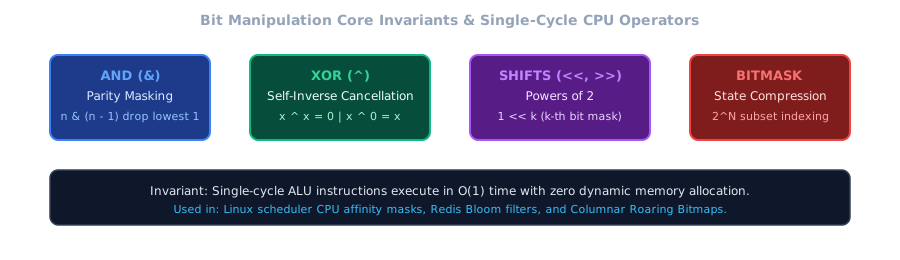
XOR of a number with itself is 0; XOR with 0 is the number itself. n & (n - 1) drops the lowest set bit; n & (-n) isolates it. Bit positions are independent — every operation is just a whole-word parallel map.
Bit positions are independent channels processed simultaneously in 1 CPU cycle. n & (n - 1) clears lowest set bit; x ^ x = 0 cancels pairs.
while n > 0: n &= n - 1 (terminates after K cycles, K = set bits); or O(1) bitwise expressions.
The 4 Mental Models of Bit Manipulation
Most interview problems are not random tricks: each one repeats a mental model below. Name it before writing code.
1XOR Cancel
stream of numbers ➔ one accumulator ➔ the unpaired answerXOR Trick (Single Number / XOR Partitioning)
O(1) extra space.| 1 | def single_number(nums: list[int]) -> int: |
| 2 | """Single Number: every value appears twice except one. |
| 3 | Time: O(N) | Space: O(1) |
| 4 | """ |
| 5 | res = 0 # running XOR of every value seen so far |
| 6 | |
| 7 | # 1. Cancel Paired Values: |
| 8 | # XOR each value into res; a value that appears twice XORs with itself |
| 9 | # and vanishes, so only the value that appears once survives in res. |
| 10 | for num in nums: |
| 11 | res ^= num |
| 12 | return res |
| 13 | |
| 14 | def single_number_iii(nums: list[int]) -> list[int]: |
| 15 | """Single Number III: two values appear once, every other value twice. |
| 16 | Time: O(N) | Space: O(1) |
| 17 | """ |
| 18 | xor_all = 0 # running XOR of every value; ends as a ^ b (the two singles) |
| 19 | |
| 20 | # 1. Combine All Values: |
| 21 | # XOR every value into xor_all; every value that appears twice cancels, |
| 22 | # leaving a ^ b for the two values that each appear once. |
| 23 | for num in nums: |
| 24 | xor_all ^= num |
| 25 | |
| 26 | # 2. Find a Distinguishing Bit: |
| 27 | # a and b differ in every bit that is set in xor_all; keep only the |
| 28 | # lowest such bit so the next step can split numbers into two groups by it. |
| 29 | diff_bit = xor_all & (-xor_all) |
| 30 | |
| 31 | a, b = 0, 0 # accumulators for each group; each ends holding one of a, b |
| 32 | |
| 33 | # 3. Split and Cancel Within Each Group: |
| 34 | # Every value with the bit set is grouped into a (duplicates among them |
| 35 | # still cancel there); every value without it is grouped into b the same way. |
| 36 | for num in nums: |
| 37 | if num & diff_bit: |
| 38 | a ^= num |
| 39 | else: |
| 40 | b ^= num |
| 41 | |
| 42 | return [a, b] |
Feed every number through res ^= num. Because x ^ x = 0 and x ^ 0 = x, and XOR does not care about order, every value that appears an even number of times cancels; the accumulator is left holding the value that appeared an odd number of times. The trap is the starting value: res = 0 is right because 0 is the one value XOR leaves unchanged; starting at res = nums[0] while the loop still visits every number XORs nums[0] in twice, so it cancels itself.
Gotcha 1 of 4
- The trap
Gotcha 1: Starting at
res = nums[0]instead ofres = 0Mistakeres = nums[0]Fixres = 0What happens: The loop XORs every number into
res,nums[0]included. Starting atnums[0]XORs it in a second time. Two copies cancel, sonums[0]disappears fromres.res = 0is the right start, becausex ^ 0 = x.Example: nums = [4, 1, 2, 1, 2]Mistake: returns 0Fix: returns 4
2Kernighan's Bit Trick
number ➔ lowest set bit ➔ one fewer bitBrian Kernighan's Algorithm / Popcount (`n & (n-1)`)
| 1 | def count_set_bits(n: int) -> int: |
| 2 | """Number of 1 Bits: counts the 1s with Brian Kernighan's trick. |
| 3 | Time: O(K), K = number of set bits (<= 32) | Space: O(1) |
| 4 | """ |
| 5 | count = 0 |
| 6 | while n > 0: |
| 7 | n &= (n - 1) # Clear lowest set bit |
| 8 | count += 1 |
| 9 | return count |
| 10 | |
| 11 | def is_power_of_two(n: int) -> bool: |
| 12 | """Power of Two: exactly one set bit, and n must be positive. |
| 13 | Time: O(1) | Space: O(1) |
| 14 | """ |
| 15 | return n > 0 and (n & (n - 1)) == 0 # n > 0 is mandatory: 0 & -1 == 0 |
n & (n - 1) clears the lowest set bit of n, so count_set_bits repeats it and counts the rounds until n is 0. Subtracting 1 turns the lowest 1 into 0 and every 0 below it into 1, while the higher bits stay the same, so the AND keeps exactly the higher bits: each round removes one set bit, and the loop runs once per set bit. The same fact makes is_power_of_two one test, since a power of two has exactly one set bit. The trap is n = 0: while n > 0 stops there because no set bit is left to clear, but 0 & -1 is also 0, so is_power_of_two needs the same n > 0 guard, or is_power_of_two(0) returns True.
Gotcha 1 of 3
- The trap
Gotcha 1: Testing a power of two without
n > 0Mistakereturn (n & (n - 1)) == 0Fixreturn n > 0 and (n & (n - 1)) == 0What happens: A power of two has exactly one set bit, so
n & (n - 1)clears it and leaves 0. But 0 has no set bit, and0 & -1is also 0. So the test alone calls 0 a power of two. The guardn > 0rules it out.Example: n = 0Mistake: returns TrueFix: returns False
3Bit Tricks
word ➔ masks + shifts ➔ rearranged wordBit Reversal with Shifts and Masks (Reverse Bits)
| 1 | def reverse_bits(n: int) -> int: |
| 2 | """Reverse Bits: mirrors the 32 bits of `n`. |
| 3 | Time: O(1) (32 iterations) | Space: O(1) |
| 4 | """ |
| 5 | res = 0 |
| 6 | for _ in range(32): |
| 7 | res = (res << 1) | (n & 1) # Shift result left, append n's lowest bit |
| 8 | n >>= 1 # Consume that bit from n |
| 9 | return res |
Treat the number as a fixed row of 32 bits and move bits with shifts and masks, never by converting it to a string. reverse_bits peels the lowest bit off n with n & 1 and appends it to res with res << 1. Each round shifts every bit already in res one place up and drops n's next-lowest bit into the free slot, so after 32 rounds bit i of n sits at bit 31 - i of res. The trap is stopping when n reaches 0: n = 2 would return 1 instead of 1073741824, because the 30 leading zeros of n were never shifted in.
Gotcha 1 of 4
- The trap
Gotcha 1: Stopping when
nreaches 0 withwhile n:Mistakewhile n:Fixfor _ in range(32):What happens: Python ints have no fixed width, so the loop must count the 32 bits itself.
while n:stops when the last 1 bit ofnis read. The leading zeros ofnare then never shifted intores. Each of them should moveresone place to the left.Example: n = 2Mistake: returns 1Fix: returns 1073741824
4Bitmask Subsets
collection ➔ integer mask ➔ subset statesBitmask Enumeration (Subset Masks)
n is small (roughly 20 or less) and you must try every subset, or a DP state is 'which items are used so far'.| 1 | def read_binary_watch(turnedOn: int) -> list[str]: |
| 2 | """Binary Watch: every set of lit LEDs is one 10-bit mask. |
| 3 | Time: O(B * 2^B), B = 10 LEDs | Space: O(1) extra, output not counted |
| 4 | """ |
| 5 | times: list[str] = [] # valid "h:mm" strings found so far |
| 6 | |
| 7 | # 1. Visit Every Possible Mask: |
| 8 | # Each integer 0 to 2^10 - 1 is one assignment of the 10 LEDs (4 hour bits, |
| 9 | # 6 minute bits), so looping over that range visits every combination once. |
| 10 | for mask in range(1 << 10): |
| 11 | if bin(mask).count("1") != turnedOn: # Popcount: how many LEDs are lit |
| 12 | continue |
| 13 | hour, minute = mask >> 6, mask & 0b111111 # Top 4 bits: hour; low 6 bits: minute |
| 14 | |
| 15 | # 2. Reject Out-Of-Range Fields: |
| 16 | # 4 bits can hold values up to 15 and 6 bits up to 63, but a watch only |
| 17 | # shows hours 0-11 and minutes 0-59, so a decoded field outside that range is dropped. |
| 18 | if hour < 12 and minute < 60: |
| 19 | times.append(f"{hour}:{minute:02d}") |
| 20 | return times |
| 21 | |
| 22 | |
| 23 | def subsets(nums: list[int]) -> list[list[int]]: |
| 24 | """Subsets: every subset of distinct nums, one bitmask per subset. |
| 25 | Time: O(N * 2^N) | Space: O(N * 2^N) output |
| 26 | """ |
| 27 | n = len(nums) |
| 28 | result: list[list[int]] = [] # one subset per mask |
| 29 | |
| 30 | # 1. Decode Each Mask Into Its Subset: |
| 31 | # Each integer 0 to 2^n - 1 is one subset; bit i of mask tells whether |
| 32 | # nums[i] is included, so collecting the items whose bit is on rebuilds that subset. |
| 33 | for mask in range(1 << n): |
| 34 | result.append([nums[i] for i in range(n) if (mask >> i) & 1]) |
| 35 | return result |
| 36 | |
| 37 | |
| 38 | def enumerate_submasks(mask: int) -> list[int]: |
| 39 | """Sub-Mask Enumeration: every subset of the bits set in `mask`, largest first. |
| 40 | Time: O(2^k), k = popcount(mask); O(3^n) summed over all masks | Space: O(2^k) output |
| 41 | """ |
| 42 | submasks: list[int] = [] # every non-empty submask found so far, largest first |
| 43 | sub = mask |
| 44 | |
| 45 | # 1. Step Through Every Non-Empty Submask: |
| 46 | # (sub - 1) & mask clears the lowest set bit of sub and sets every bit below |
| 47 | # it, then masking with mask drops anything outside it, landing on the next smaller submask. |
| 48 | while sub > 0: |
| 49 | submasks.append(sub) |
| 50 | sub = (sub - 1) & mask # Drop the lowest bit, keep only bits inside mask |
| 51 | |
| 52 | # 2. Add the Empty Set: |
| 53 | # The loop above stops once sub reaches 0, so the empty submask is never |
| 54 | # appended inside it; add it once here. |
| 55 | submasks.append(0) |
| 56 | return submasks |
An integer is a set: bit i is on when item i is chosen, so the subsets of n items are exactly the numbers in range(1 << n), (mask >> i) & 1 says whether item i is in, and bin(mask).count("1") how many items are. Each subset matches one number and each number one subset, so one loop visits every subset exactly once, with no recursion and no duplicates; to visit only the subsets of one mask, step with sub = (sub - 1) & mask, which clears the lowest set bit, sets the bits below it, and keeps only bits of mask. The trap is decoding a packed mask: split it into its fields (hour = mask >> 6, minute = mask & 0b111111) and check each field's range (hour < 12 and minute < 60), because 4 bits reach 15 and 6 bits reach 63.
Gotcha 1 of 4
- The trap
Gotcha 1: Leaving out the check
hour < 12 and minute < 60Mistaketimes.append(f"{hour}:{minute:02d}")Fixif hour < 12 and minute < 60: times.append(f"{hour}:{minute:02d}")What happens: The hour field has 4 bits, so it can hold values up to 15. The minute field has 6 bits, so it can hold values up to 63. A watch shows only hours 0 to 11 and minutes 0 to 59. Without the check, masks such as
15:63are added as times.Example: turnedOn = 10Mistake: returns ['15:63']Fix: returns []
Built on the mental models above
- Per-Bit CountingPer-Bit Counting (Single Number II / Bitwise State Machine)
A count modulo 3 is kept for each bit, where XOR Cancel keeps one parity bit.
- Shared PrefixShared Binary Prefix (Bitwise AND of Numbers Range)
Shift two numbers right together until they are equal, count the shifts in
shift, then shift the equal value back left byshift. - Carry AddAdd Without + or - (Sum of Two Integers)
Combine two numbers with XOR and with AND shifted left by 1, then repeat with the carry as the new second number until it is 0.
- Gray StepOne-Bit Steps (Gray Code)
Make the code of position
iby XOR withishifted right by 1, so counting up fromitoi + 1changes exactly one bit of the code.
The Bit Manipulation Decision Rule
When facing an unseen bit problem, ask in this order:
XOR everything in one pass. If two odd values remain, XOR-all gives a ^ b; use lowbit = xor & -xor to split the array into two buckets and XOR each.
Count the 1s in each bit position mod k, or keep k-1 registers as a mod-k counter: ones = (ones ^ x) & ~twos; twos = (twos ^ x) & ~ones.
Build an integer mask and index dp[mask] directly; enumerate sub-masks with sub = (sub - 1) & mask.
Reach for n & (n - 1) or n & -n before any loop over 32 bits.
Shift both ends right until they are equal, count the shifts in shift, and return left << shift.
total = (a ^ b) & mask, carry = ((a & b) << 1) & mask, then a, b = total, carry until b is 0.
Give position i the code i ^ (i >> 1) for i in range(1 << n); counting from i to i + 1 then changes exactly one bit.
Write the mask-and-shift steps; verify on a small binary example.
Pattern Architecture & Invariant Design Masterclass
Bit manipulation bypasses standard arithmetic loops and directly manipulates the binary representation of integers using single-cycle CPU instructions. It is used to achieve constant-time checks, pack multiple flags into a single integer, and find missing/duplicate elements using bitwise invariants (like XOR).
Every integer is already a sequence of bits. A bitwise operator is a whole-word instruction: one &, |, ^, or shift applies to all 32/64 bits at once, in parallel, in a single cycle. That is why problems that sound like "count", "find the odd one", "toggle", or "enumerate subsets" can jump from O(n) loops or O(n) space to O(1) space and sometimes O(1) time.
The six atomic operations to know cold:
| Operation | Symbol | What it does on the bit level | Most common job |
|---|---|---|---|
| AND | & | 1 only when both bits are 1 | masking, clearing bits, checking parity, n & (n-1) |
| OR | | | 1 when either bit is 1 | setting bits, merging flags/masks |
| XOR | ^ | 1 when bits differ | cancellation, toggling, "difference finder" |
| NOT | ~ | flips every bit (~x = -x - 1) | building inverted masks ~(1 << i) |
| Left shift | << | moves bits left, fills 0s | multiply by 2^k, 1 << i = bit i mask |
| Right shift | >> | moves bits right | divide by 2^k, extract bit i via (n >> i) & 1 |
The identities that make interview solutions possible (memorize these):
x ^ x = 0andx ^ 0 = x— XOR is its own inverse; pairs cancel.- XOR is commutative and associative — order never matters; a whole stream can be XORed in one pass.
-x = ~x + 1(two's complement), thereforex & (-x)isolates the lowest set bit.x & (x - 1)drops the lowest set bit — the engine of popcount and the power-of-two test.x & (x - 1) == 0(withx > 0) meansxis a power of two (exactly one set bit).(n >> i) & 1reads biti;n | (1 << i)sets it;n & ~(1 << i)clears it;n ^ (1 << i)toggles it.n & 1is the parity test (1= odd).n << k=n * 2^k;n >> k=n // 2^kfor non-negativen.
🔬 Variable Anatomy: The 7 Variables Every Bit Manipulation Solution Uses
To connect abstract bitwise logic with concrete Python syntax, here is the universal code anatomy showing what every variable does:
def bitMasterTemplate(nums: list[int], n: int) -> tuple[int, int, int, int, list[int]]: # ========================================================================= # 1. THE BIT ACCUMULATORS & MASK REGISTERS # ========================================================================= xor_acc = 0 # ⚡ XOR Accumulator: cancels paired duplicates (x ^ x = 0) ones = 0 # 1️⃣ Modulo-3 First Residue: bits seen 1 mod 3 times twos = 0 # 2️⃣ Modulo-3 Second Residue: bits seen 2 mod 3 times popcount = 0 # 🔢 Set Bit Counter: counts active 1-bits subsets_masks = [] # 🎭 Bitmask State Collection: integers representing subsets # ========================================================================= # 2. LOWEST-SET-BIT SURGERY & KERNIGHAN'S ENGINE (O(popcount)) # ========================================================================= lowbit = n & (-n) # Isolates the lowest set bit of n (0 when n == 0) temp_n = n while temp_n > 0: # Drops lowest set bit in O(1) temp_n &= (temp_n - 1) popcount += 1 # ========================================================================= # 3. PER-BIT STATE MACHINE & SUB-MASK ENUMERATION # ========================================================================= for num in nums: # XOR cancellation for single unpaired element xor_acc ^= num # Modulo-3 finite state machine update ones = (ones ^ num) & ~twos twos = (twos ^ num) & ~ones # Sub-mask enumeration for an integer mask mask = n sub = mask while sub > 0: subsets_masks.append(sub) sub = (sub - 1) & mask # ⚡ Traverses all sub-masks in descending order return xor_acc, ones, popcount, lowbit, subsets_masks Variable Role Reference:
| Variable | Role in Code | Question It Answers | ❌ What Happens If Omitted or Mismanaged? |
|---|---|---|---|
n | Binary integer word | "What raw bit sequence is currently undergoing bitwise surgery?" | ❌ In 32-bit signed languages, shifting negative integers without unsigned cast produces arithmetic sign-extension bugs. |
mask | Integer bitmask filter | "Which specific bit positions am I setting, checking, or toggling?" | ❌ Writing 1 << i with in 32-bit types overflows; in Python, integers grow unboundedly without masking with 0xFFFFFFFF. |
lowbit | n & (-n) | "What is the isolated lowest power-of-two component?" | ❌ Without lowbit, isolating the differing bit between two unique XOR elements requires an explicit 32-iteration loop. |
xor_acc | XOR reduction register | "Which unpaired bit pattern remains after identical pairs cancel to zero?" | ❌ Initializing XOR accumulator to anything other than 0 pollutes the cumulative bit parity (x ^ 0 = x). |
ones / twos | Mod-3 state registers | "Which bits have appeared and times?" | ❌ Updating twos before ones with the new value rather than the previous state breaks the finite-state machine cycle. |
carry | (a & b) << 1 | "Which bit positions generate an arithmetic carry to the next power?" | ❌ In bitwise addition without +, forgetting to shift the carry left by 1 fails to add carry bits to higher place values. |
sub | (sub - 1) & mask | "What is the next valid non-empty subset of the active bitmask?" | ❌ Using a standard decrement sub - 1 without & mask visits invalid numbers that are not sub-masks of the target. |
🧠 The Universal Contract of Bitwise Invariants:
- Cancellation Invariant:
x ^ x = 0andx ^ 0 = x. XOR is strictly associative and commutative: order of numbers in a stream never matters.- Lowest Bit Invariants:
n & (n - 1)drops the rightmost 1-bit;n & (-n)isolates the rightmost 1-bit.- Whole-Word Invariant: A bitwise instruction executes simultaneously across all 32/64 bit channels in parallel in a single CPU cycle ().
🌟 The 3 Dimensions of Bit Manipulation & The Parallel Word Principle
Every bit manipulation problem is governed by 3 Key Dimensions:
┌─────────────────────────────────────────────────────────────────────────────┐│ THE 3 DIMENSIONS OF BIT MANIPULATION │├───────────────────┬───────────────────────────────────┬─────────────────────┤│ Dimension │ Mechanism in Code │ Question It Answers │├───────────────────┼───────────────────────────────────┼─────────────────────┤│ 1. BIT POSITION │ Parallel 32-bit execution: │ "Are bit positions ││ INDEPENDENCE │ `&`, `|`, `^`, `~` │ strictly disjoint?" │├───────────────────┼───────────────────────────────────┼─────────────────────┤│ 2. ALGEBRAIC │ `x ^ x = 0` (Self-Inverse) │ "Can paired values ││ CANCELLATION │ Mod-K residue finite state machine│ cancel out cleanly?"│├───────────────────┼───────────────────────────────────┼─────────────────────┤│ 3. BIT SURGERY & │ `n & (n-1)` (Drop rightmost 1) │ "How do we isolate ││ MASKING BOUNDS │ `n & (-n)` (Isolate rightmost 1) │ or iterate bits?" │└───────────────────┴───────────────────────────────────┴─────────────────────┘ How this plays out in actual problems:
🟢 Scenario A: XOR Cancellation (Single Number LC 136)
- When every element appears twice except one, naive tracking requires an hash set with space.
- The Rule: XOR every number into accumulator
res ^= num. Paired elements cancel to 0 in any order (). - The Result: Finds the odd element in time with auxiliary space.
🔵 Scenario B: Lowest-Set-Bit Popcount (Hamming Weight LC 191)
- Counting 1-bits with a loop checks all 32 positions every time.
- The Rule: Use Brian Kernighan's algorithm
n &= (n - 1). Each step subtracts 1 (flipping the lowest 1 to 0 and trailing 0s to 1s) and ANDs withn, obliterating exactly one 1-bit per loop. - The Result: Loop runs exactly times (where is the number of 1-bits), never 32.
🟣 Scenario C: Sub-Mask Enumeration (Subset Exhaustion)
- Given a bitmask representing a set of features, finding all valid subsets naively tests all integers.
- The Rule: Initialize
sub = mask. Repeatedly updatesub = (sub - 1) & maskuntilsub == 0. - The Result: Visited states are guaranteed to be exact subsets of
mask, running in where is the number of set bits.
💡 The Ultimate Takeaway Decision Rule:
When analyzing an integer or parity problem, ask: "Is there pair cancellation, bit counting, or subset state packing?"
- If Unpaired / Missing element ➔ XOR Accumulation ( time, space).
- If Counting 1-bits or Power of 2 ➔
n & (n - 1)orn & (-n)surgery.- If Small state space () ➔ Integer bitmask representation with
1 << i.- If 3-repeat occurrences ➔ Mod-3 state machine with
onesandtwos.
🎯 The 5 Essential Bit Manipulation Paradigms & Archetypes
┌──────────────────────────────────────────────────────────────────────────────────────────────────────────────────┐│ THE 5 CORE BIT MANIPULATION ARCHETYPES │├────────────────────────┬──────────────────────┬───────────────────────────────┬──────────────────────────────────┤│ Archetype │ Core Operation │ Algebraic Invariant │ Target Problems & Complexity │├────────────────────────┼──────────────────────┼───────────────────────────────┼──────────────────────────────────┤│ 1. XOR Cancellation │ `res ^= num` │ `x ^ x = 0`, `x ^ 0 = x` │ Single Number (LC 136), Missing ││ (Accumulation) │ `lowbit = diff&-diff`│ Commutative & Associative │ Number (LC 268) — O(N), O(1) │├────────────────────────┼──────────────────────┼───────────────────────────────┼──────────────────────────────────┤│ 2. Lowest-Bit Surgery │ `n &= (n - 1)` │ `n & (n - 1)` clears low bit; │ Hamming Weight (LC 191), Power ││ (Popcount / Lowbit) │ `lowbit = n & -n` │ `n & -n` isolates low bit │ of Two (LC 231) — O(k), O(1) │├────────────────────────┼──────────────────────┼───────────────────────────────┼──────────────────────────────────┤│ 3. Masks & Sub-Masks │ `1 << i`, │ `(n >> i) & 1` tests bit i; │ Subsets (LC 78), Partition to K ││ (Subset Packing) │ `(sub - 1) & mask` │ `(sub - 1) & mask` steps sub │ Equal Subsets (LC 698) — O(2^N) │├────────────────────────┼──────────────────────┼───────────────────────────────┼──────────────────────────────────┤│ 4. Mod-K State Machine │ `ones = (ones^x)&~two│ Bit registers track counts │ Single Number II (LC 137) — ││ (Residue Counters) │ `twos = (twos^x)&~one│ modulo K in O(1) space │ O(N) time, O(1) space │├────────────────────────┼──────────────────────┼───────────────────────────────┼──────────────────────────────────┤│ 5. Whole-Word Arith. │ `(a & b) << 1` │ Fixed mask & shift steps │ Reverse Bits (LC 190), Sum of ││ (Bit Re-arrangement)│ `a ^ b` (half-adder) │ replaces multi-step loops │ Two Integers (LC 371) — O(1) │└────────────────────────┴──────────────────────┴───────────────────────────────┴──────────────────────────────────┘ ⚡ 1. XOR Cancellation & Bucket Splitting (LC 136 & 260)
- Mental Model: XOR cancels duplicate pairs. When two unique elements remain,
total_xor = a ^ b. Isolate any differing bit withdiff_bit = total_xor & -total_xorto partition all numbers into two disjoint buckets and solve each independently in space! - Code: see the XOR Cancel card.
✂️ 2. Lowest-Set-Bit Surgery & Popcount (LC 191 & 231)
- Mental Model:
n & (n - 1)drops the lowest 1-bit;n & (-n)isolates it as a power of 2. A positive numbernis a power of 2 if and only ifn & (n - 1) == 0. - Code: see the Kernighan's Bit Trick card.
🎭 3. Masks & Sub-Mask Enumeration (LC 78 & 401)
- Mental Model: An integer is a packed set of 32 booleans.
- Code: see the Bitmask Subsets card.
🔄 4. Per-Bit Mod-K Finite State Machines (LC 137)
- Mental Model: When elements appear 3 times and one appears once, XOR alone cannot cancel triples. Maintain two bit registers
onesandtwoswhere transitions reset to 0 upon the third occurrence. - Code: see the Per-Bit Counting card.
➕ 5. Whole-Word Arithmetic & Bit Re-arrangement (LC 190 & 371)
- Mental Model: Full-adder simulation using
a ^ bfor sum without carry and(a & b) << 1for carry propagation until carry becomes 0. - Code Blueprint:
def getSum(a: int, b: int) -> int: MASK = 0xFFFFFFFF MAX_INT = 0x7FFFFFFF while b: a, b = (a ^ b) & MASK, ((a & b) << 1) & MASK # keep both inside 32 bits every round return a if a <= MAX_INT else ~(a ^ MASK) 🌳 Evaluating Bitwise Invariants & Low-Level State Machines
Understanding the behavior of two's complement and fixed bit widths is vital in interviews:
1. Two's Complement & Sign Extension
- In two's complement arithmetic,
-x = ~x + 1. This mathematical identity is whyx & (-x)precisely isolates the lowest set bit. - In Python, integers have arbitrary precision and do not overflow to 32-bit negatives. To simulate 32-bit signed integers, mask with
0xFFFFFFFFand convert values exceeding0x7FFFFFFFusing~(val ^ 0xFFFFFFFF).
2. Constant Time Complexity Invariants
- Operating on 32-bit words takes strictly time and space.
- Sub-mask iteration
sub = (sub - 1) & masktakes total time , which is significantly faster than checking all pairs .
💡 Staff SWE Architectural Invariant:
Bitwise operations treat the integer word as a SIMD register of 32 or 64 independent parallel 1-bit execution units. When you can express logic with&,|,^, and shifts, you eliminate branch mispredictions and achieve optimal single-cycle throughput.
Understanding Invariants: XOR Cancellation & Lowest-Bit Surgery
XOR of a number with itself is 0; XOR with 0 is the number itself. n & (n - 1) drops the lowest set bit; n & (-n) isolates it. Bit positions are independent — every operation is just a whole-word parallel map.
A bitwise operator is a whole-word instruction applying to all 32/64 bits in parallel in a single cycle. Algebraic cancellations turn quadratic scans into O(N) single passes with O(1) memory.
Subtracting 1 flips trailing zeros to 1s and the lowest 1 to 0; ANDing with n zeroes out the lowest set bit.
Because x ^ x = 0 and x ^ 0 = x, all paired entries annihilate to 0 regardless of order, leaving the lone odd element.
Common Questions
"In Single Number, why does XORing every element together leave just the one that appears once — doesn't the order the elements arrive in matter?"
It doesn't, and that's exactly the property that makes the one-line solution work: XOR is both its own inverse and commutative/associative, so pairs cancel regardless of where they sit in the array.
Every value that appears twice contributes
x ^ x, which is0— the pair contributes nothing to the running result, no matter how far apart the two copies are or what's XORed in between them. Because XOR is commutative and associative, you can reorder the whole expression as if every pair were sitting right next to each other, even though they aren't in the actual array. What survives after every pair cancels is0 ^ unique_value, which — by the other half of the identity,x ^ 0 = x— is justunique_valueitself.This is why a single
for num in nums: res ^= numpass, inO(1)extra space, finds the unpaired element without ever building a frequency map: you're not counting occurrences at all, you're relying on pairs annihilating each other bit-by-bit, in parallel, across all 32/64 bits at once. It's also exactly why this trick needs adapting for harder variants: when duplicates appear three times instead of two (Single Number II),x ^ x ^ x = xsurvives instead of cancelling, so plain XOR is replaced by a mod-3 bit-counting state machine (ones/twosregisters) instead. When there are two distinct unique values hiding among pairs (Single Number III), XORing everything together doesn't isolate either one — it gives their XOR — so the fix is different again: XOR everything first, take any set bit in that result (lowbit = xor & -xor) to find one position where the two uniques differ, and split the whole array into two groups by that bit; plain pairwise cancellation now finds one unique value per group.
Coach discussion points
- 1.
Why does
n & (n - 1)clear the lowest set bit? Discuss the cascade of carries inn - 1. - 2.
In Single Number II, how do
onesandtwostrack modulo 3 logic without an array? What would a fourth register do? - 3.
Contrast logical shift (>>>) vs arithmetic shift (>>) in Java/JS. Why does Python not have this issue, and how do you simulate 32-bit bounds in Python?
- 4.
Why is
x ^ ya valid "difference detector" for Hamming distance? How does(x ^ y)turn into a count? - 5.
When would plain XOR fail (e.g. "appears three times"), and why does splitting by
lowbit = xor & -xorrescue Single Number III but not Single Number II? - 6.
How does
sub = (sub - 1) & maskvisit every sub-mask exactly once? Prove it terminates and never revisits. - 7.
When the constraint says
n <= 20, which families become available, and what is the time/space cost of enumerating all2^nmasks? - 8.
In Maximum XOR of Two Numbers, why must the mask grow strictly from MSB to LSB rather than any other order? What invariant breaks if you process bits LSB-first?
- 9.
Prove that
max_xornever decreases across iterations, and that every bit it locks in was already proven achievable by two real numbers. Why does this guarantee optimality without ever comparing all pairs? - 10.
Contrast the hash-set prefix implementation with a classical bit-trie implementation of the same algorithm. What does the trie make explicit that the hash-set version hides, and when would the trie's
O(N)(amortized) walk beat the hash-set'sO(N)rebuild-per-bit?
Complexity analysis
- Time Complexity:
- for operations bounding to a fixed 32 or 64 bits (e.g. Reverse Bits).
- where is the number of set bits (Brian Kernighan's).
- for Single Number (iterating over the array).
- Space Complexity: auxiliary space for almost all pure bit manipulation problems.
In high-performance networking and database systems, flags are stored as bits in a single 32-bit or 64-bit integer to save space and minimize cache misses. Determining if a specific feature is enabled takes a single bitwise AND operation, rather than iterating through a list of booleans. Bit manipulation is also foundational for IP subnet masking, hashing algorithms, and parity-based error detection.
💡 Don't worry if bitwise identities and binary masking feel low-level right now! Bit manipulation replaces arithmetic loops with single-cycle CPU instructions that process entire 32/64-bit words in parallel. As you progress through the Archetype Variants (from Hamming Weight and Single Number to Bit State Machines and Bitmask Subsets), each hands-on challenge will cement this intuition until wielding n & (n - 1), n & (-n), and XOR cancellation becomes second nature.
Iterating 32 times instead of using Brian Kernighan's algorithm: Checking all 32 bits with
n >>= 1always takes 32 iterations. Usingn &= (n - 1)clears the lowest set bit in each step, executing in operations strictly proportional to the number of set bits.Signed vs unsigned right shift: In Java, C++, and C#, using signed right shift
>>on negative integers propagates the sign bit (1s), causing infinite loops. Always use unsigned right shift>>>or cast to unsigned.Bitwise operator precedence: Bitwise operators (
&,|,^) have lower precedence than comparison operators (==,!=). Writingn & 1 == 1evaluates1 == 1first, resulting inn & True.
Staff+ Systems Architecture & Hardware Considerations
Triggers: "single number among duplicates", "count set bits / Hamming weight", "subsets via binary mask", "power of two check". Exploits direct hardware-level ALU bitwise operations (&, |, ^, ~, <<, >>).
Bit-width . All primitive bitwise operations execute in a single CPU clock cycle ( hardware instructions). Enables processing subsets of size or inside a single register.
Operator precedence bugs in languages like C++/Java/Python where arithmetic + has higher precedence than bitwise << or & (always use explicit parentheses: (x & 1)); signed shift overflow on negative integers (use unsigned shift >>> where applicable).
Conceptual Foundation & Intuitive Analogy
🧭 Conceptual Foundation & Pattern Intuition
Counting the number of set bits (1-bits) in an unsigned integer—known as the Hamming Weight or Population Count (popcount)—is one of the most fundamental operations in systems engineering and computer architecture. The naive approach inspects all 32 bits by repeatedly shifting right (n >>= 1) and checking n & 1, burning 32 clock cycles regardless of whether the integer has one set bit or thirty-two. Brian Kernighan’s Algorithm eliminates all zero bits instantly, running in exactly cycles where is the count of active 1-bits.
🏟️ The Analogy: The Domino Knockdown
Imagine a row of standing dominos where only dominos marked with a red sticker represent 1-bits. Instead of walking past all 32 domino positions and checking each one individually, you reach in with a targeted magnetic swipe that always knocks down the lowest standing red domino and leaves all white dominos untouched. The number of swipes is identical to the number of red dominos.
🔑 Why It Works
Why does n & (n - 1) work? In binary arithmetic, subtracting 1 flips the least significant 1-bit to 0, and flips all trailing 0-bits below it to 1 (e.g., ...1000 becomes ...0111). When this result is bitwise ANDed with original n, the lowest set bit and all bits below it become 0, while all higher-order bits remain completely unaffected.
XOR of a number with itself is 0; XOR with 0 is the number itself. n & (n - 1) drops the lowest set bit; n & (-n) isolates it. Bit positions are independent — every operation is just a whole-word parallel map.
Bit positions are independent channels processed simultaneously in 1 CPU cycle. n & (n - 1) clears lowest set bit; x ^ x = 0 cancels pairs.
while n > 0: n &= n - 1 (terminates after K cycles, K = set bits); or O(1) bitwise expressions.
The 4 Mental Models of Bit Manipulation
Most interview problems are not random tricks: each one repeats a mental model below. Name it before writing code.
1XOR Cancel
stream of numbers ➔ one accumulator ➔ the unpaired answerXOR Trick (Single Number / XOR Partitioning)
O(1) extra space.| 1 | def single_number(nums: list[int]) -> int: |
| 2 | """Single Number: every value appears twice except one. |
| 3 | Time: O(N) | Space: O(1) |
| 4 | """ |
| 5 | res = 0 # running XOR of every value seen so far |
| 6 | |
| 7 | # 1. Cancel Paired Values: |
| 8 | # XOR each value into res; a value that appears twice XORs with itself |
| 9 | # and vanishes, so only the value that appears once survives in res. |
| 10 | for num in nums: |
| 11 | res ^= num |
| 12 | return res |
| 13 | |
| 14 | def single_number_iii(nums: list[int]) -> list[int]: |
| 15 | """Single Number III: two values appear once, every other value twice. |
| 16 | Time: O(N) | Space: O(1) |
| 17 | """ |
| 18 | xor_all = 0 # running XOR of every value; ends as a ^ b (the two singles) |
| 19 | |
| 20 | # 1. Combine All Values: |
| 21 | # XOR every value into xor_all; every value that appears twice cancels, |
| 22 | # leaving a ^ b for the two values that each appear once. |
| 23 | for num in nums: |
| 24 | xor_all ^= num |
| 25 | |
| 26 | # 2. Find a Distinguishing Bit: |
| 27 | # a and b differ in every bit that is set in xor_all; keep only the |
| 28 | # lowest such bit so the next step can split numbers into two groups by it. |
| 29 | diff_bit = xor_all & (-xor_all) |
| 30 | |
| 31 | a, b = 0, 0 # accumulators for each group; each ends holding one of a, b |
| 32 | |
| 33 | # 3. Split and Cancel Within Each Group: |
| 34 | # Every value with the bit set is grouped into a (duplicates among them |
| 35 | # still cancel there); every value without it is grouped into b the same way. |
| 36 | for num in nums: |
| 37 | if num & diff_bit: |
| 38 | a ^= num |
| 39 | else: |
| 40 | b ^= num |
| 41 | |
| 42 | return [a, b] |
Feed every number through res ^= num. Because x ^ x = 0 and x ^ 0 = x, and XOR does not care about order, every value that appears an even number of times cancels; the accumulator is left holding the value that appeared an odd number of times. The trap is the starting value: res = 0 is right because 0 is the one value XOR leaves unchanged; starting at res = nums[0] while the loop still visits every number XORs nums[0] in twice, so it cancels itself.
Gotcha 1 of 4
- The trap
Gotcha 1: Starting at
res = nums[0]instead ofres = 0Mistakeres = nums[0]Fixres = 0What happens: The loop XORs every number into
res,nums[0]included. Starting atnums[0]XORs it in a second time. Two copies cancel, sonums[0]disappears fromres.res = 0is the right start, becausex ^ 0 = x.Example: nums = [4, 1, 2, 1, 2]Mistake: returns 0Fix: returns 4
2Kernighan's Bit Trick
number ➔ lowest set bit ➔ one fewer bitBrian Kernighan's Algorithm / Popcount (`n & (n-1)`)
| 1 | def count_set_bits(n: int) -> int: |
| 2 | """Number of 1 Bits: counts the 1s with Brian Kernighan's trick. |
| 3 | Time: O(K), K = number of set bits (<= 32) | Space: O(1) |
| 4 | """ |
| 5 | count = 0 |
| 6 | while n > 0: |
| 7 | n &= (n - 1) # Clear lowest set bit |
| 8 | count += 1 |
| 9 | return count |
| 10 | |
| 11 | def is_power_of_two(n: int) -> bool: |
| 12 | """Power of Two: exactly one set bit, and n must be positive. |
| 13 | Time: O(1) | Space: O(1) |
| 14 | """ |
| 15 | return n > 0 and (n & (n - 1)) == 0 # n > 0 is mandatory: 0 & -1 == 0 |
n & (n - 1) clears the lowest set bit of n, so count_set_bits repeats it and counts the rounds until n is 0. Subtracting 1 turns the lowest 1 into 0 and every 0 below it into 1, while the higher bits stay the same, so the AND keeps exactly the higher bits: each round removes one set bit, and the loop runs once per set bit. The same fact makes is_power_of_two one test, since a power of two has exactly one set bit. The trap is n = 0: while n > 0 stops there because no set bit is left to clear, but 0 & -1 is also 0, so is_power_of_two needs the same n > 0 guard, or is_power_of_two(0) returns True.
Gotcha 1 of 3
- The trap
Gotcha 1: Testing a power of two without
n > 0Mistakereturn (n & (n - 1)) == 0Fixreturn n > 0 and (n & (n - 1)) == 0What happens: A power of two has exactly one set bit, so
n & (n - 1)clears it and leaves 0. But 0 has no set bit, and0 & -1is also 0. So the test alone calls 0 a power of two. The guardn > 0rules it out.Example: n = 0Mistake: returns TrueFix: returns False
3Bit Tricks
word ➔ masks + shifts ➔ rearranged wordBit Reversal with Shifts and Masks (Reverse Bits)
| 1 | def reverse_bits(n: int) -> int: |
| 2 | """Reverse Bits: mirrors the 32 bits of `n`. |
| 3 | Time: O(1) (32 iterations) | Space: O(1) |
| 4 | """ |
| 5 | res = 0 |
| 6 | for _ in range(32): |
| 7 | res = (res << 1) | (n & 1) # Shift result left, append n's lowest bit |
| 8 | n >>= 1 # Consume that bit from n |
| 9 | return res |
Treat the number as a fixed row of 32 bits and move bits with shifts and masks, never by converting it to a string. reverse_bits peels the lowest bit off n with n & 1 and appends it to res with res << 1. Each round shifts every bit already in res one place up and drops n's next-lowest bit into the free slot, so after 32 rounds bit i of n sits at bit 31 - i of res. The trap is stopping when n reaches 0: n = 2 would return 1 instead of 1073741824, because the 30 leading zeros of n were never shifted in.
Gotcha 1 of 4
- The trap
Gotcha 1: Stopping when
nreaches 0 withwhile n:Mistakewhile n:Fixfor _ in range(32):What happens: Python ints have no fixed width, so the loop must count the 32 bits itself.
while n:stops when the last 1 bit ofnis read. The leading zeros ofnare then never shifted intores. Each of them should moveresone place to the left.Example: n = 2Mistake: returns 1Fix: returns 1073741824
4Bitmask Subsets
collection ➔ integer mask ➔ subset statesBitmask Enumeration (Subset Masks)
n is small (roughly 20 or less) and you must try every subset, or a DP state is 'which items are used so far'.| 1 | def read_binary_watch(turnedOn: int) -> list[str]: |
| 2 | """Binary Watch: every set of lit LEDs is one 10-bit mask. |
| 3 | Time: O(B * 2^B), B = 10 LEDs | Space: O(1) extra, output not counted |
| 4 | """ |
| 5 | times: list[str] = [] # valid "h:mm" strings found so far |
| 6 | |
| 7 | # 1. Visit Every Possible Mask: |
| 8 | # Each integer 0 to 2^10 - 1 is one assignment of the 10 LEDs (4 hour bits, |
| 9 | # 6 minute bits), so looping over that range visits every combination once. |
| 10 | for mask in range(1 << 10): |
| 11 | if bin(mask).count("1") != turnedOn: # Popcount: how many LEDs are lit |
| 12 | continue |
| 13 | hour, minute = mask >> 6, mask & 0b111111 # Top 4 bits: hour; low 6 bits: minute |
| 14 | |
| 15 | # 2. Reject Out-Of-Range Fields: |
| 16 | # 4 bits can hold values up to 15 and 6 bits up to 63, but a watch only |
| 17 | # shows hours 0-11 and minutes 0-59, so a decoded field outside that range is dropped. |
| 18 | if hour < 12 and minute < 60: |
| 19 | times.append(f"{hour}:{minute:02d}") |
| 20 | return times |
| 21 | |
| 22 | |
| 23 | def subsets(nums: list[int]) -> list[list[int]]: |
| 24 | """Subsets: every subset of distinct nums, one bitmask per subset. |
| 25 | Time: O(N * 2^N) | Space: O(N * 2^N) output |
| 26 | """ |
| 27 | n = len(nums) |
| 28 | result: list[list[int]] = [] # one subset per mask |
| 29 | |
| 30 | # 1. Decode Each Mask Into Its Subset: |
| 31 | # Each integer 0 to 2^n - 1 is one subset; bit i of mask tells whether |
| 32 | # nums[i] is included, so collecting the items whose bit is on rebuilds that subset. |
| 33 | for mask in range(1 << n): |
| 34 | result.append([nums[i] for i in range(n) if (mask >> i) & 1]) |
| 35 | return result |
| 36 | |
| 37 | |
| 38 | def enumerate_submasks(mask: int) -> list[int]: |
| 39 | """Sub-Mask Enumeration: every subset of the bits set in `mask`, largest first. |
| 40 | Time: O(2^k), k = popcount(mask); O(3^n) summed over all masks | Space: O(2^k) output |
| 41 | """ |
| 42 | submasks: list[int] = [] # every non-empty submask found so far, largest first |
| 43 | sub = mask |
| 44 | |
| 45 | # 1. Step Through Every Non-Empty Submask: |
| 46 | # (sub - 1) & mask clears the lowest set bit of sub and sets every bit below |
| 47 | # it, then masking with mask drops anything outside it, landing on the next smaller submask. |
| 48 | while sub > 0: |
| 49 | submasks.append(sub) |
| 50 | sub = (sub - 1) & mask # Drop the lowest bit, keep only bits inside mask |
| 51 | |
| 52 | # 2. Add the Empty Set: |
| 53 | # The loop above stops once sub reaches 0, so the empty submask is never |
| 54 | # appended inside it; add it once here. |
| 55 | submasks.append(0) |
| 56 | return submasks |
An integer is a set: bit i is on when item i is chosen, so the subsets of n items are exactly the numbers in range(1 << n), (mask >> i) & 1 says whether item i is in, and bin(mask).count("1") how many items are. Each subset matches one number and each number one subset, so one loop visits every subset exactly once, with no recursion and no duplicates; to visit only the subsets of one mask, step with sub = (sub - 1) & mask, which clears the lowest set bit, sets the bits below it, and keeps only bits of mask. The trap is decoding a packed mask: split it into its fields (hour = mask >> 6, minute = mask & 0b111111) and check each field's range (hour < 12 and minute < 60), because 4 bits reach 15 and 6 bits reach 63.
Gotcha 1 of 4
- The trap
Gotcha 1: Leaving out the check
hour < 12 and minute < 60Mistaketimes.append(f"{hour}:{minute:02d}")Fixif hour < 12 and minute < 60: times.append(f"{hour}:{minute:02d}")What happens: The hour field has 4 bits, so it can hold values up to 15. The minute field has 6 bits, so it can hold values up to 63. A watch shows only hours 0 to 11 and minutes 0 to 59. Without the check, masks such as
15:63are added as times.Example: turnedOn = 10Mistake: returns ['15:63']Fix: returns []
Built on the mental models above
- Per-Bit CountingPer-Bit Counting (Single Number II / Bitwise State Machine)
A count modulo 3 is kept for each bit, where XOR Cancel keeps one parity bit.
- Shared PrefixShared Binary Prefix (Bitwise AND of Numbers Range)
Shift two numbers right together until they are equal, count the shifts in
shift, then shift the equal value back left byshift. - Carry AddAdd Without + or - (Sum of Two Integers)
Combine two numbers with XOR and with AND shifted left by 1, then repeat with the carry as the new second number until it is 0.
- Gray StepOne-Bit Steps (Gray Code)
Make the code of position
iby XOR withishifted right by 1, so counting up fromitoi + 1changes exactly one bit of the code.
The Bit Manipulation Decision Rule
When facing an unseen bit problem, ask in this order:
XOR everything in one pass. If two odd values remain, XOR-all gives a ^ b; use lowbit = xor & -xor to split the array into two buckets and XOR each.
Count the 1s in each bit position mod k, or keep k-1 registers as a mod-k counter: ones = (ones ^ x) & ~twos; twos = (twos ^ x) & ~ones.
Build an integer mask and index dp[mask] directly; enumerate sub-masks with sub = (sub - 1) & mask.
Reach for n & (n - 1) or n & -n before any loop over 32 bits.
Shift both ends right until they are equal, count the shifts in shift, and return left << shift.
total = (a ^ b) & mask, carry = ((a & b) << 1) & mask, then a, b = total, carry until b is 0.
Give position i the code i ^ (i >> 1) for i in range(1 << n); counting from i to i + 1 then changes exactly one bit.
Write the mask-and-shift steps; verify on a small binary example.
Pattern Architecture & Invariant Design Masterclass
Bit manipulation bypasses standard arithmetic loops and directly manipulates the binary representation of integers using single-cycle CPU instructions. It is used to achieve constant-time checks, pack multiple flags into a single integer, and find missing/duplicate elements using bitwise invariants (like XOR).
Every integer is already a sequence of bits. A bitwise operator is a whole-word instruction: one &, |, ^, or shift applies to all 32/64 bits at once, in parallel, in a single cycle. That is why problems that sound like "count", "find the odd one", "toggle", or "enumerate subsets" can jump from O(n) loops or O(n) space to O(1) space and sometimes O(1) time.
The six atomic operations to know cold:
| Operation | Symbol | What it does on the bit level | Most common job |
|---|---|---|---|
| AND | & | 1 only when both bits are 1 | masking, clearing bits, checking parity, n & (n-1) |
| OR | | | 1 when either bit is 1 | setting bits, merging flags/masks |
| XOR | ^ | 1 when bits differ | cancellation, toggling, "difference finder" |
| NOT | ~ | flips every bit (~x = -x - 1) | building inverted masks ~(1 << i) |
| Left shift | << | moves bits left, fills 0s | multiply by 2^k, 1 << i = bit i mask |
| Right shift | >> | moves bits right | divide by 2^k, extract bit i via (n >> i) & 1 |
The identities that make interview solutions possible (memorize these):
x ^ x = 0andx ^ 0 = x— XOR is its own inverse; pairs cancel.- XOR is commutative and associative — order never matters; a whole stream can be XORed in one pass.
-x = ~x + 1(two's complement), thereforex & (-x)isolates the lowest set bit.x & (x - 1)drops the lowest set bit — the engine of popcount and the power-of-two test.x & (x - 1) == 0(withx > 0) meansxis a power of two (exactly one set bit).(n >> i) & 1reads biti;n | (1 << i)sets it;n & ~(1 << i)clears it;n ^ (1 << i)toggles it.n & 1is the parity test (1= odd).n << k=n * 2^k;n >> k=n // 2^kfor non-negativen.
🔬 Variable Anatomy: The 7 Variables Every Bit Manipulation Solution Uses
To connect abstract bitwise logic with concrete Python syntax, here is the universal code anatomy showing what every variable does:
def bitMasterTemplate(nums: list[int], n: int) -> tuple[int, int, int, int, list[int]]: # ========================================================================= # 1. THE BIT ACCUMULATORS & MASK REGISTERS # ========================================================================= xor_acc = 0 # ⚡ XOR Accumulator: cancels paired duplicates (x ^ x = 0) ones = 0 # 1️⃣ Modulo-3 First Residue: bits seen 1 mod 3 times twos = 0 # 2️⃣ Modulo-3 Second Residue: bits seen 2 mod 3 times popcount = 0 # 🔢 Set Bit Counter: counts active 1-bits subsets_masks = [] # 🎭 Bitmask State Collection: integers representing subsets # ========================================================================= # 2. LOWEST-SET-BIT SURGERY & KERNIGHAN'S ENGINE (O(popcount)) # ========================================================================= lowbit = n & (-n) # Isolates the lowest set bit of n (0 when n == 0) temp_n = n while temp_n > 0: # Drops lowest set bit in O(1) temp_n &= (temp_n - 1) popcount += 1 # ========================================================================= # 3. PER-BIT STATE MACHINE & SUB-MASK ENUMERATION # ========================================================================= for num in nums: # XOR cancellation for single unpaired element xor_acc ^= num # Modulo-3 finite state machine update ones = (ones ^ num) & ~twos twos = (twos ^ num) & ~ones # Sub-mask enumeration for an integer mask mask = n sub = mask while sub > 0: subsets_masks.append(sub) sub = (sub - 1) & mask # ⚡ Traverses all sub-masks in descending order return xor_acc, ones, popcount, lowbit, subsets_masks Variable Role Reference:
| Variable | Role in Code | Question It Answers | ❌ What Happens If Omitted or Mismanaged? |
|---|---|---|---|
n | Binary integer word | "What raw bit sequence is currently undergoing bitwise surgery?" | ❌ In 32-bit signed languages, shifting negative integers without unsigned cast produces arithmetic sign-extension bugs. |
mask | Integer bitmask filter | "Which specific bit positions am I setting, checking, or toggling?" | ❌ Writing 1 << i with in 32-bit types overflows; in Python, integers grow unboundedly without masking with 0xFFFFFFFF. |
lowbit | n & (-n) | "What is the isolated lowest power-of-two component?" | ❌ Without lowbit, isolating the differing bit between two unique XOR elements requires an explicit 32-iteration loop. |
xor_acc | XOR reduction register | "Which unpaired bit pattern remains after identical pairs cancel to zero?" | ❌ Initializing XOR accumulator to anything other than 0 pollutes the cumulative bit parity (x ^ 0 = x). |
ones / twos | Mod-3 state registers | "Which bits have appeared and times?" | ❌ Updating twos before ones with the new value rather than the previous state breaks the finite-state machine cycle. |
carry | (a & b) << 1 | "Which bit positions generate an arithmetic carry to the next power?" | ❌ In bitwise addition without +, forgetting to shift the carry left by 1 fails to add carry bits to higher place values. |
sub | (sub - 1) & mask | "What is the next valid non-empty subset of the active bitmask?" | ❌ Using a standard decrement sub - 1 without & mask visits invalid numbers that are not sub-masks of the target. |
🧠 The Universal Contract of Bitwise Invariants:
- Cancellation Invariant:
x ^ x = 0andx ^ 0 = x. XOR is strictly associative and commutative: order of numbers in a stream never matters.- Lowest Bit Invariants:
n & (n - 1)drops the rightmost 1-bit;n & (-n)isolates the rightmost 1-bit.- Whole-Word Invariant: A bitwise instruction executes simultaneously across all 32/64 bit channels in parallel in a single CPU cycle ().
🌟 The 3 Dimensions of Bit Manipulation & The Parallel Word Principle
Every bit manipulation problem is governed by 3 Key Dimensions:
┌─────────────────────────────────────────────────────────────────────────────┐│ THE 3 DIMENSIONS OF BIT MANIPULATION │├───────────────────┬───────────────────────────────────┬─────────────────────┤│ Dimension │ Mechanism in Code │ Question It Answers │├───────────────────┼───────────────────────────────────┼─────────────────────┤│ 1. BIT POSITION │ Parallel 32-bit execution: │ "Are bit positions ││ INDEPENDENCE │ `&`, `|`, `^`, `~` │ strictly disjoint?" │├───────────────────┼───────────────────────────────────┼─────────────────────┤│ 2. ALGEBRAIC │ `x ^ x = 0` (Self-Inverse) │ "Can paired values ││ CANCELLATION │ Mod-K residue finite state machine│ cancel out cleanly?"│├───────────────────┼───────────────────────────────────┼─────────────────────┤│ 3. BIT SURGERY & │ `n & (n-1)` (Drop rightmost 1) │ "How do we isolate ││ MASKING BOUNDS │ `n & (-n)` (Isolate rightmost 1) │ or iterate bits?" │└───────────────────┴───────────────────────────────────┴─────────────────────┘ How this plays out in actual problems:
🟢 Scenario A: XOR Cancellation (Single Number LC 136)
- When every element appears twice except one, naive tracking requires an hash set with space.
- The Rule: XOR every number into accumulator
res ^= num. Paired elements cancel to 0 in any order (). - The Result: Finds the odd element in time with auxiliary space.
🔵 Scenario B: Lowest-Set-Bit Popcount (Hamming Weight LC 191)
- Counting 1-bits with a loop checks all 32 positions every time.
- The Rule: Use Brian Kernighan's algorithm
n &= (n - 1). Each step subtracts 1 (flipping the lowest 1 to 0 and trailing 0s to 1s) and ANDs withn, obliterating exactly one 1-bit per loop. - The Result: Loop runs exactly times (where is the number of 1-bits), never 32.
🟣 Scenario C: Sub-Mask Enumeration (Subset Exhaustion)
- Given a bitmask representing a set of features, finding all valid subsets naively tests all integers.
- The Rule: Initialize
sub = mask. Repeatedly updatesub = (sub - 1) & maskuntilsub == 0. - The Result: Visited states are guaranteed to be exact subsets of
mask, running in where is the number of set bits.
💡 The Ultimate Takeaway Decision Rule:
When analyzing an integer or parity problem, ask: "Is there pair cancellation, bit counting, or subset state packing?"
- If Unpaired / Missing element ➔ XOR Accumulation ( time, space).
- If Counting 1-bits or Power of 2 ➔
n & (n - 1)orn & (-n)surgery.- If Small state space () ➔ Integer bitmask representation with
1 << i.- If 3-repeat occurrences ➔ Mod-3 state machine with
onesandtwos.
🎯 The 5 Essential Bit Manipulation Paradigms & Archetypes
┌──────────────────────────────────────────────────────────────────────────────────────────────────────────────────┐│ THE 5 CORE BIT MANIPULATION ARCHETYPES │├────────────────────────┬──────────────────────┬───────────────────────────────┬──────────────────────────────────┤│ Archetype │ Core Operation │ Algebraic Invariant │ Target Problems & Complexity │├────────────────────────┼──────────────────────┼───────────────────────────────┼──────────────────────────────────┤│ 1. XOR Cancellation │ `res ^= num` │ `x ^ x = 0`, `x ^ 0 = x` │ Single Number (LC 136), Missing ││ (Accumulation) │ `lowbit = diff&-diff`│ Commutative & Associative │ Number (LC 268) — O(N), O(1) │├────────────────────────┼──────────────────────┼───────────────────────────────┼──────────────────────────────────┤│ 2. Lowest-Bit Surgery │ `n &= (n - 1)` │ `n & (n - 1)` clears low bit; │ Hamming Weight (LC 191), Power ││ (Popcount / Lowbit) │ `lowbit = n & -n` │ `n & -n` isolates low bit │ of Two (LC 231) — O(k), O(1) │├────────────────────────┼──────────────────────┼───────────────────────────────┼──────────────────────────────────┤│ 3. Masks & Sub-Masks │ `1 << i`, │ `(n >> i) & 1` tests bit i; │ Subsets (LC 78), Partition to K ││ (Subset Packing) │ `(sub - 1) & mask` │ `(sub - 1) & mask` steps sub │ Equal Subsets (LC 698) — O(2^N) │├────────────────────────┼──────────────────────┼───────────────────────────────┼──────────────────────────────────┤│ 4. Mod-K State Machine │ `ones = (ones^x)&~two│ Bit registers track counts │ Single Number II (LC 137) — ││ (Residue Counters) │ `twos = (twos^x)&~one│ modulo K in O(1) space │ O(N) time, O(1) space │├────────────────────────┼──────────────────────┼───────────────────────────────┼──────────────────────────────────┤│ 5. Whole-Word Arith. │ `(a & b) << 1` │ Fixed mask & shift steps │ Reverse Bits (LC 190), Sum of ││ (Bit Re-arrangement)│ `a ^ b` (half-adder) │ replaces multi-step loops │ Two Integers (LC 371) — O(1) │└────────────────────────┴──────────────────────┴───────────────────────────────┴──────────────────────────────────┘ ⚡ 1. XOR Cancellation & Bucket Splitting (LC 136 & 260)
- Mental Model: XOR cancels duplicate pairs. When two unique elements remain,
total_xor = a ^ b. Isolate any differing bit withdiff_bit = total_xor & -total_xorto partition all numbers into two disjoint buckets and solve each independently in space! - Code: see the XOR Cancel card.
✂️ 2. Lowest-Set-Bit Surgery & Popcount (LC 191 & 231)
- Mental Model:
n & (n - 1)drops the lowest 1-bit;n & (-n)isolates it as a power of 2. A positive numbernis a power of 2 if and only ifn & (n - 1) == 0. - Code: see the Kernighan's Bit Trick card.
🎭 3. Masks & Sub-Mask Enumeration (LC 78 & 401)
- Mental Model: An integer is a packed set of 32 booleans.
- Code: see the Bitmask Subsets card.
🔄 4. Per-Bit Mod-K Finite State Machines (LC 137)
- Mental Model: When elements appear 3 times and one appears once, XOR alone cannot cancel triples. Maintain two bit registers
onesandtwoswhere transitions reset to 0 upon the third occurrence. - Code: see the Per-Bit Counting card.
➕ 5. Whole-Word Arithmetic & Bit Re-arrangement (LC 190 & 371)
- Mental Model: Full-adder simulation using
a ^ bfor sum without carry and(a & b) << 1for carry propagation until carry becomes 0. - Code Blueprint:
def getSum(a: int, b: int) -> int: MASK = 0xFFFFFFFF MAX_INT = 0x7FFFFFFF while b: a, b = (a ^ b) & MASK, ((a & b) << 1) & MASK # keep both inside 32 bits every round return a if a <= MAX_INT else ~(a ^ MASK) 🌳 Evaluating Bitwise Invariants & Low-Level State Machines
Understanding the behavior of two's complement and fixed bit widths is vital in interviews:
1. Two's Complement & Sign Extension
- In two's complement arithmetic,
-x = ~x + 1. This mathematical identity is whyx & (-x)precisely isolates the lowest set bit. - In Python, integers have arbitrary precision and do not overflow to 32-bit negatives. To simulate 32-bit signed integers, mask with
0xFFFFFFFFand convert values exceeding0x7FFFFFFFusing~(val ^ 0xFFFFFFFF).
2. Constant Time Complexity Invariants
- Operating on 32-bit words takes strictly time and space.
- Sub-mask iteration
sub = (sub - 1) & masktakes total time , which is significantly faster than checking all pairs .
💡 Staff SWE Architectural Invariant:
Bitwise operations treat the integer word as a SIMD register of 32 or 64 independent parallel 1-bit execution units. When you can express logic with&,|,^, and shifts, you eliminate branch mispredictions and achieve optimal single-cycle throughput.
Understanding Invariants: XOR Cancellation & Lowest-Bit Surgery
XOR of a number with itself is 0; XOR with 0 is the number itself. n & (n - 1) drops the lowest set bit; n & (-n) isolates it. Bit positions are independent — every operation is just a whole-word parallel map.
A bitwise operator is a whole-word instruction applying to all 32/64 bits in parallel in a single cycle. Algebraic cancellations turn quadratic scans into O(N) single passes with O(1) memory.
Subtracting 1 flips trailing zeros to 1s and the lowest 1 to 0; ANDing with n zeroes out the lowest set bit.
Because x ^ x = 0 and x ^ 0 = x, all paired entries annihilate to 0 regardless of order, leaving the lone odd element.
Common Questions
"In Single Number, why does XORing every element together leave just the one that appears once — doesn't the order the elements arrive in matter?"
It doesn't, and that's exactly the property that makes the one-line solution work: XOR is both its own inverse and commutative/associative, so pairs cancel regardless of where they sit in the array.
Every value that appears twice contributes
x ^ x, which is0— the pair contributes nothing to the running result, no matter how far apart the two copies are or what's XORed in between them. Because XOR is commutative and associative, you can reorder the whole expression as if every pair were sitting right next to each other, even though they aren't in the actual array. What survives after every pair cancels is0 ^ unique_value, which — by the other half of the identity,x ^ 0 = x— is justunique_valueitself.This is why a single
for num in nums: res ^= numpass, inO(1)extra space, finds the unpaired element without ever building a frequency map: you're not counting occurrences at all, you're relying on pairs annihilating each other bit-by-bit, in parallel, across all 32/64 bits at once. It's also exactly why this trick needs adapting for harder variants: when duplicates appear three times instead of two (Single Number II),x ^ x ^ x = xsurvives instead of cancelling, so plain XOR is replaced by a mod-3 bit-counting state machine (ones/twosregisters) instead. When there are two distinct unique values hiding among pairs (Single Number III), XORing everything together doesn't isolate either one — it gives their XOR — so the fix is different again: XOR everything first, take any set bit in that result (lowbit = xor & -xor) to find one position where the two uniques differ, and split the whole array into two groups by that bit; plain pairwise cancellation now finds one unique value per group.
Coach discussion points
- 1.
Why does
n & (n - 1)clear the lowest set bit? Discuss the cascade of carries inn - 1. - 2.
In Single Number II, how do
onesandtwostrack modulo 3 logic without an array? What would a fourth register do? - 3.
Contrast logical shift (>>>) vs arithmetic shift (>>) in Java/JS. Why does Python not have this issue, and how do you simulate 32-bit bounds in Python?
- 4.
Why is
x ^ ya valid "difference detector" for Hamming distance? How does(x ^ y)turn into a count? - 5.
When would plain XOR fail (e.g. "appears three times"), and why does splitting by
lowbit = xor & -xorrescue Single Number III but not Single Number II? - 6.
How does
sub = (sub - 1) & maskvisit every sub-mask exactly once? Prove it terminates and never revisits. - 7.
When the constraint says
n <= 20, which families become available, and what is the time/space cost of enumerating all2^nmasks? - 8.
In Maximum XOR of Two Numbers, why must the mask grow strictly from MSB to LSB rather than any other order? What invariant breaks if you process bits LSB-first?
- 9.
Prove that
max_xornever decreases across iterations, and that every bit it locks in was already proven achievable by two real numbers. Why does this guarantee optimality without ever comparing all pairs? - 10.
Contrast the hash-set prefix implementation with a classical bit-trie implementation of the same algorithm. What does the trie make explicit that the hash-set version hides, and when would the trie's
O(N)(amortized) walk beat the hash-set'sO(N)rebuild-per-bit?
Complexity analysis
- Time Complexity:
- for operations bounding to a fixed 32 or 64 bits (e.g. Reverse Bits).
- where is the number of set bits (Brian Kernighan's).
- for Single Number (iterating over the array).
- Space Complexity: auxiliary space for almost all pure bit manipulation problems.
In high-performance networking and database systems, flags are stored as bits in a single 32-bit or 64-bit integer to save space and minimize cache misses. Determining if a specific feature is enabled takes a single bitwise AND operation, rather than iterating through a list of booleans. Bit manipulation is also foundational for IP subnet masking, hashing algorithms, and parity-based error detection.
💡 Don't worry if bitwise identities and binary masking feel low-level right now! Bit manipulation replaces arithmetic loops with single-cycle CPU instructions that process entire 32/64-bit words in parallel. As you progress through the Archetype Variants (from Hamming Weight and Single Number to Bit State Machines and Bitmask Subsets), each hands-on challenge will cement this intuition until wielding n & (n - 1), n & (-n), and XOR cancellation becomes second nature.
Iterating 32 times instead of using Brian Kernighan's algorithm: Checking all 32 bits with
n >>= 1always takes 32 iterations. Usingn &= (n - 1)clears the lowest set bit in each step, executing in operations strictly proportional to the number of set bits.Signed vs unsigned right shift: In Java, C++, and C#, using signed right shift
>>on negative integers propagates the sign bit (1s), causing infinite loops. Always use unsigned right shift>>>or cast to unsigned.Bitwise operator precedence: Bitwise operators (
&,|,^) have lower precedence than comparison operators (==,!=). Writingn & 1 == 1evaluates1 == 1first, resulting inn & True.
Staff+ Systems Architecture & Hardware Considerations
Triggers: "single number among duplicates", "count set bits / Hamming weight", "subsets via binary mask", "power of two check". Exploits direct hardware-level ALU bitwise operations (&, |, ^, ~, <<, >>).
Bit-width . All primitive bitwise operations execute in a single CPU clock cycle ( hardware instructions). Enables processing subsets of size or inside a single register.
Operator precedence bugs in languages like C++/Java/Python where arithmetic + has higher precedence than bitwise << or & (always use explicit parentheses: (x & 1)); signed shift overflow on negative integers (use unsigned shift >>> where applicable).