Canonical Abstract Pattern Template
Review the archetype skeleton and test your memory retrieval.
We strongly advise reading through the rest of this page first—especially Core Intuition, Real-World Story, and Decision Rules below—to build your mental model before revealing the pattern template.
- Pattern Overview & Core Intuition
Core Invariant & Operational Mechanism
Binary search is not "an algorithm for finding a number in a sorted array." It is a decision procedure: you have a range of candidate answers, you can ask one yes/no question about the middle candidate, and the answer to that question is guaranteed to tell you which half of the range to throw away. Because you throw away half every time, a range of one million candidates is exhausted in about twenty questions instead of one million.
The one thing that must be true for this to work is monotonicity: as you move from left to right across the candidate range, the answer to your yes/no question flips from No to Yes exactly once and never flips back — [No, No, No, Yes, Yes, Yes]. If the answers can flip back and forth, discarding a half is unsound and the whole method collapses. Sortedness is just the most common way monotonicity shows up; it is not the requirement itself.
What an invariant is (this term recurs in every pattern, so it is worth one definition): an invariant is a statement that is true before the loop starts, still true after every single pass, and therefore true when the loop ends. It is how you prove code is right without running it — and in an interview, stating your invariant out loud is worth more than the code itself, because it shows you know why the algorithm terminates with the right answer rather than that you remember its shape.
Invariant-First Boundary Design (and the "Pair vs. Target" Heuristic)
Boundary conditions (< vs <=) and pointer shrinkage rules (mid ± 1 vs mid) are not arbitrary magic or rigid keyword rules. In technical interviews, senior interviewers specifically test whether you can derive loop conditions directly from your candidate search space invariant:
1. Closed Candidate Space (while left <= right:)
- The Invariant: At the start of every iteration, if a solution exists, it is guaranteed to lie in the closed index range
[left, right]. - The Halting Condition: The candidate set is non-empty whenever
left <= right. Whenleft == right, exactly one candidate element remains to be inspected (the singleton state). - The Update Rules: Because the loop body evaluates
nums[mid]directly (e.g.if nums[mid] == target: return mid),midhas been thoroughly inspected. If it doesn't match, we must shrink both sides pastmid:left = mid + 1orright = mid - 1. - When to Use: Standard Exact-Match Search (LC 704) where an immediate equality match triggers an early return, or where you shrink until
left > rightand return a sentinel if not found.
2. Half-Open Candidate Space (while left < right:)
- The Invariant: The target or boundary value is guaranteed to lie in the half-open range
[left, right), whererightis an exclusive upper bound. - The Halting Condition: The candidate set is non-empty as long as
left < right. Whenleft == right, the interval[left, left)has length zero (empty candidate set), and the loop terminates naturally. At termination,left(andright) points precisely to the boundary index without requiring post-loop fixups. - The Update Rules: If
feasible(mid)is true (ornums[mid] >= target),midcould be the minimal valid answer. Sincerightis exclusive, settingright = midkeepsmidinside the candidate space! Iffeasible(mid)is false,midis eliminated, soleft = mid + 1. - When to Use: Lower Bound / First Feasible Search (
bisect_left, LC 35, LC 1011 Capacity to Ship Packages, LC 875 Koko Eating Bananas).
3. Deconstructing "Target": Why the Term Can Mislead
"Target" is an overloaded term in algorithmic problems. Depending on what you are looking for, the invariant changes:
- Exact-Match Target: Looking for a specific key value in an array typically uses closed interval with
left <= rightand 3-way branching (==,<,>). - Insertion Point / Lower Bound Target: Finding the first index where
nums[i] >= targettypically uses half-open withleft < rightandright = mid. - Boundary / Feasibility Target (Answer Space): Finding the minimum valid configuration (capacity, speed, days) where
is_valid(mid)holds uses monotonic predicate boundary searchleft < rightwithright = mid.
4. The "Pair vs. Target" Heuristic (Rule of Thumb)
The popular "Pair vs. Target" trick is a memorable starting heuristic, but it is not a universal law for pointer or binary-search loops:
- The Heuristic: Developers often reach for
<when needing a pair of distinct elements (Two Sum II, Valid Palindrome) because is degenerate, and<=when testing a target in a closed candidate space so the final singleton is examined. - Why It Is Not Universal: Correct boundary conditions depend on the precise invariant, whether endpoints are inclusive or exclusive , whether a problem needs the first/last valid position or an exact match, and the update rules for
left,right, andmid. For instance, lower-bound and feasibility searches evaluate targets withwhile left < rightandright = midwithout post-processing, while 3-way Dutch National Flag partitioning inspects elements withwhile mid <= high. - Senior Formulation: State your candidate invariant first: "I am maintaining the candidate answer in . Since the candidate set is non-empty whenever , my loop condition is
while left <= right:, and my updates aremid + 1andmid - 1."
🗣️ At every moment, if an answer exists at all, it lies inside [left, right]. Every branch I take preserves that.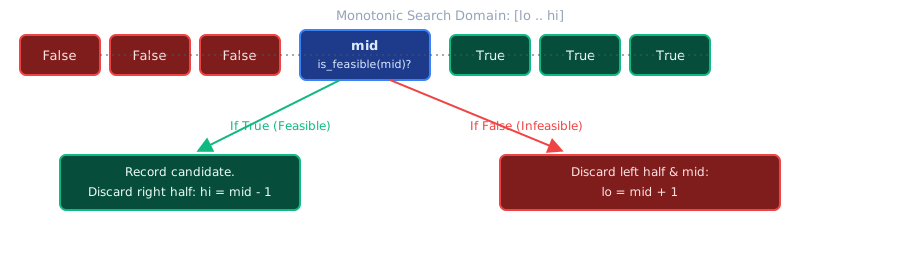
💡 Don't worry if this feels abstract right now! Backtracking is one fundamental 3-move loop applied across different search spaces. As you progress through the 9 Archetype Variants (from Phone Numbers to Coin Change and Word Break), each hands-on challenge will cement this intuition until writing path.append() and path.pop() becomes second nature.