Conceptual Foundation & Intuitive Analogy
🧭 Conceptual Foundation & Pattern Intuition
Backtracking is a systematic method for exploring large, combinatorial decision spaces. Where simple iteration scans a flat list, backtracking explores a tree of potential choices where every node represents a decision frame. The foundational triad of the pattern is Choose, Explore, Un-Choose:
- Choose: Select a candidate element and add it to the active path.
- Explore: Recurse down the branch to evaluate all consequences of that choice.
- Un-Choose: Symmetrically remove the candidate from the path before returning to the parent, leaving zero trace of the experiment.
For the power set (Subsets), we use a forward-advancing
startindex: each recursive step decides which remaining elements to include, naturally generating all unique subsets without generating duplicate permutations.
🏟️ The Analogy: Packing a Backpack for a Weekend Hike
Imagine packing a small backpack from a table of gear: a flashlight, a compass, and a camera. You start with an empty pack (Subset 1: []). You add the flashlight (Subset 2: ["flashlight"]). Keeping the flashlight in, you add the compass (Subset 3: ["flashlight", "compass"]). Keeping both, you add the camera (Subset 4: ["flashlight", "compass", "camera"]). You have reached the end of the table. You remove the camera (un-choose), remove the compass (un-choose), and try adding just the camera (Subset 5: ["flashlight", "camera"]). You unpack and repack one item at a time until every possible gear combination has been cataloged.
🔑 Why It Works
Notice results.append(path[:]). If you write results.append(path), Python stores a reference to the single mutable list. As backtracking unwinds, path.pop() empties that list, leaving results filled with empty arrays [[], [], ...]. Taking a snapshot path[:] freezes the state in amber.
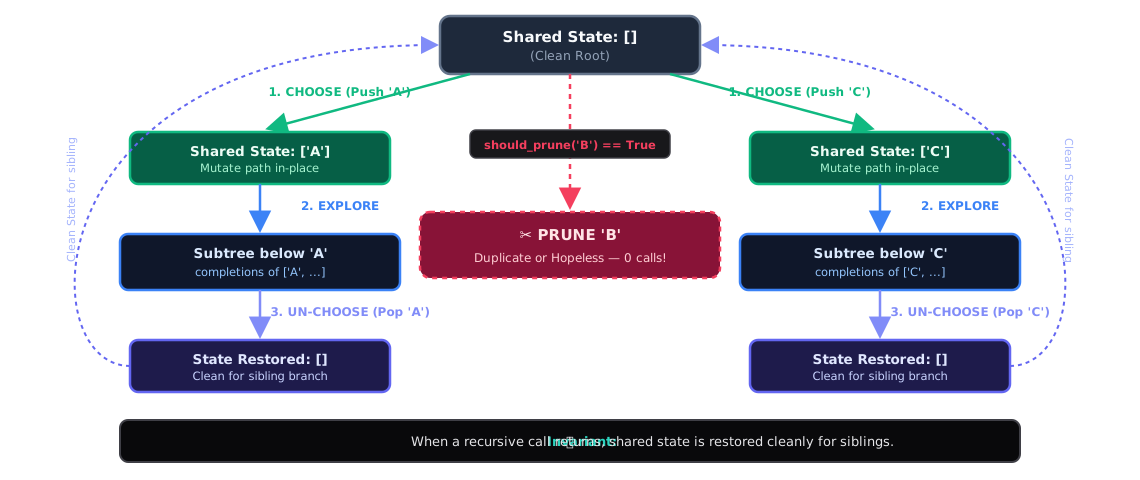
When a recursive call returns, the shared state is byte-for-byte what it was before the call. Every branch starts clean.
Branch exploration via in-place mutation followed by immediate backtrack restoration. Sibling deduplication prunes duplicate subtrees.
Recursive base case: if len(path) == target: record copy; for i in range(start, n): choose, recurse, un-choose.
The 2 Mental Models of Backtracking
Distinguish whether the decision tree snapshots every node, leaves only, or permutational arrangements.
In the realm of backtracking, combinatorial generation generally splits into three distinct families based on how you navigate the state space:
- Subsets (Power Sets): Generate all possible group sizes. → Subsets
- Combinations: Generate groups of a specific size or matching a specific constraint (like summing to a target), where order does not matter. → Combinations
- Permutations: Generate arrangements where order does matter. → Permutations
All three share the same choose → explore → un-choose loop. Only two decisions change: when you record path, and where the next call starts.
| Family | Record path | Next call |
|---|---|---|
| Subsets | Every node | i + 1 |
| Combinations | len(path) == k or remain == 0 | i + 1, or i to reuse |
| Permutations | len(path) == len(nums) | loop from 0, skip used[i] |
For nums = [1,2,3]: 8 subsets (sizes 0 to 3), 3 combinations of size 2 ([1,2], [1,3], [2,3]), and 6 permutations, because [1,2] ≠ [2,1].
One Choice per Slot, String Partitioning and Constraint Backtracking reuse the same loop to fill fixed slots, to cut a string into valid pieces and to fill a board. Meet in the Middle splits the input in half when 2^n choices are too many.
1Subsets
elements ➔ every decision tree node is valid ➔ snapshot deep copySubsets (Power Set)
| 1 | from typing import List |
| 2 | |
| 3 | def subsets(nums: List[int]) -> List[List[int]]: |
| 4 | """Subsets (LC 78): every subset of nums, saved once at the node of the decision tree that builds it. |
| 5 | N = len(nums) and all values are different. |
| 6 | Time: O(N * 2^N) | Space: O(N) path + recursion stack, output not counted |
| 7 | """ |
| 8 | results: List[List[int]] = [] |
| 9 | path: List[int] = [] # the choices from the root to the current node, in order |
| 10 | |
| 11 | def backtrack(start: int) -> None: |
| 12 | # 1. Save This Node: |
| 13 | # Every node of the decision tree is a valid subset, so copy path into results |
| 14 | # as soon as the call starts, before trying any further choice. |
| 15 | results.append(list(path)) |
| 16 | |
| 17 | for i in range(start, len(nums)): |
| 18 | # 2. Choose, Explore, Un-choose: |
| 19 | # Add nums[i] to path, recurse forward so the next call only sees later |
| 20 | # indices, then remove nums[i] so the loop's next i tries its own branch. |
| 21 | path.append(nums[i]) |
| 22 | backtrack(i + 1) |
| 23 | path.pop() |
| 24 | |
| 25 | backtrack(0) |
| 26 | return results |
Every node of the decision tree is a valid subset, so save a copy of path as soon as you enter backtrack. The loop only picks indices from start onward, so each subset is built in one order and saved once. The trap is saving path itself: path keeps changing with append and pop, so write results.append(list(path)), or every saved subset ends up empty.
Gotcha 1 of 4
- The trap
Gotcha 1: Saving
pathinstead of a copylist(path)Mistakeresults.append(path)Fixresults.append(list(path))What happens:
results.append(path)stores the same list object every time. The code keeps changing that one list withappendandpop. At the end it is empty, so every saved subset is empty.Example: nums = [1, 2]Mistake: returns [[], [], [], []]Fix: returns [[], [1], [1, 2], [2]]
2Meet in the Middle
n up to 40 ➔ every subset sum of each half ➔ sort one half, binary search the otherMeet in the Middle
| 1 | from bisect import bisect_left |
| 2 | |
| 3 | |
| 4 | def min_abs_difference(nums: list[int], goal: int) -> int: |
| 5 | """Closest Subsequence Sum: meet in the middle on the subset sums of each half. |
| 6 | Time: O(2^(N/2) * N) | Space: O(2^(N/2)) |
| 7 | """ |
| 8 | def all_sums(part: list[int]) -> list[int]: |
| 9 | # 1. Extend Every Existing Sum: |
| 10 | # sums starts as [0], the sum of choosing nothing from part; for each number x, |
| 11 | # adding x to a copy of every sum already found accounts for both taking x and |
| 12 | # not taking it, so sums ends up holding every subset sum of part. |
| 13 | sums = [0] |
| 14 | for x in part: |
| 15 | sums += [s + x for s in sums] |
| 16 | return sums |
| 17 | |
| 18 | half = len(nums) // 2 |
| 19 | left = all_sums(nums[:half]) # every subset sum achievable from the left half |
| 20 | right = sorted(all_sums(nums[half:])) # every subset sum from the right half, sorted for binary search |
| 21 | |
| 22 | best = abs(goal) # choosing nothing from either half gives the sum 0 |
| 23 | for s in left: |
| 24 | # 2. Find the Closest Right Sum for This Left Sum: |
| 25 | # Every subsequence sum is one left sum s plus one right sum; need is the right |
| 26 | # sum that would make the total exactly goal, and bisect_left on the sorted |
| 27 | # right list finds where need would sit among the right sums. |
| 28 | need = goal - s |
| 29 | k = bisect_left(right, need) |
| 30 | # 3. Check Both Neighbors of the Insertion Point: |
| 31 | # The closest right sum to need is whichever of right[k] (the first sum >= need) |
| 32 | # and right[k - 1] (the last sum < need) is nearer; only one of the two may exist. |
| 33 | if k < len(right): |
| 34 | best = min(best, right[k] - need) |
| 35 | if k > 0: |
| 36 | best = min(best, need - right[k - 1]) |
| 37 | return best |
Split nums into two halves and list every subset sum of each half with all_sums: for 40 numbers that is two lists of about a million sums instead of a trillion subsequences. Every subsequence is one choice from the left half plus one from the right half, so for each left sum s you only need the right sum closest to need = goal - s: sort right once and find it with k = bisect_left(right, need). This is correct because all_sums starts from [0], the empty choice, so a subsequence that takes nothing from one half is still one left sum plus one right sum, and in a sorted list the value closest to need always sits next to the place where need would be inserted. The trap is checking only right[k], the first sum at or above need: the closest one may be just below it, so also check right[k - 1] when k > 0. On [2, 9, 1, 8] with goal = 13, the best sum, 12, is s = 11 plus the right sum 1, just below need = 2; checking only right[k] returns 4 instead of 1.
Gotcha 1 of 4
- The trap
Gotcha 1: Checking only
right[k]and notright[k - 1]Mistakeif k < len(right): best = min(best, right[k] - need)Fixif k < len(right): best = min(best, right[k] - need) if k > 0: best = min(best, need - right[k - 1])What happens:
bisect_leftreturns the place whereneedwould be inserted.right[k]is the smallest sum that is greater than or equal toneed. The closest sum can beright[k - 1], just belowneed. Without that check, the best total is missed.Example: nums = [2, 9, 1, 8], goal = 13Mistake: returns 4Fix: returns 1
Built on the mental models above
- CombinationsCombinations / Combination Sum
The loop starts at
startand the search tracks a remaining target, so it stops a branch when the remainder goes below zero. - String PartitioningString Partitioning Backtracking
The choice is where the next piece ends, and a piece is taken only if it passes the check.
- One Choice per SlotCartesian Product Backtracking (One Choice per Slot)
Each position has its own list of options, so the loop reads that list and there is no
startand nousedarray. - PermutationsPermutations
A
usedarray replacesstart, so any element not yet inpathcan come next, and each element is used once. - Constraint BacktrackingConstraint Satisfaction Backtracking (N-Queens, Sudoku)
Each placement is checked against marked sets (columns and diagonals), and the marks are removed when the search backs out.
- Find One SolutionFind One Solution and Stop (Sudoku Solver, Word Search)
The search returns True as soon as one full solution exists, and every caller returns at once, so the rest of the tree is skipped.
- Subsets IISubsets with Duplicates (Sibling Deduplication)
Sort first, then skip a value that equals its left neighbour unless it is the first choice of its call, so no subset is saved twice.
The Backtracking Decision Rule
When facing an unseen combinatorial search problem, ask in this order:
Split the input into halves, list every subset sum of each, sort one list and binary search it for each sum of the other.
backtrack(index): record path when index == len(digits); otherwise try each option of slot index and recurse on index + 1.
Use start pointer to prevent looking backward, pass i + 1, and snapshot at every node.
Sort first, then skip nums[i] when i > start and nums[i] == nums[i - 1].
Use start pointer to prevent looking backward; snapshot only when len(path) == k or remain == 0. Pass i + 1 to use each item once, i to allow reuse.
Loop from 0 to N-1 with used boolean array or in-place swapping.
Loop end from start to N-1, validate prefix, and recurse on end + 1.
Make the recursive function return True when every position is filled, return True at once when a call returns True, and undo a placement only after a call returned False.
Maintain O(1) lookup sets (cols, diag1, diag2) and branch row by row; undo every mark on the way back.
Pattern Architecture & Invariant Design Masterclass
Backtracking is how you explore every possibility without ever building them all in memory at once. You keep exactly one partial answer — a single list you keep editing — and you walk a decision tree with three moves that always appear together:
- Choose. Add one option to the partial answer.
- Explore. Recurse, and let the rest of the decisions be made deeper down.
- Un-choose. Remove that option again, so the next sibling branch starts from an identical, uncontaminated state.
Step 3 is the whole pattern and is the step students omit. Without it, choices from one branch leak into the next and every later answer is wrong.
The difference from plain DFS (the DFS pattern) is exactly this: DFS walks a structure that already exists. Backtracking walks a decision tree that exists only while you are standing in it — the tree is the sequence of choices, and un-choosing is what deletes the part you have finished with.
Distinguishing State vs. Path (Mental Model Clarity)
It is important to keep State and Path distinct:
- State (
start,index,remaining/rem): The forward-looking subproblem parameters passed to recursion that determine what future choices are legally available. Because State is path-independent, it serves as the key for memoization (memo[rem]). - Path (
path = []): The backward-looking mutable history buffer tracking the sequence of decisions from the root. When exploring choices, you dopath.append(choice); when backtracking, you dopath.pop(). Optimization problems (like Coin Change) only track State and don't even needpath.
The 3 Core Moves in Action (Micro-Step Trace)
Consider generating combinations of length 2 from ['A', 'B', 'C']:
- Step 0 (Clean Root):
path = [] - Step 1 (CHOOSE 'A'):
path.append('A')→path = ['A'] - Step 2 (EXPLORE):
backtrack(path)recursive call begins. - Step 3 (CHOOSE 'B'):
path.append('B')→path = ['A', 'B'] - Step 4 (RECORD):
result.append(list(path))→ Saves frozen copy['A', 'B']. - Step 5 (UN-CHOOSE 'B'):
path.pop()→pathis cleanly restored to['A']. - Step 6 (CHOOSE 'C'): the loop under
'A'moves on:path.append('C')→path = ['A', 'C']. - Step 7 (RECORD): saves the copy
['A', 'C']. - Step 8 (UN-CHOOSE 'C'):
path.pop()→path = ['A']; nothing is left after'C'. - Step 9 (UN-CHOOSE 'A'):
path.pop()→path = [], so the next root sibling'B'starts clean and builds['B', 'C'].
Mental Model Context & Problem Statement: The decision tree diagram below traces the backtracking process for Generating Combinations of Length 2 from Elements
['A', 'B', 'C'](with sibling choice and branch exploration).
🔬 Variable Anatomy: The 7 Variables Every Backtracker Uses
To connect abstract concepts with concrete Python syntax, here is the universal code anatomy showing what every variable does:
def backtrackingMasterTemplate(nums: list[int], target: int) -> list[list[int]]: # ========================================================================= # 1. THE STORAGE POOLS # ========================================================================= results = [] # 📦 Global output container (stores frozen snapshot copies) path = [] # 🧵 Single shared mutable buffer (the active path from root) used = [False] * len(nums) # 🚫 used[i]: nums[i] is in path (ONLY for Permutations, where start is dropped) memo = {} # 🧠 Memoization cache (for DP/Backtracking subproblems: Word Break, Coin Change) # ========================================================================= # 2. THE RECURSIVE FUNCTION & VARIABLE ROLES # ========================================================================= def dfs( start: int, # 🚪 One-Way Door: boundary index (prevents backward duplicates) remaining: int # 🎯 Dynamic Quota: target quota decremented on each choice ) -> None: # --- A. BASE CASES / GOAL CHECK --- if remaining == 0: # ⚠️ CRITICAL: Must snapshot with list(path) or path[:], NEVER append(path)! results.append(list(path)) return if remaining < 0: return # ✂️ Child Pruning: overshoot infeasibility # --- B. THE CHOICES LOOP --- for i in range(start, len(nums)): # 'i' = 🎯 The specific candidate being evaluated right now candidate = nums[i] # --- C. PRUNING GUARDS --- # Guard 1: Sibling Deduplication (Subsets II / CS II) # If sorted and duplicate choice at this same depth, skip! if i > start and nums[i] == nums[i - 1]: continue # Guard 2: Early Break (Sorted array exceeds remaining target) if candidate > remaining: break # --- D. THE 3 CORE MOVES --- path.append(candidate) # 1️⃣ CHOOSE: add to mutable buffer # 2️⃣ EXPLORE: step 1 depth deeper (going down in the depth of the decision tree) # - For Subsets/Combinations: pass `i + 1` (forward only) # - For Unbounded Reuse: pass `i` (stay at current index) # - For Permutations: drop start, loop 0..N, toggle used[i] dfs(i + 1, remaining - candidate) # 🌲 Going down in the depth of the decision tree path.pop() # 3️⃣ UN-CHOOSE: restore state byte-for-byte # ========================================================================= # 3. KICK OFF RECURSION # ========================================================================= nums.sort() # Required for adjacent deduplication and early break pruning dfs(0, target) return results Variable Role Reference:
| Variable | Role in Code | Question It Answers | ❌ What Happens If Omitted or Mismanaged? |
|---|---|---|---|
path | Single mutable buffer | "What decisions have I made from root to here?" | ❌ If you don't pop(), past choices leak into sibling branches and corrupt state. |
results | Output collection | "Where do completed valid answers get stored?" | ❌ Appending path instead of list(path) appends a mutable reference, resulting in [[], [], []]. |
start | One-Way Door index | "Which items am I legally allowed to look at?" | ❌ Without start, combinations produce backward duplicates like [1,2] and [2,1]. |
i | Loop choice cursor | "Which specific candidate am I trying right now?" | ❌ Passing start + 1 instead of i + 1 lets a number repeat ([2, 2]) and a group appear in two orders ([2, 3] and [3, 2]). |
used | One flag per position | "Did I already pick this exact element in this branch?" | ❌ Without used, Permutations pick the exact same index multiple times (e.g. [1, 1, 1]). |
remaining | Dynamic target quota | "How much capacity / target remains to be satisfied?" | ❌ Without remaining, checking target sums requires expensive repeated sum(path) calls. |
memo | Subproblem cache | "Have I already solved this remaining subproblem?" | ❌ Without memo, branching explosions re-solve identical subproblems in exponential time. |
🧠 The Universal Contract of Memoization & State Arrays (
memo/dp):
Every memoization table or array operates on a strict Index Value contract:
- The Index / Key (
i/rem): Represents the exact subproblem state you are currently trying to solve (e.g. in Coin Change: the exact remaining amount of money; in Word Break / Decode Ways: the suffix start positions[i:]).- The Value (
memo[i]): Represents the optimal answer or viability for that exact subproblem (e.g. in Coin Change: the minimum number of coins required to make that exact amounti; in Decode Ways: total valid decoding ways for suffix fromi).
🌟 The 3 Dimensions of Backtracking & The "One-Way Door" Principle
Recursion itself is what controls the depth. The start index does not control depth; it acts as a One-Way Door for your choices.
To make this crystal clear, let's break a for-loop down into the 3 Dimensions of Backtracking:
-
The Recursion = Depth
- Every time you call
dfs(), you are stepping one level deeper into the tree. - Question it answers: "How many items are currently in my path?"
- Every time you call
-
The Loop Variable (
i) = The Choices- The
for i in range(...)loop represents you standing at a specific depth and pointing at the options laid out in front of you. - Question it answers: "Which specific item am I picking right now?"
- The
-
The
startVariable (orusedset) = The Constraintsstartis a constraint filter. It determines the boundary of whatiis allowed to look at.- Question it answers: "Which items am I allowed to pick from?"
How this plays out in actual problems:
- Scenario A: Subsets / Combinations (Using
start): order doesn't matter, so the next call starts after the pick and never looks back (the Subsets and Combinations cards). - Scenario B: Permutations (Dropping
start): order matters, so every depth loops from0and skips positions already inpath(the Permutations card).
💡 The Ultimate Takeaway
When you are looking at a new problem, don't ask "what should my start index be?"
Instead, ask: "Am I allowed to look backward in the array?"
- If NO (Combinations/Subsets): Use a
startindex and passdfs(i + 1). - If YES (Permutations): Drop the
startindex, loop from 0 every time, and skip positions whoseused[i]flag is set.
🎯 The Backtracking Cards at a Glance
Each shape below has its own card with the full blueprint, trap and worked example:
- Subsets: save at every node; among equal values skip a sibling repeat (the Subsets card).
- Combinations: save only a complete group; recurse with
i + 1, oriwhen a number may be reused (the Combinations card). - Permutations: loop from
0and skip positions already used (the Permutations card).
When Memoization Applies: Minimum Number of Coins (Coin Change as Backtracking vs DP)
- Decision Tree Architecture:
- At every step, you have the goal of reaching
0fromamount. - Choice Continuity: Because coins can be reused without restriction, all coin denominations
[c1, c2, c3]remain accessible at every depth.
- At every step, you have the goal of reaching
- The Top-Down Memoized Decision Tree (O(C × A), where C = len(coins) and A = amount):
def coinChange(coins: list[int], amount: int) -> int: memo = [-1] * (amount + 1) def dfs(rem: int) -> int: if rem == 0: return 0 # 0 coins needed to make 0 amount if rem < 0: return float('inf') # Invalid path, we overshot if memo[rem] != -1: return memo[rem] # Return previously calculated answer ans = float('inf') for coin in coins: result = dfs(rem - coin) if result != float('inf'): ans = min(ans, result + 1) memo[rem] = ans return ans res = dfs(amount) return res if res != float('inf') else -1 - Why Memoization / DP is Required:
- Notice that
remis the only state variable needed to evaluate future decisions. The exact path of coins chosen to reachrem = 7does not change the optimal number of coins needed to clear the remaining7. - Initializing
memo = [-1] * (amount + 1)collapses the exponential O(C^A) unpruned decision tree into an optimal O(C × A) linear state table (where C = len(coins) and A = amount)!
- Notice that
🌳 Evaluating Decision Trees, State Management & Option Pools
Building a mental decision tree before writing code establishes the foundation for any backtracking algorithm, helping map out choices, constraints, and goal states.
1. Evaluating Decision Trees and State Management
- Choice Continuity: When options remain static across recursive calls (such as picking any coin of any denomination in a problem where element reuse is allowed), the full option pool stays accessible, and a position tracker is not strictly required.
- Option Consumption: When elements can only be used once (like subsets or permutations), the choice space shrinks. Passing an index parameter or maintaining a visited array ensures execution moves forward and avoids redundant selections.
- The Nuance of Memoization: Standard backtracking explores every valid path to generate configurations or navigate exponential search spaces ( or ). Memoization only applies if the problem exhibits overlapping subproblems—meaning the exact same state can be reached via different paths and the remaining future outcomes are identical. If states are strictly path-dependent (such as tracking an ordered sequence or permutation), memoization is ineffective unless the problem is reframed as dynamic programming.
2. Core Backtracking Implementation Tips
- Master the Standard Template: Structure every backtracking function around four core actions: check the base case (is the goal met?), record/process the valid path, iterate through choices, and undo the choice (backtrack) before moving to the next iteration.
- Prune Early: If a partial state violates a constraint (e.g., the current running sum exceeds a target),
breakorcontinueimmediately to cut off entire subtrees of the decision tree. - Pass State Efficiently: Instead of slicing arrays or allocating new collections at every recursive frame—which introduces unnecessary or overhead—modify a single data structure in place and backtrack by popping elements or reverting state variables.
💡 Staff SWE Architectural Invariant:
Decision trees, state progression and shrinking or static option pools describe every backtracking search; memoization helps only when subproblems overlap.
Understanding Invariants: Choose, Explore, Un-choose & Sibling vs Child Pruning
The mutable path state must reflect only the sequence of choices leading from the root to the current node. Upon returning from exploring a child branch, path.pop() restores the exact state before that choice was made.
Recursion itself is what controls the depth (stepping 1 level deeper). The start index acts as a One-Way Door for your choices, locking previous indices behind you in forward-only combinations.
Because all subsequent sorted candidates will also overshoot.
To prevent generating duplicate combinations from the same level.
Common Questions
"Since path is shared and mutated in place, why do we have to explicitly path.pop() after recursing — couldn't we just pass a new list at each call instead, so there's nothing to undo?"
You could — and some solutions do — but it trades a cheap operation for an expensive one, and it's worth knowing why the mutate-and-undo version is the default.
Passing a new list means allocating and copying the whole path at every single call:
backtrack(path + [choice])creates anO(depth)copy on every recursive step, for every node in the decision tree. Across a tree with exponentially many nodes, those copies dominate the runtime — you can turn an already-exponential algorithm asymptotically worse for no algorithmic reason.Mutating one shared buffer and undoing the mutation costs
O(1)per step:path.append(choice)on the way down,path.pop()on the way back up. The byte-for-byte restoration invariant is what makes this safe — as long as everyappendis matched by exactly onepopbefore the function returns, sibling branches never see each other's leftover state, so there's no correctness difference between the two approaches, only a performance one.The one place this causes a bug:
results.append(path)(appending the reference) instead ofresults.append(list(path))(a snapshot). Sincepathkeeps getting mutated after you've stored a reference to it, every entry you thought you saved silently changes too — usually ending up as a list of identical, empty-looking results. Snapshot when you record; mutate-and-undo everywhere else.
Coach discussion points
- 1.
"You said
O(2ⁿ). Walk me through what happens on the line where you record a subset, and tell me again." — Surfaces theO(n)snapshot cost hidden inside the recording line. The highest-signal question in this pattern. - 2.
"Delete the
path.pop()line. What is the first input that produces a wrong answer, and what does the wrong answer look like?" — Forces the student to reason about state contamination concretely rather than reciting "you need to backtrack". - 3.
"Why does the deduplication check use
i > startand noti > 0? Give me the input that distinguishes them." —[1,2,2]:i > 0would also prune the legitimate[1,2,2]branch. This one question separates memorisation from understanding. - 4.
"You could have used a set to remove duplicate subsets at the end. Why is pruning better, and is there a case where the set is the right call?" — Tests judgement, not just technique; the honest answer includes "when the dedup rule is too complex to express as a branch prune."
- 5.
"In Sudoku Solver, why do we check the row, column, AND box for every candidate digit, instead of just checking whether the digit already appears anywhere on the board?" — Surfaces the understanding that a digit can legally repeat elsewhere on the board (in a different row/column/box) — only the three local neighborhoods matter, which is exactly why the check stays bounded at 27 cells instead of scanning all 81.
- 6.
"Restore IP Addresses has no visible 'pruning' step like N-Queens' diagonal sets. Is it still backtracking? Why is it still fast?" — Tests whether the student recognizes that bounding the branching factor (3) and the depth (4) is itself a form of built-in pruning — the search space is small by construction, not because of an explicit early-exit check.
Complexity analysis
Time for Subsets II (LC 90): O(n · 2ⁿ) — not O(2ⁿ).
There are 2ⁿ subsets, and each one is copied into the results list when recorded. A subset averages n/2 elements, so each copy costs O(n). Multiply: O(n · 2ⁿ). Candidates who say O(2ⁿ) have forgotten the snapshot cost, and this is the specific thing a Staff-level interviewer listens for.
Time for Permutations (LC 46): O(n · n!). n! complete orderings, each copied at O(n).
Time for Combination Sum (LC 39): O(n^(T/m)) where T is the target and m the smallest candidate — the tree's depth is at most T/m and its branching factor at most n. Bounds like this one are legitimately loose; saying "exponential in target / min(candidates), and here is why" is a better answer than a confidently wrong tight bound.
Space: O(n) auxiliary, not counting the output. One shared path of at most n elements, plus a recursion stack at most n deep. The output itself is O(n · 2ⁿ) and is conventionally excluded — but say that you are excluding it rather than silently ignoring it.
Why pruning matters even though the bound stays exponential: pruning does not change the worst case; it changes the actual case, often by orders of magnitude. In Subsets II (LC 90), two prunes removed 25% of the tree on a three-element input. That ratio grows with n.
A CI (Continuous Integration) system must decide which subset of 20 optional feature flags to enable for a canary release. Some combinations are forbidden. There is no formula — the only way is to try combinations, and the moment a partial combination already violates a rule, every completion of it also violates it and the entire branch can be abandoned unexplored. That abandonment ("pruning") is why backtracking beats generating all 2²⁰ combinations blindly. Sudoku solvers, regex engines, dependency resolvers, and constraint schedulers are all this same loop.
💡 Don't worry if this feels abstract right now! Backtracking is one fundamental 3-move loop applied across different search spaces. As you progress through the Archetype Variants (from Phone Numbers and Subsets II to Combination Sum and N-Queens), each hands-on challenge will cement this intuition until writing path.append() and path.pop() becomes second nature.
Appending live
pathreference instead of shallow copy:results.append(path)stores a reference to the mutable list. When backtracking empties the list withpath.pop(), all elements inresultsbecome empty lists[]. Always appendpath[:]orlist(path).Duplicate subsets from unsorted inputs: If inputs contain duplicates, subsets will generate duplicate combinations unless inputs are sorted and sibling duplicates skipped.
Recursion stack depth exceeding limits: For , subsets exceed time and memory bounds. Ensure .
Staff+ Systems Architecture & Hardware Considerations
Triggers: "generate all valid combinations / permutations / subsets", "find all solutions satisfying constraints", "Sudoku / N-Queens constraint satisfaction". Systematic state-space tree traversal with early pruning of non-viable branches.
Problem search space size is small ( for power sets , for permutations ). Without pruning, exponential searches time out; aggressive early pruning drops branch complexity by orders of magnitude.
Accidentally appending mutable reference res.append(path) instead of deep copy res.append(list(path)); exponential duplicate branch explosion when inputs contain duplicates (mitigate via sibling branch pruning nums[i] == nums[i-1]); inefficient backtracking state cloning.
Conceptual Foundation & Intuitive Analogy
🧭 Conceptual Foundation & Pattern Intuition
Backtracking is a systematic method for exploring large, combinatorial decision spaces. Where simple iteration scans a flat list, backtracking explores a tree of potential choices where every node represents a decision frame. The foundational triad of the pattern is Choose, Explore, Un-Choose:
- Choose: Select a candidate element and add it to the active path.
- Explore: Recurse down the branch to evaluate all consequences of that choice.
- Un-Choose: Symmetrically remove the candidate from the path before returning to the parent, leaving zero trace of the experiment.
For the power set (Subsets), we use a forward-advancing
startindex: each recursive step decides which remaining elements to include, naturally generating all unique subsets without generating duplicate permutations.
🏟️ The Analogy: Packing a Backpack for a Weekend Hike
Imagine packing a small backpack from a table of gear: a flashlight, a compass, and a camera. You start with an empty pack (Subset 1: []). You add the flashlight (Subset 2: ["flashlight"]). Keeping the flashlight in, you add the compass (Subset 3: ["flashlight", "compass"]). Keeping both, you add the camera (Subset 4: ["flashlight", "compass", "camera"]). You have reached the end of the table. You remove the camera (un-choose), remove the compass (un-choose), and try adding just the camera (Subset 5: ["flashlight", "camera"]). You unpack and repack one item at a time until every possible gear combination has been cataloged.
🔑 Why It Works
Notice results.append(path[:]). If you write results.append(path), Python stores a reference to the single mutable list. As backtracking unwinds, path.pop() empties that list, leaving results filled with empty arrays [[], [], ...]. Taking a snapshot path[:] freezes the state in amber.
When a recursive call returns, the shared state is byte-for-byte what it was before the call. Every branch starts clean.
Branch exploration via in-place mutation followed by immediate backtrack restoration. Sibling deduplication prunes duplicate subtrees.
Recursive base case: if len(path) == target: record copy; for i in range(start, n): choose, recurse, un-choose.
The 2 Mental Models of Backtracking
Distinguish whether the decision tree snapshots every node, leaves only, or permutational arrangements.
In the realm of backtracking, combinatorial generation generally splits into three distinct families based on how you navigate the state space:
- Subsets (Power Sets): Generate all possible group sizes. → Subsets
- Combinations: Generate groups of a specific size or matching a specific constraint (like summing to a target), where order does not matter. → Combinations
- Permutations: Generate arrangements where order does matter. → Permutations
All three share the same choose → explore → un-choose loop. Only two decisions change: when you record path, and where the next call starts.
| Family | Record path | Next call |
|---|---|---|
| Subsets | Every node | i + 1 |
| Combinations | len(path) == k or remain == 0 | i + 1, or i to reuse |
| Permutations | len(path) == len(nums) | loop from 0, skip used[i] |
For nums = [1,2,3]: 8 subsets (sizes 0 to 3), 3 combinations of size 2 ([1,2], [1,3], [2,3]), and 6 permutations, because [1,2] ≠ [2,1].
One Choice per Slot, String Partitioning and Constraint Backtracking reuse the same loop to fill fixed slots, to cut a string into valid pieces and to fill a board. Meet in the Middle splits the input in half when 2^n choices are too many.
1Subsets
elements ➔ every decision tree node is valid ➔ snapshot deep copySubsets (Power Set)
| 1 | from typing import List |
| 2 | |
| 3 | def subsets(nums: List[int]) -> List[List[int]]: |
| 4 | """Subsets (LC 78): every subset of nums, saved once at the node of the decision tree that builds it. |
| 5 | N = len(nums) and all values are different. |
| 6 | Time: O(N * 2^N) | Space: O(N) path + recursion stack, output not counted |
| 7 | """ |
| 8 | results: List[List[int]] = [] |
| 9 | path: List[int] = [] # the choices from the root to the current node, in order |
| 10 | |
| 11 | def backtrack(start: int) -> None: |
| 12 | # 1. Save This Node: |
| 13 | # Every node of the decision tree is a valid subset, so copy path into results |
| 14 | # as soon as the call starts, before trying any further choice. |
| 15 | results.append(list(path)) |
| 16 | |
| 17 | for i in range(start, len(nums)): |
| 18 | # 2. Choose, Explore, Un-choose: |
| 19 | # Add nums[i] to path, recurse forward so the next call only sees later |
| 20 | # indices, then remove nums[i] so the loop's next i tries its own branch. |
| 21 | path.append(nums[i]) |
| 22 | backtrack(i + 1) |
| 23 | path.pop() |
| 24 | |
| 25 | backtrack(0) |
| 26 | return results |
Every node of the decision tree is a valid subset, so save a copy of path as soon as you enter backtrack. The loop only picks indices from start onward, so each subset is built in one order and saved once. The trap is saving path itself: path keeps changing with append and pop, so write results.append(list(path)), or every saved subset ends up empty.
Gotcha 1 of 4
- The trap
Gotcha 1: Saving
pathinstead of a copylist(path)Mistakeresults.append(path)Fixresults.append(list(path))What happens:
results.append(path)stores the same list object every time. The code keeps changing that one list withappendandpop. At the end it is empty, so every saved subset is empty.Example: nums = [1, 2]Mistake: returns [[], [], [], []]Fix: returns [[], [1], [1, 2], [2]]
2Meet in the Middle
n up to 40 ➔ every subset sum of each half ➔ sort one half, binary search the otherMeet in the Middle
| 1 | from bisect import bisect_left |
| 2 | |
| 3 | |
| 4 | def min_abs_difference(nums: list[int], goal: int) -> int: |
| 5 | """Closest Subsequence Sum: meet in the middle on the subset sums of each half. |
| 6 | Time: O(2^(N/2) * N) | Space: O(2^(N/2)) |
| 7 | """ |
| 8 | def all_sums(part: list[int]) -> list[int]: |
| 9 | # 1. Extend Every Existing Sum: |
| 10 | # sums starts as [0], the sum of choosing nothing from part; for each number x, |
| 11 | # adding x to a copy of every sum already found accounts for both taking x and |
| 12 | # not taking it, so sums ends up holding every subset sum of part. |
| 13 | sums = [0] |
| 14 | for x in part: |
| 15 | sums += [s + x for s in sums] |
| 16 | return sums |
| 17 | |
| 18 | half = len(nums) // 2 |
| 19 | left = all_sums(nums[:half]) # every subset sum achievable from the left half |
| 20 | right = sorted(all_sums(nums[half:])) # every subset sum from the right half, sorted for binary search |
| 21 | |
| 22 | best = abs(goal) # choosing nothing from either half gives the sum 0 |
| 23 | for s in left: |
| 24 | # 2. Find the Closest Right Sum for This Left Sum: |
| 25 | # Every subsequence sum is one left sum s plus one right sum; need is the right |
| 26 | # sum that would make the total exactly goal, and bisect_left on the sorted |
| 27 | # right list finds where need would sit among the right sums. |
| 28 | need = goal - s |
| 29 | k = bisect_left(right, need) |
| 30 | # 3. Check Both Neighbors of the Insertion Point: |
| 31 | # The closest right sum to need is whichever of right[k] (the first sum >= need) |
| 32 | # and right[k - 1] (the last sum < need) is nearer; only one of the two may exist. |
| 33 | if k < len(right): |
| 34 | best = min(best, right[k] - need) |
| 35 | if k > 0: |
| 36 | best = min(best, need - right[k - 1]) |
| 37 | return best |
Split nums into two halves and list every subset sum of each half with all_sums: for 40 numbers that is two lists of about a million sums instead of a trillion subsequences. Every subsequence is one choice from the left half plus one from the right half, so for each left sum s you only need the right sum closest to need = goal - s: sort right once and find it with k = bisect_left(right, need). This is correct because all_sums starts from [0], the empty choice, so a subsequence that takes nothing from one half is still one left sum plus one right sum, and in a sorted list the value closest to need always sits next to the place where need would be inserted. The trap is checking only right[k], the first sum at or above need: the closest one may be just below it, so also check right[k - 1] when k > 0. On [2, 9, 1, 8] with goal = 13, the best sum, 12, is s = 11 plus the right sum 1, just below need = 2; checking only right[k] returns 4 instead of 1.
Gotcha 1 of 4
- The trap
Gotcha 1: Checking only
right[k]and notright[k - 1]Mistakeif k < len(right): best = min(best, right[k] - need)Fixif k < len(right): best = min(best, right[k] - need) if k > 0: best = min(best, need - right[k - 1])What happens:
bisect_leftreturns the place whereneedwould be inserted.right[k]is the smallest sum that is greater than or equal toneed. The closest sum can beright[k - 1], just belowneed. Without that check, the best total is missed.Example: nums = [2, 9, 1, 8], goal = 13Mistake: returns 4Fix: returns 1
Built on the mental models above
- CombinationsCombinations / Combination Sum
The loop starts at
startand the search tracks a remaining target, so it stops a branch when the remainder goes below zero. - String PartitioningString Partitioning Backtracking
The choice is where the next piece ends, and a piece is taken only if it passes the check.
- One Choice per SlotCartesian Product Backtracking (One Choice per Slot)
Each position has its own list of options, so the loop reads that list and there is no
startand nousedarray. - PermutationsPermutations
A
usedarray replacesstart, so any element not yet inpathcan come next, and each element is used once. - Constraint BacktrackingConstraint Satisfaction Backtracking (N-Queens, Sudoku)
Each placement is checked against marked sets (columns and diagonals), and the marks are removed when the search backs out.
- Find One SolutionFind One Solution and Stop (Sudoku Solver, Word Search)
The search returns True as soon as one full solution exists, and every caller returns at once, so the rest of the tree is skipped.
- Subsets IISubsets with Duplicates (Sibling Deduplication)
Sort first, then skip a value that equals its left neighbour unless it is the first choice of its call, so no subset is saved twice.
The Backtracking Decision Rule
When facing an unseen combinatorial search problem, ask in this order:
Split the input into halves, list every subset sum of each, sort one list and binary search it for each sum of the other.
backtrack(index): record path when index == len(digits); otherwise try each option of slot index and recurse on index + 1.
Use start pointer to prevent looking backward, pass i + 1, and snapshot at every node.
Sort first, then skip nums[i] when i > start and nums[i] == nums[i - 1].
Use start pointer to prevent looking backward; snapshot only when len(path) == k or remain == 0. Pass i + 1 to use each item once, i to allow reuse.
Loop from 0 to N-1 with used boolean array or in-place swapping.
Loop end from start to N-1, validate prefix, and recurse on end + 1.
Make the recursive function return True when every position is filled, return True at once when a call returns True, and undo a placement only after a call returned False.
Maintain O(1) lookup sets (cols, diag1, diag2) and branch row by row; undo every mark on the way back.
Pattern Architecture & Invariant Design Masterclass
Backtracking is how you explore every possibility without ever building them all in memory at once. You keep exactly one partial answer — a single list you keep editing — and you walk a decision tree with three moves that always appear together:
- Choose. Add one option to the partial answer.
- Explore. Recurse, and let the rest of the decisions be made deeper down.
- Un-choose. Remove that option again, so the next sibling branch starts from an identical, uncontaminated state.
Step 3 is the whole pattern and is the step students omit. Without it, choices from one branch leak into the next and every later answer is wrong.
The difference from plain DFS (the DFS pattern) is exactly this: DFS walks a structure that already exists. Backtracking walks a decision tree that exists only while you are standing in it — the tree is the sequence of choices, and un-choosing is what deletes the part you have finished with.
Distinguishing State vs. Path (Mental Model Clarity)
It is important to keep State and Path distinct:
- State (
start,index,remaining/rem): The forward-looking subproblem parameters passed to recursion that determine what future choices are legally available. Because State is path-independent, it serves as the key for memoization (memo[rem]). - Path (
path = []): The backward-looking mutable history buffer tracking the sequence of decisions from the root. When exploring choices, you dopath.append(choice); when backtracking, you dopath.pop(). Optimization problems (like Coin Change) only track State and don't even needpath.
The 3 Core Moves in Action (Micro-Step Trace)
Consider generating combinations of length 2 from ['A', 'B', 'C']:
- Step 0 (Clean Root):
path = [] - Step 1 (CHOOSE 'A'):
path.append('A')→path = ['A'] - Step 2 (EXPLORE):
backtrack(path)recursive call begins. - Step 3 (CHOOSE 'B'):
path.append('B')→path = ['A', 'B'] - Step 4 (RECORD):
result.append(list(path))→ Saves frozen copy['A', 'B']. - Step 5 (UN-CHOOSE 'B'):
path.pop()→pathis cleanly restored to['A']. - Step 6 (CHOOSE 'C'): the loop under
'A'moves on:path.append('C')→path = ['A', 'C']. - Step 7 (RECORD): saves the copy
['A', 'C']. - Step 8 (UN-CHOOSE 'C'):
path.pop()→path = ['A']; nothing is left after'C'. - Step 9 (UN-CHOOSE 'A'):
path.pop()→path = [], so the next root sibling'B'starts clean and builds['B', 'C'].
Mental Model Context & Problem Statement: The decision tree diagram below traces the backtracking process for Generating Combinations of Length 2 from Elements
['A', 'B', 'C'](with sibling choice and branch exploration).
🔬 Variable Anatomy: The 7 Variables Every Backtracker Uses
To connect abstract concepts with concrete Python syntax, here is the universal code anatomy showing what every variable does:
def backtrackingMasterTemplate(nums: list[int], target: int) -> list[list[int]]: # ========================================================================= # 1. THE STORAGE POOLS # ========================================================================= results = [] # 📦 Global output container (stores frozen snapshot copies) path = [] # 🧵 Single shared mutable buffer (the active path from root) used = [False] * len(nums) # 🚫 used[i]: nums[i] is in path (ONLY for Permutations, where start is dropped) memo = {} # 🧠 Memoization cache (for DP/Backtracking subproblems: Word Break, Coin Change) # ========================================================================= # 2. THE RECURSIVE FUNCTION & VARIABLE ROLES # ========================================================================= def dfs( start: int, # 🚪 One-Way Door: boundary index (prevents backward duplicates) remaining: int # 🎯 Dynamic Quota: target quota decremented on each choice ) -> None: # --- A. BASE CASES / GOAL CHECK --- if remaining == 0: # ⚠️ CRITICAL: Must snapshot with list(path) or path[:], NEVER append(path)! results.append(list(path)) return if remaining < 0: return # ✂️ Child Pruning: overshoot infeasibility # --- B. THE CHOICES LOOP --- for i in range(start, len(nums)): # 'i' = 🎯 The specific candidate being evaluated right now candidate = nums[i] # --- C. PRUNING GUARDS --- # Guard 1: Sibling Deduplication (Subsets II / CS II) # If sorted and duplicate choice at this same depth, skip! if i > start and nums[i] == nums[i - 1]: continue # Guard 2: Early Break (Sorted array exceeds remaining target) if candidate > remaining: break # --- D. THE 3 CORE MOVES --- path.append(candidate) # 1️⃣ CHOOSE: add to mutable buffer # 2️⃣ EXPLORE: step 1 depth deeper (going down in the depth of the decision tree) # - For Subsets/Combinations: pass `i + 1` (forward only) # - For Unbounded Reuse: pass `i` (stay at current index) # - For Permutations: drop start, loop 0..N, toggle used[i] dfs(i + 1, remaining - candidate) # 🌲 Going down in the depth of the decision tree path.pop() # 3️⃣ UN-CHOOSE: restore state byte-for-byte # ========================================================================= # 3. KICK OFF RECURSION # ========================================================================= nums.sort() # Required for adjacent deduplication and early break pruning dfs(0, target) return results Variable Role Reference:
| Variable | Role in Code | Question It Answers | ❌ What Happens If Omitted or Mismanaged? |
|---|---|---|---|
path | Single mutable buffer | "What decisions have I made from root to here?" | ❌ If you don't pop(), past choices leak into sibling branches and corrupt state. |
results | Output collection | "Where do completed valid answers get stored?" | ❌ Appending path instead of list(path) appends a mutable reference, resulting in [[], [], []]. |
start | One-Way Door index | "Which items am I legally allowed to look at?" | ❌ Without start, combinations produce backward duplicates like [1,2] and [2,1]. |
i | Loop choice cursor | "Which specific candidate am I trying right now?" | ❌ Passing start + 1 instead of i + 1 lets a number repeat ([2, 2]) and a group appear in two orders ([2, 3] and [3, 2]). |
used | One flag per position | "Did I already pick this exact element in this branch?" | ❌ Without used, Permutations pick the exact same index multiple times (e.g. [1, 1, 1]). |
remaining | Dynamic target quota | "How much capacity / target remains to be satisfied?" | ❌ Without remaining, checking target sums requires expensive repeated sum(path) calls. |
memo | Subproblem cache | "Have I already solved this remaining subproblem?" | ❌ Without memo, branching explosions re-solve identical subproblems in exponential time. |
🧠 The Universal Contract of Memoization & State Arrays (
memo/dp):
Every memoization table or array operates on a strict Index Value contract:
- The Index / Key (
i/rem): Represents the exact subproblem state you are currently trying to solve (e.g. in Coin Change: the exact remaining amount of money; in Word Break / Decode Ways: the suffix start positions[i:]).- The Value (
memo[i]): Represents the optimal answer or viability for that exact subproblem (e.g. in Coin Change: the minimum number of coins required to make that exact amounti; in Decode Ways: total valid decoding ways for suffix fromi).
🌟 The 3 Dimensions of Backtracking & The "One-Way Door" Principle
Recursion itself is what controls the depth. The start index does not control depth; it acts as a One-Way Door for your choices.
To make this crystal clear, let's break a for-loop down into the 3 Dimensions of Backtracking:
-
The Recursion = Depth
- Every time you call
dfs(), you are stepping one level deeper into the tree. - Question it answers: "How many items are currently in my path?"
- Every time you call
-
The Loop Variable (
i) = The Choices- The
for i in range(...)loop represents you standing at a specific depth and pointing at the options laid out in front of you. - Question it answers: "Which specific item am I picking right now?"
- The
-
The
startVariable (orusedset) = The Constraintsstartis a constraint filter. It determines the boundary of whatiis allowed to look at.- Question it answers: "Which items am I allowed to pick from?"
How this plays out in actual problems:
- Scenario A: Subsets / Combinations (Using
start): order doesn't matter, so the next call starts after the pick and never looks back (the Subsets and Combinations cards). - Scenario B: Permutations (Dropping
start): order matters, so every depth loops from0and skips positions already inpath(the Permutations card).
💡 The Ultimate Takeaway
When you are looking at a new problem, don't ask "what should my start index be?"
Instead, ask: "Am I allowed to look backward in the array?"
- If NO (Combinations/Subsets): Use a
startindex and passdfs(i + 1). - If YES (Permutations): Drop the
startindex, loop from 0 every time, and skip positions whoseused[i]flag is set.
🎯 The Backtracking Cards at a Glance
Each shape below has its own card with the full blueprint, trap and worked example:
- Subsets: save at every node; among equal values skip a sibling repeat (the Subsets card).
- Combinations: save only a complete group; recurse with
i + 1, oriwhen a number may be reused (the Combinations card). - Permutations: loop from
0and skip positions already used (the Permutations card).
When Memoization Applies: Minimum Number of Coins (Coin Change as Backtracking vs DP)
- Decision Tree Architecture:
- At every step, you have the goal of reaching
0fromamount. - Choice Continuity: Because coins can be reused without restriction, all coin denominations
[c1, c2, c3]remain accessible at every depth.
- At every step, you have the goal of reaching
- The Top-Down Memoized Decision Tree (O(C × A), where C = len(coins) and A = amount):
def coinChange(coins: list[int], amount: int) -> int: memo = [-1] * (amount + 1) def dfs(rem: int) -> int: if rem == 0: return 0 # 0 coins needed to make 0 amount if rem < 0: return float('inf') # Invalid path, we overshot if memo[rem] != -1: return memo[rem] # Return previously calculated answer ans = float('inf') for coin in coins: result = dfs(rem - coin) if result != float('inf'): ans = min(ans, result + 1) memo[rem] = ans return ans res = dfs(amount) return res if res != float('inf') else -1 - Why Memoization / DP is Required:
- Notice that
remis the only state variable needed to evaluate future decisions. The exact path of coins chosen to reachrem = 7does not change the optimal number of coins needed to clear the remaining7. - Initializing
memo = [-1] * (amount + 1)collapses the exponential O(C^A) unpruned decision tree into an optimal O(C × A) linear state table (where C = len(coins) and A = amount)!
- Notice that
🌳 Evaluating Decision Trees, State Management & Option Pools
Building a mental decision tree before writing code establishes the foundation for any backtracking algorithm, helping map out choices, constraints, and goal states.
1. Evaluating Decision Trees and State Management
- Choice Continuity: When options remain static across recursive calls (such as picking any coin of any denomination in a problem where element reuse is allowed), the full option pool stays accessible, and a position tracker is not strictly required.
- Option Consumption: When elements can only be used once (like subsets or permutations), the choice space shrinks. Passing an index parameter or maintaining a visited array ensures execution moves forward and avoids redundant selections.
- The Nuance of Memoization: Standard backtracking explores every valid path to generate configurations or navigate exponential search spaces ( or ). Memoization only applies if the problem exhibits overlapping subproblems—meaning the exact same state can be reached via different paths and the remaining future outcomes are identical. If states are strictly path-dependent (such as tracking an ordered sequence or permutation), memoization is ineffective unless the problem is reframed as dynamic programming.
2. Core Backtracking Implementation Tips
- Master the Standard Template: Structure every backtracking function around four core actions: check the base case (is the goal met?), record/process the valid path, iterate through choices, and undo the choice (backtrack) before moving to the next iteration.
- Prune Early: If a partial state violates a constraint (e.g., the current running sum exceeds a target),
breakorcontinueimmediately to cut off entire subtrees of the decision tree. - Pass State Efficiently: Instead of slicing arrays or allocating new collections at every recursive frame—which introduces unnecessary or overhead—modify a single data structure in place and backtrack by popping elements or reverting state variables.
💡 Staff SWE Architectural Invariant:
Decision trees, state progression and shrinking or static option pools describe every backtracking search; memoization helps only when subproblems overlap.
Understanding Invariants: Choose, Explore, Un-choose & Sibling vs Child Pruning
The mutable path state must reflect only the sequence of choices leading from the root to the current node. Upon returning from exploring a child branch, path.pop() restores the exact state before that choice was made.
Recursion itself is what controls the depth (stepping 1 level deeper). The start index acts as a One-Way Door for your choices, locking previous indices behind you in forward-only combinations.
Because all subsequent sorted candidates will also overshoot.
To prevent generating duplicate combinations from the same level.
Common Questions
"Since path is shared and mutated in place, why do we have to explicitly path.pop() after recursing — couldn't we just pass a new list at each call instead, so there's nothing to undo?"
You could — and some solutions do — but it trades a cheap operation for an expensive one, and it's worth knowing why the mutate-and-undo version is the default.
Passing a new list means allocating and copying the whole path at every single call:
backtrack(path + [choice])creates anO(depth)copy on every recursive step, for every node in the decision tree. Across a tree with exponentially many nodes, those copies dominate the runtime — you can turn an already-exponential algorithm asymptotically worse for no algorithmic reason.Mutating one shared buffer and undoing the mutation costs
O(1)per step:path.append(choice)on the way down,path.pop()on the way back up. The byte-for-byte restoration invariant is what makes this safe — as long as everyappendis matched by exactly onepopbefore the function returns, sibling branches never see each other's leftover state, so there's no correctness difference between the two approaches, only a performance one.The one place this causes a bug:
results.append(path)(appending the reference) instead ofresults.append(list(path))(a snapshot). Sincepathkeeps getting mutated after you've stored a reference to it, every entry you thought you saved silently changes too — usually ending up as a list of identical, empty-looking results. Snapshot when you record; mutate-and-undo everywhere else.
Coach discussion points
- 1.
"You said
O(2ⁿ). Walk me through what happens on the line where you record a subset, and tell me again." — Surfaces theO(n)snapshot cost hidden inside the recording line. The highest-signal question in this pattern. - 2.
"Delete the
path.pop()line. What is the first input that produces a wrong answer, and what does the wrong answer look like?" — Forces the student to reason about state contamination concretely rather than reciting "you need to backtrack". - 3.
"Why does the deduplication check use
i > startand noti > 0? Give me the input that distinguishes them." —[1,2,2]:i > 0would also prune the legitimate[1,2,2]branch. This one question separates memorisation from understanding. - 4.
"You could have used a set to remove duplicate subsets at the end. Why is pruning better, and is there a case where the set is the right call?" — Tests judgement, not just technique; the honest answer includes "when the dedup rule is too complex to express as a branch prune."
- 5.
"In Sudoku Solver, why do we check the row, column, AND box for every candidate digit, instead of just checking whether the digit already appears anywhere on the board?" — Surfaces the understanding that a digit can legally repeat elsewhere on the board (in a different row/column/box) — only the three local neighborhoods matter, which is exactly why the check stays bounded at 27 cells instead of scanning all 81.
- 6.
"Restore IP Addresses has no visible 'pruning' step like N-Queens' diagonal sets. Is it still backtracking? Why is it still fast?" — Tests whether the student recognizes that bounding the branching factor (3) and the depth (4) is itself a form of built-in pruning — the search space is small by construction, not because of an explicit early-exit check.
Complexity analysis
Time for Subsets II (LC 90): O(n · 2ⁿ) — not O(2ⁿ).
There are 2ⁿ subsets, and each one is copied into the results list when recorded. A subset averages n/2 elements, so each copy costs O(n). Multiply: O(n · 2ⁿ). Candidates who say O(2ⁿ) have forgotten the snapshot cost, and this is the specific thing a Staff-level interviewer listens for.
Time for Permutations (LC 46): O(n · n!). n! complete orderings, each copied at O(n).
Time for Combination Sum (LC 39): O(n^(T/m)) where T is the target and m the smallest candidate — the tree's depth is at most T/m and its branching factor at most n. Bounds like this one are legitimately loose; saying "exponential in target / min(candidates), and here is why" is a better answer than a confidently wrong tight bound.
Space: O(n) auxiliary, not counting the output. One shared path of at most n elements, plus a recursion stack at most n deep. The output itself is O(n · 2ⁿ) and is conventionally excluded — but say that you are excluding it rather than silently ignoring it.
Why pruning matters even though the bound stays exponential: pruning does not change the worst case; it changes the actual case, often by orders of magnitude. In Subsets II (LC 90), two prunes removed 25% of the tree on a three-element input. That ratio grows with n.
A CI (Continuous Integration) system must decide which subset of 20 optional feature flags to enable for a canary release. Some combinations are forbidden. There is no formula — the only way is to try combinations, and the moment a partial combination already violates a rule, every completion of it also violates it and the entire branch can be abandoned unexplored. That abandonment ("pruning") is why backtracking beats generating all 2²⁰ combinations blindly. Sudoku solvers, regex engines, dependency resolvers, and constraint schedulers are all this same loop.
💡 Don't worry if this feels abstract right now! Backtracking is one fundamental 3-move loop applied across different search spaces. As you progress through the Archetype Variants (from Phone Numbers and Subsets II to Combination Sum and N-Queens), each hands-on challenge will cement this intuition until writing path.append() and path.pop() becomes second nature.
Appending live
pathreference instead of shallow copy:results.append(path)stores a reference to the mutable list. When backtracking empties the list withpath.pop(), all elements inresultsbecome empty lists[]. Always appendpath[:]orlist(path).Duplicate subsets from unsorted inputs: If inputs contain duplicates, subsets will generate duplicate combinations unless inputs are sorted and sibling duplicates skipped.
Recursion stack depth exceeding limits: For , subsets exceed time and memory bounds. Ensure .
Staff+ Systems Architecture & Hardware Considerations
Triggers: "generate all valid combinations / permutations / subsets", "find all solutions satisfying constraints", "Sudoku / N-Queens constraint satisfaction". Systematic state-space tree traversal with early pruning of non-viable branches.
Problem search space size is small ( for power sets , for permutations ). Without pruning, exponential searches time out; aggressive early pruning drops branch complexity by orders of magnitude.
Accidentally appending mutable reference res.append(path) instead of deep copy res.append(list(path)); exponential duplicate branch explosion when inputs contain duplicates (mitigate via sibling branch pruning nums[i] == nums[i-1]); inefficient backtracking state cloning.