Conceptual Foundation & Intuitive Analogy
Advanced Data Structures conquer the problems where standard arrays, hash maps, and binary heaps fail: multi-dimensional state coordination, dynamic equivalence clustering, and strict sub-linear retrieval.
🧭 Conceptual Foundation & Pattern Intuition
Standard data structures are single-dimensional: a hash table offers point lookups but cannot answer prefix queries or maintain order without re-scans. A binary search tree maintains order but pays per query and degrades without complex self-balancing. The Advanced Data Structures cluster synthesizes specialized topological pointer arrangements to break these trade-offs:
- Prefix Trees (Tries): Exploit common character subpaths to guarantee string insertion, exact search, and prefix validation in time proportional strictly to string length, independent of dictionary size.
- Disjoint Set Union (DSU / Union-Find): Tracks dynamic equivalence classes and connected components in near-constant amortized time using tree flattening (path compression) and tree balancing (union-by-rank).
- Composite Caches (LRU, LFU, All O`one): Couples hash maps with doubly-linked lists and frequency buckets to deliver simultaneous key lookup and ordered eviction.
🏙️ The Analogy: The Metropolitan Public Transit & Archive System
Think of a city infrastructure system:
- A Trie is the city's postal routing hub: letters destined for "101 Main St", "101 Market St", and "101 Michigan Ave" all travel down the exact same highway corridor ("101 M...") before branching off at the final block. Words with a shared prefix share the same path.
- Union-Find is the regional marriage and civil registry: instead of asking every person if they are related to someone else by tracing an entire family tree, every person simply names their community's recognized village elder (canonical root). If two people name the same elder, they belong to the same clan.
- LRU/LFU Caches are the tiered express warehouses: an inventory clipboard (hash map) tells the forklift driver the exact shelf coordinates of any pallet, while a physical conveyor belt (doubly linked list) automatically moves accessed items to the front and pushes dusty, untouched pallets toward the donation chute at the back.
🔑 Why It Works
Each paradigm couples an entry map with an localized structural invariant, bypassing brute-force scans.
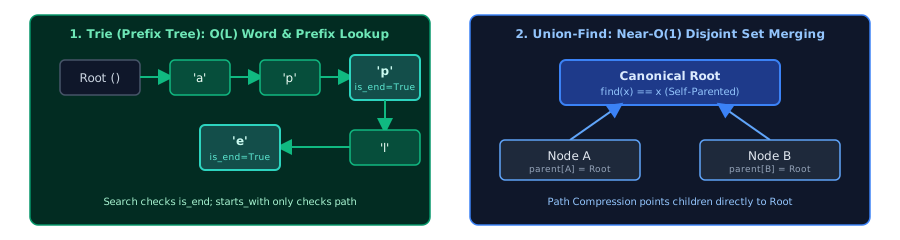
Trie: "A node's is_end flag, not its existence, is what says a word was stored here." Union-Find: "Two elements are connected exactly when find(a) == find(b). Nothing else in the structure means anything."
Trie: root-to-node path encodes common prefix; DSU: find(u) with path compression flattens tree so root is direct parent.
Trie: traverse word char-by-char in O(L); DSU: if find(u) != find(v): union(u, v) in O(alpha(N)).
The 8 Mental Models of Advanced Data Structures
Select the specialized data structure based on query semantics.
1Trie
strings / dictionary ➔ 26-ary tree of characters ➔ O(L) prefix searchTrie (Prefix Tree)
| 1 | from typing import Optional |
| 2 | |
| 3 | class TrieNode: |
| 4 | def __init__(self) -> None: |
| 5 | self.children: dict[str, "TrieNode"] = {} # One edge per next character |
| 6 | self.is_end = False # A whole word ends here |
| 7 | |
| 8 | class Trie: |
| 9 | """Implement Trie (Prefix Tree) with a shared _walk traversal helper. |
| 10 | Time: O(L) per operation, L = word length | Space: O(total characters) |
| 11 | """ |
| 12 | def __init__(self) -> None: |
| 13 | self.root = TrieNode() |
| 14 | |
| 15 | def _walk(self, s: str) -> Optional[TrieNode]: |
| 16 | node = self.root |
| 17 | |
| 18 | # 1. Follow One Edge Per Character: |
| 19 | # Moving to the matching child reconstructs the path s spells out one letter at a time. |
| 20 | # If a child is missing, no inserted word ever created this prefix, so the walk stops early. |
| 21 | for ch in s: |
| 22 | if ch not in node.children: |
| 23 | return None # Path breaks: no word has this prefix |
| 24 | node = node.children[ch] |
| 25 | return node |
| 26 | |
| 27 | def insert(self, word: str) -> None: |
| 28 | node = self.root |
| 29 | |
| 30 | # 1. Create Or Reuse One Edge Per Character: |
| 31 | # setdefault reuses the child already built by an earlier word that shares this prefix, |
| 32 | # and creates a new child only the first time a path through this character is needed. |
| 33 | for ch in word: |
| 34 | node = node.children.setdefault(ch, TrieNode()) # Create missing edges |
| 35 | node.is_end = True # Mark the end, or search() can't tell "app" from "apple" |
| 36 | |
| 37 | def search(self, word: str) -> bool: |
| 38 | node = self._walk(word) |
| 39 | return node is not None and node.is_end # Path exists AND a word ends here |
| 40 | |
| 41 | def startsWith(self, prefix: str) -> bool: |
| 42 | return self._walk(prefix) is not None # Any path is enough for a prefix |
Words that share a prefix share one path from root, so any prefix is found by walking one child per letter. insert creates missing children with setdefault and sets is_end on the last node; search and startsWith share _walk. This is correct because a path exists exactly when some inserted word has that prefix, and is_end marks exactly the nodes where a whole word stopped. The trap is skipping is_end in search: after inserting "apple", search("app") would return true.
Gotcha 1 of 5
- The trap
Gotcha 1: Returning
node is not NoneinsearchMistakereturn node is not NoneFixreturn node is not None and node.is_endWhat happens: Reaching a node only proves that some inserted word starts with
word. Afterinsert("apple"), the path for "app" exists. Onlynode.is_endsays that a whole word stopped at that node.Example: insert("apple"), then search("app")Mistake: returns TrueFix: returns False
2Union-Find
dynamic edges / sets ➔ find canonical root ➔ flatten tree & merge ranksUnion-Find (Disjoint Set Union)
| 1 | from typing import List |
| 2 | |
| 3 | class UnionFind: |
| 4 | """Union-Find with path compression and union by size, run on Redundant Connection. |
| 5 | Time: O(N · alpha(N)) for N edges, O(alpha(N)) amortized per call | Space: O(N) |
| 6 | """ |
| 7 | def __init__(self, n: int): |
| 8 | self.parent = list(range(n)) |
| 9 | self.size = [1] * n |
| 10 | self.num_components = n |
| 11 | |
| 12 | def find(self, x: int) -> int: |
| 13 | """Path compression: points traversed nodes directly to root.""" |
| 14 | root = x |
| 15 | |
| 16 | # 1. Walk Up To The Root: |
| 17 | # parent[root] == root only at the root, so climbing parent links from x always ends there. |
| 18 | while root != self.parent[root]: |
| 19 | root = self.parent[root] |
| 20 | |
| 21 | # 2. Compress The Path: |
| 22 | # Repointing every visited node straight at root shortens the next walk from any of them to one step. |
| 23 | while x != root: |
| 24 | nxt = self.parent[x] |
| 25 | self.parent[x] = root |
| 26 | x = nxt |
| 27 | |
| 28 | return root |
| 29 | |
| 30 | def union(self, a: int, b: int) -> bool: |
| 31 | """Union by size: hangs smaller tree under larger.""" |
| 32 | ra, rb = self.find(a), self.find(b) |
| 33 | |
| 34 | # 1. Detect An Already-Closed Group: |
| 35 | # Equal roots mean a and b were already connected before this edge, so this edge closes a cycle. |
| 36 | if ra == rb: |
| 37 | return False # Already connected / cycle detected! |
| 38 | |
| 39 | # 2. Hang The Smaller Tree Under The Larger: |
| 40 | # Attaching the smaller tree to the larger root keeps every tree's height small, which keeps find's walk short. |
| 41 | if self.size[ra] < self.size[rb]: |
| 42 | ra, rb = rb, ra |
| 43 | |
| 44 | self.parent[rb] = ra |
| 45 | self.size[ra] += self.size[rb] |
| 46 | self.num_components -= 1 |
| 47 | return True |
| 48 | |
| 49 | def findRedundantConnection(edges: List[List[int]]) -> List[int]: |
| 50 | uf = UnionFind(len(edges) + 1) # Nodes are numbered 1..n |
| 51 | |
| 52 | # 1. Union Each Edge, Stopping At The First Cycle: |
| 53 | # union returns False only when its two endpoints are already in the same group, which is exactly the edge that closes the first cycle. |
| 54 | for a, b in edges: |
| 55 | if not uf.union(a, b): |
| 56 | return [a, b] # a and b were already connected: this edge closes the cycle |
| 57 | return [] |
Name each group by the root of its tree: find follows parent links up to the root, and union joins two groups by pointing one root at the other. Two items are connected exactly when find returns the same root for both, so union returns False when ra == rb, which is how an edge that closes a cycle is detected. Path compression in find and hanging the smaller tree under the larger (size) keep every tree shallow. The trap is linking the items instead of their roots: always link rb under ra after both find calls, never self.parent[b] = a.
Gotcha 1 of 4
- The trap
Gotcha 1: Writing
self.parent[b] = ainstead of linking the rootsMistakeself.parent[b] = aFixself.parent[rb] = raWhat happens:
bmay not be a root. Thenself.parent[b] = amoves onlybinto the other group. The rest ofb's old group still points at its old root. A laterunionof the two groups finds two different roots and returns True. So the edge that closes the cycle is missed.Example: edges = [[1, 2], [3, 2], [1, 3]]Mistake: returns []Fix: returns [1, 3]
3LRU Cache
key-value storage ➔ hash map (O(1) lookup) + DLL (O(1) recency)LRU Cache (HashMap + Doubly Linked List)
O(1) lookups plus eviction by least recent use (or by frequency).| 1 | from typing import Optional |
| 2 | |
| 3 | class DLinkedNode: |
| 4 | def __init__(self, key: int = 0, val: int = 0) -> None: |
| 5 | self.key = key # Stored so eviction can delete the map entry |
| 6 | self.val = val |
| 7 | self.prev: Optional["DLinkedNode"] = None |
| 8 | self.next: Optional["DLinkedNode"] = None |
| 9 | |
| 10 | class LRUCache: |
| 11 | """LRU Cache: hash map for O(1) lookup + doubly-linked list for O(1) recency order. |
| 12 | Time: O(1) get and put | Space: O(capacity) |
| 13 | """ |
| 14 | def __init__(self, capacity: int) -> None: |
| 15 | self.cap = capacity |
| 16 | self.cache: dict[int, DLinkedNode] = {} |
| 17 | self.head = DLinkedNode() # Sentinel: most recent side |
| 18 | self.tail = DLinkedNode() # Sentinel: least recent side |
| 19 | self.head.next = self.tail |
| 20 | self.tail.prev = self.head |
| 21 | |
| 22 | def _remove(self, node: DLinkedNode) -> None: |
| 23 | node.prev.next = node.next # Unlink: sentinels mean no null checks |
| 24 | node.next.prev = node.prev |
| 25 | |
| 26 | def _add_to_head(self, node: DLinkedNode) -> None: |
| 27 | node.prev = self.head |
| 28 | node.next = self.head.next |
| 29 | self.head.next.prev = node |
| 30 | self.head.next = node |
| 31 | |
| 32 | def get(self, key: int) -> int: |
| 33 | # 1. Return A Miss, Or Promote The Found Node To Most Recently Used: |
| 34 | # A successful read counts as a use just like a write, so the node must move to the front |
| 35 | # before its value is returned; otherwise the node next to tail could stop being the least-recently-used one. |
| 36 | if key not in self.cache: |
| 37 | return -1 |
| 38 | node = self.cache[key] |
| 39 | self._remove(node) # A read counts as a use: |
| 40 | self._add_to_head(node) # move to the most recent position |
| 41 | return node.val |
| 42 | |
| 43 | def put(self, key: int, value: int) -> None: |
| 44 | # 1. Update In Place And Promote, Or Insert A New Node (Evicting If Full): |
| 45 | # An existing key keeps its map entry and only moves to the front; a brand-new key may first |
| 46 | # evict the node next to tail, which is always the least recently used because every use moves its node to the front. |
| 47 | if key in self.cache: |
| 48 | node = self.cache[key] |
| 49 | node.val = value # Update in place, then mark as most recent |
| 50 | self._remove(node) |
| 51 | self._add_to_head(node) |
| 52 | else: |
| 53 | if len(self.cache) >= self.cap: |
| 54 | lru = self.tail.prev # Least recently used sits next to the tail |
| 55 | self._remove(lru) |
| 56 | del self.cache[lru.key] |
| 57 | new_node = DLinkedNode(key, value) |
| 58 | self.cache[key] = new_node |
| 59 | self._add_to_head(new_node) |
The hash map finds any node instantly, and the doubly linked list keeps nodes in order of use: most recent next to head, least recent next to tail. This is correct because every get and every put moves its node to the front, so no node can sit behind one that was used less recently, and the node just before tail is always the least recently used; each node stores its key so evicting it can also del self.cache[lru.key]. The trap is put on a key that is already there: update node.val and move the node to the front, or it keeps its old place and is evicted too early; with capacity 2, put(1, 1), put(2, 2), put(1, 9), put(3, 3) must evict 2, not 1.
Gotcha 1 of 4
- The trap
Gotcha 1: Updating
node.valwithout moving the node to the frontMistakenode.val = valueFixnode.val = value self._remove(node) self._add_to_head(node)What happens:
puton a cached key is a use, likeget. Without the move, the node keeps its old place neartail. With capacity 2,put(1, 1),put(2, 2),put(1, 9)andput(3, 3)then evict key 1. Key 2 was used less recently, so key 2 must be evicted.Example: capacity = 2: put(1, 1), put(2, 2), put(1, 9), put(3, 3), then get(1) and get(2)Mistake: returns (-1, 2)Fix: returns (9, -1)
4Insert Delete GetRandom
values list + index map ➔ move the last value into the gap ➔ O(1) delete and uniform pickArray + Index Map (Swap-with-Last Delete)
O(1) on average.| 1 | import random |
| 2 | |
| 3 | |
| 4 | class RandomizedSet: |
| 5 | """Insert Delete GetRandom O(1): a gap-free list for the random pick, a map for each value's slot. |
| 6 | Time: O(1) average per call | Space: O(N) |
| 7 | """ |
| 8 | |
| 9 | def __init__(self) -> None: |
| 10 | self.values: list[int] = [] # Every value once, no gaps: random.choice is uniform |
| 11 | self.index: dict[int, int] = {} # value -> its slot in self.values |
| 12 | |
| 13 | def insert(self, val: int) -> bool: |
| 14 | # 1. Reject A Duplicate, Else Append At The Next Free Slot: |
| 15 | # The list is always gap-free, so its current length is exactly the slot the new value will occupy. |
| 16 | if val in self.index: |
| 17 | return False |
| 18 | self.index[val] = len(self.values) # The next free slot is the end |
| 19 | self.values.append(val) |
| 20 | return True |
| 21 | |
| 22 | def remove(self, val: int) -> bool: |
| 23 | # 1. Fill val's Slot With The Last Value, Then Drop The Last Slot: |
| 24 | # A set has no order, so moving the last value into the freed slot keeps the list gap-free |
| 25 | # without shifting anything; the moved value's own map entry must be fixed before val's entry is deleted. |
| 26 | if val not in self.index: |
| 27 | return False |
| 28 | i = self.index[val] |
| 29 | last = self.values[-1] |
| 30 | self.values[i] = last # Fill the hole with the last value |
| 31 | self.index[last] = i # Update the moved value's slot first... |
| 32 | del self.index[val] # ...then delete: right even when last == val |
| 33 | self.values.pop() # The last slot is now a copy: drop it in O(1) |
| 34 | return True |
| 35 | |
| 36 | def getRandom(self) -> int: |
| 37 | return random.choice(self.values) # One slot per value: each has a 1-in-n chance |
A pick where every value is equally likely needs the values packed in a list, random.choice(self.values), and a list can only drop its last slot without shifting the rest, so remove fills the hole with the last value instead of shifting: self.values[i] = last, then self.values.pop(). A set has no order, so moving one value changes nothing a caller can see, and self.index finds i with one lookup; the list stays gap-free, so every value keeps exactly one slot and the same 1-in-n chance. The trap is the order of the two map writes: self.index[last] = i must come before del self.index[val]. When val is itself the last value, last == val, and deleting first writes val straight back into the map at a slot that pop() removes, so a later insert(val) returns False.
Gotcha 1 of 3
- The trap
Gotcha 1: Deleting
self.index[val]before writingself.index[last]Mistakedel self.index[val] self.index[last] = iFixself.index[last] = i del self.index[val]What happens: When
valis the last value,last == val. Deleting first removesval, thenself.index[last] = iwrites it back.pop()removes the slot, but the map still says thatvalis present. A laterinsert(val)then returns False.Example: insert(1), remove(1), then insert(1)Mistake: returns FalseFix: returns True
5Fenwick Tree
array ➔ isolate lowbit = x & (-x) ➔ O(log N) prefix query & updateFenwick Tree (Binary Indexed Tree)
| 1 | class FenwickTree: |
| 2 | """Binary Indexed Tree (Fenwick Tree) for 1-indexed range sums. |
| 3 | Time: O(log N) update & query | Space: O(N) |
| 4 | """ |
| 5 | def __init__(self, n: int): |
| 6 | self.n = n |
| 7 | self.tree = [0] * (n + 1) |
| 8 | |
| 9 | def update(self, i: int, delta: int) -> None: |
| 10 | """Add delta to index i (1-indexed).""" |
| 11 | # 1. Walk Up, Fixing Every Block That Covers i: |
| 12 | # Adding the lowest set bit jumps from i to the next larger block that still contains it, |
| 13 | # so this visits exactly the blocks whose stored sum needs delta added. |
| 14 | while i <= self.n: |
| 15 | self.tree[i] += delta |
| 16 | i += i & (-i) # Step up to parent covering range |
| 17 | |
| 18 | def query(self, i: int) -> int: |
| 19 | """Sum elements from 1 to i (1-indexed).""" |
| 20 | total = 0 |
| 21 | |
| 22 | # 1. Walk Down, Adding Disjoint Blocks: |
| 23 | # Removing the lowest set bit jumps to just before the block tree[i] covers, so each block |
| 24 | # added is disjoint from the ones before it, and together they cover exactly 1..i once. |
| 25 | while i > 0: |
| 26 | total += self.tree[i] |
| 27 | i -= i & (-i) # Step down to next disjoint prefix |
| 28 | return total |
| 29 | |
| 30 | def range_query(self, left: int, right: int) -> int: |
| 31 | """Sum in range [left, right] inclusive.""" |
| 32 | return self.query(right) - self.query(left - 1) |
| 33 | |
| 34 | |
| 35 | class NumArray: |
| 36 | """Range Sum Query - Mutable: keep the values, send each change to the Fenwick tree.""" |
| 37 | def __init__(self, nums: list[int]): |
| 38 | self.nums = list(nums) |
| 39 | self.fenwick = FenwickTree(len(nums)) |
| 40 | |
| 41 | # 1. Seed The Tree With Every Starting Value: |
| 42 | # Each 0-based position lives one slot higher in the 1-indexed tree, so index + 1 is its i. |
| 43 | for index, val in enumerate(nums): |
| 44 | self.fenwick.update(index + 1, val) # Position index lives at i = index + 1 |
| 45 | |
| 46 | def update(self, index: int, val: int) -> None: |
| 47 | self.fenwick.update(index + 1, val - self.nums[index]) # Add the change, not the new value |
| 48 | self.nums[index] = val |
| 49 | |
| 50 | def sumRange(self, left: int, right: int) -> int: |
| 51 | return self.fenwick.range_query(left + 1, right + 1) |
Let tree[i] hold the sum of the block of i & (-i) values that ends at position i: query adds whole blocks while i -= i & (-i) walks down, and update fixes every block that contains i while i += i & (-i) walks up. Removing the lowest set bit jumps to just before the block tree[i] covers, so the blocks query visits never overlap and together cover exactly 1..i; adding it lands on the next larger block that also contains i. The trap is index 0: the tree is 1-indexed, and i & (-i) is 0 when i is 0, so update(0, ...) never moves and loops forever; shift every position up by one.
Gotcha 1 of 5
- The trap
Gotcha 1: Calling
update(index, val)with a 0-basedindexMistakeself.fenwick.update(index, val)Fixself.fenwick.update(index + 1, val)What happens: The tree is 1-indexed. For
i = 0,i & (-i)is 0, soi += i & (-i)leavesiat 0. The loopwhile i <= self.nthen never ends. Shift every position up by one, sonums[index]lives ati = index + 1.Example: nums = [1, 3, 5], then sumRange(0, 2)Mistake: the loop never endsFix: returns 9
6Ordered Set
sorted keys ➔ bisect position ➔ floor and ceiling neighboursOrdered Set (Floor/Ceiling Lookups)
| 1 | import bisect |
| 2 | |
| 3 | |
| 4 | class MyCalendar: |
| 5 | """My Calendar I: keep booked events sorted by start; a new event can only clash with its two neighbours. |
| 6 | Time: O(log N) search + O(N) insert per book, N = bookings so far | Space: O(N) |
| 7 | """ |
| 8 | def __init__(self) -> None: |
| 9 | self.starts: list[int] = [] # Start times of booked events, kept sorted |
| 10 | self.ends: list[int] = [] # ends[j] is the end of the event that starts at starts[j] |
| 11 | |
| 12 | def book(self, startTime: int, endTime: int) -> bool: |
| 13 | i = bisect.bisect_right(self.starts, startTime) # Events before i start at or before startTime |
| 14 | |
| 15 | # 1. Reject An Overlap With Either Neighbour, Else Insert Between Them: |
| 16 | # The floor and ceiling are the only stored events that could possibly overlap the new one, |
| 17 | # since every other event sits sorted further away; both half-open checks must stay strict. |
| 18 | if i > 0 and self.ends[i - 1] > startTime: |
| 19 | return False # Floor neighbour is still running at startTime |
| 20 | if i < len(self.starts) and self.starts[i] < endTime: |
| 21 | return False # Ceiling neighbour starts before endTime |
| 22 | self.starts.insert(i, startTime) # Insert in place: starts stays sorted |
| 23 | self.ends.insert(i, endTime) |
| 24 | return True |
Keep the stored keys sorted however they arrive, so one bisect_right finds both neighbours of a new value: the floor at i - 1 and the ceiling at i. For a calendar that is all you need: stored events never overlap, so sorted by start they are sorted by end too, and every other event either ends before the floor starts or starts after the ceiling. A new event fits exactly when the floor has ended by startTime and the ceiling starts no earlier than endTime; then it is inserted at i in both starts and ends. The trap is the half-open ends: the checks are self.ends[i - 1] > startTime and self.starts[i] < endTime, strict, because an event ending at 20 and one starting at 20 share no moment.
Gotcha 1 of 5
- The trap
Gotcha 1: Writing
>=instead of>in the floor checkMistakeif i > 0 and self.ends[i - 1] >= startTime:Fixif i > 0 and self.ends[i - 1] > startTime:What happens: Events are half-open, so
[10, 20)and[20, 30)share no moment. With>=, an event that ends at 20 blocks one that starts at 20. The ceiling checkself.starts[i] < endTimemust stay strict for the same reason.Example: book(10, 20), then book(20, 30)Mistake: returns FalseFix: returns True
7Merge Sort Counting
pairs i < j ➔ count across two sorted halves ➔ mergeMerge Sort Counting (Reverse Pairs, Count of Range Sum)
i < j whose values satisfy a comparison (an earlier value bigger than a later one, more than twice it, or a difference within a range), and checking every pair is too slow.| 1 | def reverse_pairs(nums: list[int]) -> int: |
| 2 | """Reverse Pairs: count the pairs that cross the middle while both halves are sorted, then merge. |
| 3 | Time: O(N log N) | Space: O(N) |
| 4 | """ |
| 5 | def sort_count(lo: int, hi: int) -> int: |
| 6 | # 1. Handle One Value, Then Count Each Half On Its Own: |
| 7 | # A range of one value holds no pair; otherwise the recursive calls count every pair |
| 8 | # that does not cross this range's middle, and hand back two sorted halves. |
| 9 | if hi - lo <= 1: |
| 10 | return 0 |
| 11 | mid = (lo + hi) // 2 |
| 12 | count = sort_count(lo, mid) + sort_count(mid, hi) |
| 13 | |
| 14 | # 2. Count The Pairs That Cross The Middle, While Both Halves Are Still Sorted: |
| 15 | # nums[i] only grows as i moves through the sorted left half, so the right values |
| 16 | # that pair with it, nums[mid:j], can only grow too; j never has to move back. |
| 17 | j = mid |
| 18 | for i in range(lo, mid): |
| 19 | while j < hi and nums[i] > 2 * nums[j]: |
| 20 | j += 1 |
| 21 | count += j - mid |
| 22 | |
| 23 | # 3. Merge The Two Sorted Halves, Now That Counting Is Done: |
| 24 | # The merge moves by plain order, nums[a] <= nums[b], not by the pair's own test, so |
| 25 | # counting must happen first, in its own pass; merging afterwards hands the parent a |
| 26 | # sorted range. |
| 27 | merged: list[int] = [] |
| 28 | a, b = lo, mid |
| 29 | while a < mid and b < hi: |
| 30 | if nums[a] <= nums[b]: |
| 31 | merged.append(nums[a]) |
| 32 | a += 1 |
| 33 | else: |
| 34 | merged.append(nums[b]) |
| 35 | b += 1 |
| 36 | merged.extend(nums[a:mid]) |
| 37 | merged.extend(nums[b:hi]) |
| 38 | nums[lo:hi] = merged |
| 39 | return count |
| 40 | |
| 41 | return sort_count(0, len(nums)) |
Every pair i < j either sits inside one half of the range or crosses its middle, so let the recursive calls count the pairs inside each half and count only the crossing pairs yourself, at the moment both halves come back sorted. Sorted halves are what make that fast: the right values that pair with nums[i] form a prefix nums[mid:j] of the right half, and as nums[i] grows through the sorted left half that prefix only grows, so one pointer j that never moves back counts all of them with count += j - mid; merging afterwards hands the parent a sorted range, which keeps the argument true one level up. The trap is counting inside the merge loop, the way inversions are counted: the merge moves by nums[a] <= nums[b], not by the pair's own test nums[i] > 2 * nums[j], so on [3,5,2,1] it misses 5 > 2 * 2 and returns 2 instead of 3. Count in a separate pass, then merge.
Gotcha 1 of 5
- The trap
Gotcha 1: Counting pairs inside the merge loop
Mistakeelse: if nums[a] > 2 * nums[b]: count += mid - a merged.append(nums[b]) b += 1Fixj = mid for i in range(lo, mid): while j < hi and nums[i] > 2 * nums[j]: j += 1 count += j - midWhat happens: The merge moves
aandbby the testnums[a] <= nums[b]. The pair test is a different one,nums[i] > 2 * nums[j]. So the merge can move past a right value before it is tested against the larger left values. The separate pass tests every left value with its own pointerj.Example: nums = [3, 5, 2, 1]Mistake: returns 2Fix: returns 3
8Segment Tree
array ➔ binary tree of range sums ➔ O(log N) point update & range sumSegment Tree (Range Sums With Point Updates)
| 1 | class SegmentTree: |
| 2 | """Sum Segment Tree with Point Updates. |
| 3 | Node i covers [left, right]; its children are 2i+1 (left half) and 2i+2 (right half). |
| 4 | Time: O(N) build, O(log N) query & update | Space: O(N) |
| 5 | """ |
| 6 | def __init__(self, nums: list[int]) -> None: |
| 7 | self.n = len(nums) |
| 8 | self.tree = [0] * (4 * self.n) # tree[node] is the sum of the slots node covers; 4n is always enough room |
| 9 | self._build(nums, 0, 0, self.n - 1) |
| 10 | |
| 11 | def _build(self, nums: list[int], node: int, left: int, right: int) -> None: |
| 12 | # 1. Fill A Leaf With Its One Element, Else Build Both Halves First: |
| 13 | # A node's sum is the sum of its two halves, so both children must be built before this node can combine them. |
| 14 | if left == right: |
| 15 | self.tree[node] = nums[left] # Leaf: one array element |
| 16 | return |
| 17 | mid = (left + right) // 2 |
| 18 | self._build(nums, 2 * node + 1, left, mid) |
| 19 | self._build(nums, 2 * node + 2, mid + 1, right) |
| 20 | self.tree[node] = self.tree[2 * node + 1] + self.tree[2 * node + 2] # Combine the two halves |
| 21 | |
| 22 | def update(self, index: int, val: int, node: int = 0, left: int = 0, right: int = -1) -> None: |
| 23 | # 1. Default The Range, Then Stop At The Leaf For index: |
| 24 | # The first call omits left/right, so they default here; once left == right only one |
| 25 | # slot is left in the range, and that slot is index, so the leaf's own value is set. |
| 26 | if right == -1: |
| 27 | right = self.n - 1 # Default: start at the whole range |
| 28 | if left == right: |
| 29 | self.tree[node] = val # Reached the leaf for index |
| 30 | return |
| 31 | |
| 32 | # 2. Recurse Into The Half That Contains index, Then Recompute On The Way Up: |
| 33 | # index lies in exactly one half, so only one child is visited; recomputing this node's |
| 34 | # sum from both children afterward keeps every ancestor's stored sum in sync with the new leaf. |
| 35 | mid = (left + right) // 2 |
| 36 | if index <= mid: |
| 37 | self.update(index, val, 2 * node + 1, left, mid) # Go left |
| 38 | else: |
| 39 | self.update(index, val, 2 * node + 2, mid + 1, right) # Go right |
| 40 | self.tree[node] = self.tree[2 * node + 1] + self.tree[2 * node + 2] # Recompute on the way up |
| 41 | |
| 42 | def query(self, ql: int, qr: int, node: int = 0, left: int = 0, right: int = -1) -> int: |
| 43 | # 1. Default The Range, Then Resolve Full Overlap Or No Overlap: |
| 44 | # A node fully inside [ql, qr] can answer from its own stored sum; a node fully outside |
| 45 | # contributes 0, since it holds none of the requested slots. |
| 46 | if right == -1: |
| 47 | right = self.n - 1 |
| 48 | if ql <= left and right <= qr: |
| 49 | return self.tree[node] # Fully inside the query: use the stored sum |
| 50 | if right < ql or left > qr: |
| 51 | return 0 # Fully outside: contributes nothing |
| 52 | |
| 53 | # 2. Split On Partial Overlap And Add Both Halves: |
| 54 | # Neither child's range is fully inside or outside, so both are queried and their sums are added. |
| 55 | mid = (left + right) // 2 # Partial overlap: split into both halves |
| 56 | return (self.query(ql, qr, 2 * node + 1, left, mid) + |
| 57 | self.query(ql, qr, 2 * node + 2, mid + 1, right)) |
| 58 | |
| 59 | |
| 60 | class NumArray: |
| 61 | """Range Sum Query - Mutable: every call goes straight to the segment tree.""" |
| 62 | def __init__(self, nums: list[int]): |
| 63 | self.seg = SegmentTree(nums) |
| 64 | |
| 65 | def update(self, index: int, val: int) -> None: |
| 66 | self.seg.update(index, val) # The leaf is overwritten with val, then its ancestors recomputed |
| 67 | |
| 68 | def sumRange(self, left: int, right: int) -> int: |
| 69 | return self.seg.query(left, right) |
Node node stores the sum of the slots left..right it covers, and its children 2 * node + 1 and 2 * node + 2 store the sums of the two halves. So update sets one leaf and, on the way back up, rebuilds each ancestor's sum from its two children. query(ql, qr) splits the range the same way: a node fully inside [ql, qr] returns its stored self.tree[node], a node fully outside returns 0, and a node that overlaps only part of the range adds the answers of both children. At most two nodes per level overlap only part of the range, so every update and query stays on a few nodes per level. The trap is the last line of update, self.tree[node] = self.tree[2 * node + 1] + self.tree[2 * node + 2]. If it is missing, the leaf changes but every ancestor keeps its old sum, and a later query that returns a stored self.tree[node] reads that old sum.
Gotcha 1 of 5
- The trap
Gotcha 1: Changing the leaf but not recomputing its ancestors
Mistakeelse: self.update(index, val, 2 * node + 2, mid + 1, right)Fixelse: self.update(index, val, 2 * node + 2, mid + 1, right) self.tree[node] = self.tree[2 * node + 1] + self.tree[2 * node + 2]What happens:
updatechanges the leaf forindex, then returns up the recursion. Each node on the way holds the sum of its range. Without the lineself.tree[node] = ..., those nodes keep their old sum. A laterquerythat fully covers such a node returns its storedself.tree[node]and misses the new value. Fornums = [1, 3, 5], the root keeps9afterupdate(1, 2), although the sum is now8.Example: nums = [1, 3, 5], update(1, 2), then sumRange(0, 2)Mistake: returns 9Fix: returns 8
Built on the mental models above
- Max Segment TreeMax Segment Tree (Range Maximum Query)
Each node keeps the maximum instead of the sum, so an update writes max(...) and a query takes max over the covered nodes.
The Advanced Data Structures Decision Rule
When facing an unseen system design or data structure problem, ask in this order:
Build Trie and descend character by character in O(L) time.
Maintain parent and rank arrays in O(alpha(N)).
Implement 1-indexed BIT using lowbit = i & -i.
Each node stores its segment's aggregate (here the sum of its slots); updates and queries touch O(log N) nodes, with lazy tags for range updates.
Store the maximum in every node of a segment tree; an update recomputes the maximum of each ancestor, and a query takes the maximum over the covered nodes.
Keep the keys sorted (SortedList) and bisect for the floor and the ceiling in O(log N).
Pair a Hash Map with a Doubly-Linked List with sentinel head/tail.
Store values in a list plus a value-to-index map; remove by moving the last value into the gap and popping.
Sort with merge sort, and count the pairs between the two sorted halves just before each merge, in O(N log N).
Pattern Architecture & Invariant Design Masterclass
This pattern is different from the others in the curriculum. It is not a way of walking data — it is a pair of purpose-built containers you construct when the plain ones cannot answer the question fast enough. The skill being tested is recognising which query shape demands which structure, and being able to build it from nothing.
A Trie (prefix tree) stores words as paths down a tree, one character per edge. Every word sharing a prefix shares that part of the path. Looking up a word costs time proportional to the length of the word — completely independent of how many words are stored. A million words or ten, "apple" takes five steps.
The one subtlety, and it is the whole interview question: a path existing does not mean a word was stored. After inserting
"apple", the path for"app"exists — it is a stretch of"apple"'s path. Every node therefore needs a boolean flag marking "a word ends exactly here." Searching checks the flag; prefix-matching does not. Getting that distinction wrong is the classic Trie bug.
Union-Find (Disjoint Set Union) answers one question fast: "are these two things in the same group?" — while groups keep merging. Each element points at a parent; following parents leads to a group's representative. Two elements are in the same group when they reach the same representative. Merging two groups is one pointer change.
The one subtlety: naively, the parent chains grow into long lists and every query walks them, degrading to
O(n). Two small fixes — path compression (re-point every node you pass directly at the root) and union by size (always hang the smaller tree under the larger) — make every operation effectively constant time.
🔬 Variable Anatomy: The 7 Variables Every Trie & Union-Find Uses
To connect abstract specialized tree structures with concrete Python syntax, here is the universal code anatomy showing what every variable does:
# =============================================================================# 1. TRIE MASTER STRUCTURE# =============================================================================class TrieNode: def __init__(self): self.children = {} # 🔤 Outgoing Character Edges: char -> TrieNode self.is_end = False # 🚩 Terminal Word Flag: True ONLY on final char of stored word class TrieMasterTemplate: def __init__(self): self.root = TrieNode() # ⚓ Empty Prefix Root Anchor def insert(self, word: str) -> None: curr = self.root for ch in word: if ch not in curr.children: curr.children[ch] = TrieNode() curr = curr.children[ch] curr.is_end = True # ⚠️ Set True strictly on the terminal node def search(self, word: str) -> bool: curr = self.root for ch in word: if ch not in curr.children: return False curr = curr.children[ch] return curr.is_end # ⚠️ Requires is_end == True def startsWith(self, prefix: str) -> bool: curr = self.root for ch in prefix: if ch not in curr.children: return False curr = curr.children[ch] return True # ⚠️ Prefix existence is sufficient # =============================================================================# 2. DISJOINT SET UNION (UNION-FIND) MASTER STRUCTURE# =============================================================================class UnionFindMasterTemplate: def __init__(self, size: int): self.parent = list(range(size)) # 🔗 Representative Parent Pointers self.rank = [1] * size # 🌲 Component Tree Size / Rank self.num_components = size # 🔢 Total Disjoint Components def find(self, x: int) -> int: # Path Compression: flatten traversal path directly to root root = x while root != self.parent[root]: root = self.parent[root] curr = x while curr != root: nxt = self.parent[curr] self.parent[curr] = root # ⚡ Point directly to canonical root curr = nxt return root def union(self, a: int, b: int) -> bool: ra, rb = self.find(a), self.find(b) if ra == rb: return False # 🚫 Already connected (Cycle detected!) # Union by Rank / Size: hang smaller tree under larger root if self.rank[ra] < self.rank[rb]: ra, rb = rb, ra self.parent[rb] = ra self.rank[ra] += self.rank[rb] self.num_components -= 1 return True Variable Role Reference:
| Variable | Role in Code | Question It Answers | ❌ What Happens If Omitted or Mismanaged? |
|---|---|---|---|
root | TrieNode anchor | "Where does prefix exploration begin?" | ❌ Storing characters on root confuses empty prefix "" with 1-character words. |
children | dict[str, TrieNode] | "Does an edge exist for the next character in this prefix?" | ❌ Using fixed 26-element arrays crashes on uppercase or non-ASCII characters without index mapping. |
is_end | Boolean flag | "Did a stored word terminate at this node, or is it merely a prefix?" | ❌ If search returns True without checking is_end, search("app") returns True after only inserting "apple". |
parent | list[int] | "Who is the immediate ancestor / canonical representative of node ?" | ❌ Comparing parent[a] == parent[b] instead of find(a) == find(b) fails on deep unflattened trees. |
rank / size | list[int] | "Which tree has larger depth/size to serve as root during union?" | ❌ Without union-by-rank, parent chains degenerate into linked lists. |
num_components | Integer count | "How many independent connected clusters remain after dynamic edges?" | ❌ Without decrementing on valid unions, calculating active components requires an scan. |
lowbit | i & (-i) | "What is the step size for Fenwick tree navigation?" | ❌ In Binary Indexed Trees, calculating lowbit without two's complement requires loop searches. |
🧠 The Universal Contracts of Advanced Containers:
- Trie Invariant: Word length , not dataset size , dictates latency. Insertion and search are strictly .
- Union-Find Invariant: With both Path Compression and Union-by-Rank, the amortized cost per operation is (inverse Ackermann function for all physical universe inputs).
🌟 The 3 Dimensions of Advanced Data Structures & Structural Invariants
Every Advanced Data Structure is governed by 3 Key Dimensions:
┌─────────────────────────────────────────────────────────────────────────────┐│ THE 3 DIMENSIONS OF ADVANCED DATA STRUCTURES │├───────────────────┬───────────────────────────────────┬─────────────────────┤│ Dimension │ Mechanism in Code │ Question It Answers │├───────────────────┼───────────────────────────────────┼─────────────────────┤│ 1. TARGET DOMAIN │ Character paths (Trie) vs │ "Are we indexing ││ SPECIALIZATION │ Equivalence partitions (DSU) │ prefixes or sets?" │├───────────────────┼───────────────────────────────────┼─────────────────────┤│ 2. LATENCY BOUND │ O(L) per word (Trie) vs │ "How does runtime ││ INVARIANT │ O(alpha(N)) amortized (DSU) │ scale with input?" │├───────────────────┼───────────────────────────────────┼─────────────────────┤│ 3. STRUCTURAL │ Node flag separation (`is_end`) vs│ "How do we compress ││ COMPRESSION │ In-place pointer flattening │ path traversal?" │└───────────────────┴───────────────────────────────────┴─────────────────────┘ How this plays out in actual problems:
🟢 Scenario A: Prefix Searching & Autocomplete (Trie)
- When querying millions of words for common prefixes, hashing every prefix consumes memory.
- The Rule: Build a 26-ary character tree. Descend one character edge per step. Prefix lookup stops when characters survive; word search requires
curr.is_end == True. - The Result: exact and prefix searches independent of dictionary volume.
🔵 Scenario B: Dynamic Connectivity & Undirected Cycle Detection (Union-Find)
- When edges arrive incrementally in a graph, running DFS/BFS to check connectivity after each edge takes .
- The Rule: Initialize
parent[i] = i. For edge , computera, rb = find(u), find(v). Ifra == rb, a cycle exists! Otherwise merge withunion(u, v). - The Result: Near-instant connectivity verification per edge.
💡 The Ultimate Takeaway Decision Rule:
When analyzing an unseen data structure problem, ask: "Is this a string prefix problem, or an incremental set-merging problem?"
- If Prefix matching / Autocomplete / Word Boggle ➔ Build a Trie ( query).
- If Dynamic connected components / Redundant connections ➔ Build Union-Find with Path Compression ().
- If Frequent prefix sum point updates ➔ Build a Fenwick Tree / BIT ().
🎯 The 5 Essential Advanced Data Structures Paradigms & Archetypes
┌──────────────────────────────────────────────────────────────────────────────────────────────────────────────────┐│ THE 5 CORE ADVANCED DATA STRUCTURE ARCHETYPES │├────────────────────────┬──────────────────────┬───────────────────────────────┬──────────────────────────────────┤│ Archetype │ Container Mechanism │ Invariant / Structural Rule │ Target Problems & Complexity │├────────────────────────┼──────────────────────┼───────────────────────────────┼──────────────────────────────────┤│ 1. Trie Prefix Tree │ 26-ary character tree│ `is_end` required for search; │ Implement Trie (LC 208), Add & ││ (LC 208 / LC 211) │ with `is_end` flag │ prefix only checks traversal │ Search Words (LC 211) — O(L) │├────────────────────────┼──────────────────────┼───────────────────────────────┼──────────────────────────────────┤│ 2. Trie + 2D Matrix │ Trie coupled with │ Prune grid branches when Trie │ Word Search II (LC 212) — ││ (LC 212) │ in-place DFS marking │ node child is missing │ O(R * C * 4^L) with fast pruning │├────────────────────────┼──────────────────────┼───────────────────────────────┼──────────────────────────────────┤│ 3. DSU Cycle Detection │ Disjoint Set Union │ Edge redundant iff roots match│ Redundant Connection (LC 684) — ││ (LC 684 / LC 547) │ with Path Compression│ `find(u) == find(v)` │ O(E * alpha(V)) │├────────────────────────┼──────────────────────┼───────────────────────────────┼──────────────────────────────────┤│ 4. Equivalence Sets │ DSU on mapped indices│ Connect distinct attributes to│ Accounts Merge (LC 721), Min ││ (LC 721 / LC 1584) │ (email -> account id)│ single representative owner │ Cost Connect Points (LC 1584) │├────────────────────────┼──────────────────────┼───────────────────────────────┼──────────────────────────────────┤│ 5. Fenwick Tree / BIT │ 1-indexed array with │ `lowbit = i & -i` steps parent│ Range Sum Query Mutable (LC 307) ││ (LC 307 / LC 315) │ lowbit index jumps │ prefix sums and point updates │ — O(log N) update and query │└────────────────────────┴──────────────────────┴───────────────────────────────┴──────────────────────────────────┘ 🌲 1. Trie: Word Insertion and Verification (LC 208)
- Mental Model: A Trie routes character sequences down shared trunk prefixes.
- Code Blueprint:
class TrieNode: def __init__(self): self.children = {} self.is_end = False class Trie: def __init__(self): self.root = TrieNode() def _walk(self, s: str): curr = self.root for ch in s: if ch not in curr.children: return None curr = curr.children[ch] return curr def insert(self, word: str) -> None: curr = self.root for ch in word: if ch not in curr.children: curr.children[ch] = TrieNode() curr = curr.children[ch] curr.is_end = True def search(self, word: str) -> bool: node = self._walk(word) return node is not None and node.is_end def startsWith(self, prefix: str) -> bool: return self._walk(prefix) is not None 🔍 2. Trie + 2D Matrix Search (LC 212 — Word Search II)
- Mental Model: Loading words into a Trie allows exploring a 2D board once while searching for thousands of dictionary words simultaneously.
- Pruning Invariant: If the current grid path character does not exist in the active Trie node's children, backtrack immediately without exploring 4-way neighbors.
🔗 3. Union-Find: Cycle Detection in Redundant Connections (LC 684)
- Mental Model: Two vertices and are already connected if they share the same representative. An extra edge between them creates an undirected cycle.
- Code Blueprint:
def findRedundantConnection(edges: list[list[int]]) -> list[int]: n = len(edges) parent = list(range(n + 1)) rank = [1] * (n + 1) def find(x: int) -> int: if parent[x] != x: parent[x] = find(parent[x]) # Path compression return parent[x] for u, v in edges: ru, rv = find(u), find(v) if ru == rv: return [u, v] # Cycle detected! # Union-by-rank: attach shallower tree under deeper tree if rank[ru] < rank[rv]: ru, rv = rv, ru parent[rv] = ru if rank[ru] == rank[rv]: rank[ru] += 1 return [] 📧 4. Equivalence Grouping (LC 721 — Accounts Merge)
- Mental Model: Map every unique email to an integer identifier, union emails belonging to the same user account, and group all emails sharing the same root representative.
📈 5. Binary Indexed Tree / Fenwick Tree (LC 307)
- Mental Model: Uses the binary representation of integers to store cumulative frequency intervals, enabling point updates and prefix sums in time.
🌳 Evaluating Trie and DSU State & Space Invariants
Designing advanced custom containers requires understanding memory and pointer structures:
1. Trie Node Space vs Dictionary Allocations
- Python dictionaries (
children = {}) dynamically allocate space only for edges that exist, which is much more memory efficient than pre-allocating size-26 lists on sparse alphabets. - To prevent memory leaks in large grid searches, prune leaf nodes from the Trie when their words are found.
2. Union-Find 1-Indexing and Iterative Traversal
- Many graph problems use 1-indexed vertex IDs. Always allocate
parent = list(range(n + 1))to avoid index out-of-range errors. - Prefer iterative path compression or single-pass path splitting over deep recursive
find()calls on long degenerate chains.
💡 Staff SWE Architectural Invariant:
Choose Trie when the query space is bounded by character prefix lengths (), and choose Disjoint Set Union when the problem involves dynamic equivalence clustering or cycle detection in undirected graphs ().
Understanding Invariants: Prefix Tree Termination & Disjoint Set Path Compression
A Trie node's is_end flag, not its path existence, determines if a word was stored. In Union-Find, two elements are connected if and only if find(a) == find(b).
Trie nodes encode shared prefixes along paths down a tree; Union-Find flattens parent pointers on traversal via path compression and balances heights with union-by-rank to achieve near O(1) amortized operations.
A prefix path exists for any substring of an inserted word, but is_end == True only for words explicitly added.
Adding an edge between two vertices that already share the same canonical representative creates a cycle.
Common Questions
"If I can walk the whole word without falling off the Trie, doesn't that mean the word must be stored? Why do we need a separate is_end flag at all?"
Because a path existing and a word being stored are two different facts, and a Trie's whole efficiency comes from sharing paths between words that were never themselves inserted.
Trace it concretely: insert only
"apple"into an empty Trie. The patha → p → p → l → enow exists. But the patha → p → p— spelling"app"— also exists, purely as a byproduct of walking through"apple"'s own path. Ifsearch("app")reused the "did I fall off the tree" test thatstartsWithcorrectly uses, it would answerTruefor"app", even though"app"was never inserted on its own.The only fact that distinguishes "this node happens to lie on someone else's path" from "a word was deliberately stored ending exactly here" is a flag set at insert-time on that exact node, and checked at query-time on that exact node — nothing about the tree's shape encodes it, because sharing that shape between related words is the entire reason a Trie is cheap in the first place. That's why
searchispath exists AND is_end, whilestartsWithispath existsalone:startsWith("app")is legitimately asking "is there anything below this point," which mere path existence answers correctly, whilesearch("app")asks the strictly stronger question "does a word end at this exact point," which only the flag can answer.
Coach discussion points
- 1.
"I inserted only
'apple'. Tell me whatsearch('app')andstartsWith('app')return, and explain why they differ when they walk to the same node." — The single highest-signal Trie question. A student who has genuinely built one answers instantly; one who has copied a template hesitates. - 2.
"When is a hash set better than your Trie, and when is it useless?" — Tests whether the structure was chosen or reached for. The honest answer names the prefix query as the dividing line, and the construction cost as the price.
- 3.
"You wrote path compression. Suppose I delete it — what still works, and what stops working?" — Everything still works; it just gets slow, and only on large inputs. Distinguishing correctness bugs from performance bugs is a genuinely senior skill.
- 4.
"Your
unionreturnsFalsesometimes. What does the caller do with that, and what other problem does it solve?" — Cycle detection. Follow-up: "could you use this on a directed graph?" — No, and knowing why (DSU has no notion of edge direction) is the boundary-of-the-tool signal. - 5.
"In Number of Islands II, why does a successful
union()decrement the count, when in Redundant Connection a successful cycle check isunion()returningFalse?" — Because the two problems ask opposite questions of the same primitive: Redundant Connection asks "did this edge create a redundant connection?" (answered by union() returning False), while Number of Islands II asks "did this operation productively merge two components?" (answered by union() returning True). A student who can articulate this duality has genuinely internalized DSU rather than memorized two separate templates. - 6.
"Why can't you just reuse your LRU Cache's hash map + doubly-linked list for LFU, adding a
freqfield to each node?" — Because a single linked list can only maintain one total order. The moment two keys have different frequencies but you need both "which frequency is lowest" and "which key is oldest within that frequency," one list can't express two independent orderings at once. That's exactly why LFU needs a second hash map (freq -> bucket), not just an extra field. - 7.
"Your
min_freqpointer only ever increments, never decrements after aget. Walk me through exactly when it does change, and prove it's never stale." — It changes only when the bucket it currently points at becomes empty (advances by exactly 1, since frequencies increase by exactly 1 per access) or when a brand-new key is inserted (reset to 1, since a fresh key is trivially the new minimum). Proving it's never stale means showing no other code path can leavemin_freqpointing at a bucket that no longer exists. - 8.
**"All O
one needs both a max and a min in O(1). Why doesn't LFU Cache need the same trick for itsmin_freq-- couldn't you also track amax_freq?"** — LFU never needs the max frequency for anything; it only ever evicts from the min. Tracking amax_freq` you never read would be a real correctness liability (another pointer to keep consistent) for zero benefit -- a good check for whether a student is pattern-matching the bucket trick or actually reasoning about what each structure is asked to report.
Complexity analysis
Trie
| Operation | Time | Why |
|---|---|---|
insert(word) | O(L) | One dictionary lookup or insertion per character, each O(1) |
search(word) | O(L) | Same walk, plus one flag read |
startsWith(prefix) | O(L) | Same walk, no flag read |
L is the length of the query, not the size of the stored set. That is the entire selling point: with a million words stored, search("cat") still takes three steps. Compare with a hash set, which also does O(L) membership (it must hash the whole string) but cannot answer startsWith at all without scanning every key. The prefix query is the reason to pay for a Trie.
Space: O(total characters inserted) in the worst case. With 26 possible children per node, a naive fixed-array implementation costs 26 pointers per node whether used or not; a dictionary costs only what is present. For a dictionary of English words the sharing is substantial — "car", "card", "care", "careful" occupy 10 nodes, not 18.
Union-Find
| Operation | Time | Why |
|---|---|---|
find(x) | O(α(n)) amortised | With path compression and union by size |
union(a, b) | O(α(n)) amortised | Two finds plus one pointer write |
| Space | O(n) | Two integer arrays |
α(n) is the inverse Ackermann function. It grows so slowly that for any n that could physically be stored — beyond the number of atoms in the observable universe — α(n) < 5. Treat it as constant, but be able to say what it is, because "effectively O(1), formally O(α(n)) inverse Ackermann" is a precise answer and "O(1)" alone is a hand-wave.
What happens without the optimisations, stated exactly:
- Neither optimisation:
O(n)per operation — the structure degenerates into a linked list. - Path compression only:
O(log n)amortised. - Union by size only:
O(log n). - Both:
O(α(n)). The near-constant bound needs both, and knowing that is the follow-up question.
LRU Cache
| Operation | Time | Why |
|---|---|---|
get(key) | O(1) average | Hash map pointer lookup + fixed-cost doubly-linked-list splice |
put(key, value) | O(1) average | Hash map insertion + fixed-cost splice + at most one fixed-cost eviction |
| Space | O(C) | Hash map of size C + doubly linked list of C + 2 nodes (C = capacity) |
LFU Cache
| Operation | Time | Why |
|---|---|---|
get(key) | O(1) average | key_node lookup + _bump_freq's fixed-cost bucket splice |
put(key, value) | O(1) average | key_node/freq_bucket lookups + fixed-cost splice + at most one fixed-cost eviction |
| Space | O(C) | key_node map of size C + freq_bucket map whose bucket node counts sum to C (C = capacity) |
min_freq never costs anything extra: it is only ever read, or bumped by exactly 1 when its own bucket empties, or reset to 1 on a fresh insert -- it is never recomputed by scanning all buckets, which is the detail that keeps this genuinely O(1) rather than O(1) amortised against an occasional scan.
All O`one Data Structure
| Operation | Time | Why |
|---|---|---|
inc(key) / dec(key) | O(1) average | key_bucket lookup + _insert_after's fixed-cost reuse-or-splice + fixed-cost set add/remove |
getMaxKey() / getMinKey() | O(1) | Direct peek at tail.prev/head.next's key set, no traversal |
| Space | O(K) | key_bucket map of size K + bucket chain whose key sets sum to K (K = number of distinct keys currently tracked) |
Trie: a search box suggests completions after every keystroke. It cannot scan a million-word dictionary between keys. It walks one edge per character down a prefix tree and reads off the words hanging below — the cost depends on what you typed, never on the dictionary's size. This is what powers autocomplete, IDE symbol lookup, IP routing tables, and spell-checkers.
Union-Find: a network is being built one cable at a time, and after each cable an operator must know whether two machines can now reach each other, and whether the new cable created a redundant loop. Rerunning a traversal after every cable is O(V + E) each time; Union-Find answers each question in effectively constant time. Kruskal's minimum-spanning-tree algorithm, image segmentation, and cycle detection in incremental graphs all use it.
💡 Don't worry if Trie pointers or Disjoint Set Union structures feel abstract right now! Advanced data structures compress large domains into efficient navigation trees and dynamic equivalence partitions. As you progress through the Archetype Variants (from Implement Trie and Word Search II to Union-Find Cycle Detection and Accounts Merge), each hands-on challenge will cement this intuition until implementing find() with path compression and Trie node lookups becomes second nature.
Conflating path existence with word completion:
searchmust verifynode.is_end == True. Checking only that the character chain exists causes prefix-only matches (e.g. searching 'app' when only 'apple' was inserted) to incorrectly returnTrue.Omitting path compression (Union-Find). Every test with 10 elements passes; the one with 100,000 times out. The most common performance failure in this pattern.
Using a singly-linked list (LRU Cache). Removing a node needs its
prevpointer; without one, removal degrades toO(N). This is the whole reason the structure is doubly linked.
Staff+ Systems Architecture & Hardware Considerations
Triggers: "autocomplete prefix matching", "dynamic connected components with fast merges", "constant-time key-value eviction (LRU/LFU)", "prefix search across dictionary". Standard hash maps and arrays cannot satisfy prefix branching or dynamic equivalence partitions in sub-linear time.
Queries up to , dictionary words up to of length . Disjoint Set Union (DSU) operates in near-constant amortized time. Trie prefix searches run in strictly time independent of dictionary size .
Pointer overhead and memory bloat in naive Tries (each node allocating 26 child pointers on heap); forgetting path compression in DSU ( degrades to worst-case tree); DLL node dangling pointers on LRU eviction.
Conceptual Foundation & Intuitive Analogy
Advanced Data Structures conquer the problems where standard arrays, hash maps, and binary heaps fail: multi-dimensional state coordination, dynamic equivalence clustering, and strict sub-linear retrieval.
🧭 Conceptual Foundation & Pattern Intuition
Standard data structures are single-dimensional: a hash table offers point lookups but cannot answer prefix queries or maintain order without re-scans. A binary search tree maintains order but pays per query and degrades without complex self-balancing. The Advanced Data Structures cluster synthesizes specialized topological pointer arrangements to break these trade-offs:
- Prefix Trees (Tries): Exploit common character subpaths to guarantee string insertion, exact search, and prefix validation in time proportional strictly to string length, independent of dictionary size.
- Disjoint Set Union (DSU / Union-Find): Tracks dynamic equivalence classes and connected components in near-constant amortized time using tree flattening (path compression) and tree balancing (union-by-rank).
- Composite Caches (LRU, LFU, All O`one): Couples hash maps with doubly-linked lists and frequency buckets to deliver simultaneous key lookup and ordered eviction.
🏙️ The Analogy: The Metropolitan Public Transit & Archive System
Think of a city infrastructure system:
- A Trie is the city's postal routing hub: letters destined for "101 Main St", "101 Market St", and "101 Michigan Ave" all travel down the exact same highway corridor ("101 M...") before branching off at the final block. Words with a shared prefix share the same path.
- Union-Find is the regional marriage and civil registry: instead of asking every person if they are related to someone else by tracing an entire family tree, every person simply names their community's recognized village elder (canonical root). If two people name the same elder, they belong to the same clan.
- LRU/LFU Caches are the tiered express warehouses: an inventory clipboard (hash map) tells the forklift driver the exact shelf coordinates of any pallet, while a physical conveyor belt (doubly linked list) automatically moves accessed items to the front and pushes dusty, untouched pallets toward the donation chute at the back.
🔑 Why It Works
Each paradigm couples an entry map with an localized structural invariant, bypassing brute-force scans.
Trie: "A node's is_end flag, not its existence, is what says a word was stored here." Union-Find: "Two elements are connected exactly when find(a) == find(b). Nothing else in the structure means anything."
Trie: root-to-node path encodes common prefix; DSU: find(u) with path compression flattens tree so root is direct parent.
Trie: traverse word char-by-char in O(L); DSU: if find(u) != find(v): union(u, v) in O(alpha(N)).
The 8 Mental Models of Advanced Data Structures
Select the specialized data structure based on query semantics.
1Trie
strings / dictionary ➔ 26-ary tree of characters ➔ O(L) prefix searchTrie (Prefix Tree)
| 1 | from typing import Optional |
| 2 | |
| 3 | class TrieNode: |
| 4 | def __init__(self) -> None: |
| 5 | self.children: dict[str, "TrieNode"] = {} # One edge per next character |
| 6 | self.is_end = False # A whole word ends here |
| 7 | |
| 8 | class Trie: |
| 9 | """Implement Trie (Prefix Tree) with a shared _walk traversal helper. |
| 10 | Time: O(L) per operation, L = word length | Space: O(total characters) |
| 11 | """ |
| 12 | def __init__(self) -> None: |
| 13 | self.root = TrieNode() |
| 14 | |
| 15 | def _walk(self, s: str) -> Optional[TrieNode]: |
| 16 | node = self.root |
| 17 | |
| 18 | # 1. Follow One Edge Per Character: |
| 19 | # Moving to the matching child reconstructs the path s spells out one letter at a time. |
| 20 | # If a child is missing, no inserted word ever created this prefix, so the walk stops early. |
| 21 | for ch in s: |
| 22 | if ch not in node.children: |
| 23 | return None # Path breaks: no word has this prefix |
| 24 | node = node.children[ch] |
| 25 | return node |
| 26 | |
| 27 | def insert(self, word: str) -> None: |
| 28 | node = self.root |
| 29 | |
| 30 | # 1. Create Or Reuse One Edge Per Character: |
| 31 | # setdefault reuses the child already built by an earlier word that shares this prefix, |
| 32 | # and creates a new child only the first time a path through this character is needed. |
| 33 | for ch in word: |
| 34 | node = node.children.setdefault(ch, TrieNode()) # Create missing edges |
| 35 | node.is_end = True # Mark the end, or search() can't tell "app" from "apple" |
| 36 | |
| 37 | def search(self, word: str) -> bool: |
| 38 | node = self._walk(word) |
| 39 | return node is not None and node.is_end # Path exists AND a word ends here |
| 40 | |
| 41 | def startsWith(self, prefix: str) -> bool: |
| 42 | return self._walk(prefix) is not None # Any path is enough for a prefix |
Words that share a prefix share one path from root, so any prefix is found by walking one child per letter. insert creates missing children with setdefault and sets is_end on the last node; search and startsWith share _walk. This is correct because a path exists exactly when some inserted word has that prefix, and is_end marks exactly the nodes where a whole word stopped. The trap is skipping is_end in search: after inserting "apple", search("app") would return true.
Gotcha 1 of 5
- The trap
Gotcha 1: Returning
node is not NoneinsearchMistakereturn node is not NoneFixreturn node is not None and node.is_endWhat happens: Reaching a node only proves that some inserted word starts with
word. Afterinsert("apple"), the path for "app" exists. Onlynode.is_endsays that a whole word stopped at that node.Example: insert("apple"), then search("app")Mistake: returns TrueFix: returns False
2Union-Find
dynamic edges / sets ➔ find canonical root ➔ flatten tree & merge ranksUnion-Find (Disjoint Set Union)
| 1 | from typing import List |
| 2 | |
| 3 | class UnionFind: |
| 4 | """Union-Find with path compression and union by size, run on Redundant Connection. |
| 5 | Time: O(N · alpha(N)) for N edges, O(alpha(N)) amortized per call | Space: O(N) |
| 6 | """ |
| 7 | def __init__(self, n: int): |
| 8 | self.parent = list(range(n)) |
| 9 | self.size = [1] * n |
| 10 | self.num_components = n |
| 11 | |
| 12 | def find(self, x: int) -> int: |
| 13 | """Path compression: points traversed nodes directly to root.""" |
| 14 | root = x |
| 15 | |
| 16 | # 1. Walk Up To The Root: |
| 17 | # parent[root] == root only at the root, so climbing parent links from x always ends there. |
| 18 | while root != self.parent[root]: |
| 19 | root = self.parent[root] |
| 20 | |
| 21 | # 2. Compress The Path: |
| 22 | # Repointing every visited node straight at root shortens the next walk from any of them to one step. |
| 23 | while x != root: |
| 24 | nxt = self.parent[x] |
| 25 | self.parent[x] = root |
| 26 | x = nxt |
| 27 | |
| 28 | return root |
| 29 | |
| 30 | def union(self, a: int, b: int) -> bool: |
| 31 | """Union by size: hangs smaller tree under larger.""" |
| 32 | ra, rb = self.find(a), self.find(b) |
| 33 | |
| 34 | # 1. Detect An Already-Closed Group: |
| 35 | # Equal roots mean a and b were already connected before this edge, so this edge closes a cycle. |
| 36 | if ra == rb: |
| 37 | return False # Already connected / cycle detected! |
| 38 | |
| 39 | # 2. Hang The Smaller Tree Under The Larger: |
| 40 | # Attaching the smaller tree to the larger root keeps every tree's height small, which keeps find's walk short. |
| 41 | if self.size[ra] < self.size[rb]: |
| 42 | ra, rb = rb, ra |
| 43 | |
| 44 | self.parent[rb] = ra |
| 45 | self.size[ra] += self.size[rb] |
| 46 | self.num_components -= 1 |
| 47 | return True |
| 48 | |
| 49 | def findRedundantConnection(edges: List[List[int]]) -> List[int]: |
| 50 | uf = UnionFind(len(edges) + 1) # Nodes are numbered 1..n |
| 51 | |
| 52 | # 1. Union Each Edge, Stopping At The First Cycle: |
| 53 | # union returns False only when its two endpoints are already in the same group, which is exactly the edge that closes the first cycle. |
| 54 | for a, b in edges: |
| 55 | if not uf.union(a, b): |
| 56 | return [a, b] # a and b were already connected: this edge closes the cycle |
| 57 | return [] |
Name each group by the root of its tree: find follows parent links up to the root, and union joins two groups by pointing one root at the other. Two items are connected exactly when find returns the same root for both, so union returns False when ra == rb, which is how an edge that closes a cycle is detected. Path compression in find and hanging the smaller tree under the larger (size) keep every tree shallow. The trap is linking the items instead of their roots: always link rb under ra after both find calls, never self.parent[b] = a.
Gotcha 1 of 4
- The trap
Gotcha 1: Writing
self.parent[b] = ainstead of linking the rootsMistakeself.parent[b] = aFixself.parent[rb] = raWhat happens:
bmay not be a root. Thenself.parent[b] = amoves onlybinto the other group. The rest ofb's old group still points at its old root. A laterunionof the two groups finds two different roots and returns True. So the edge that closes the cycle is missed.Example: edges = [[1, 2], [3, 2], [1, 3]]Mistake: returns []Fix: returns [1, 3]
3LRU Cache
key-value storage ➔ hash map (O(1) lookup) + DLL (O(1) recency)LRU Cache (HashMap + Doubly Linked List)
O(1) lookups plus eviction by least recent use (or by frequency).| 1 | from typing import Optional |
| 2 | |
| 3 | class DLinkedNode: |
| 4 | def __init__(self, key: int = 0, val: int = 0) -> None: |
| 5 | self.key = key # Stored so eviction can delete the map entry |
| 6 | self.val = val |
| 7 | self.prev: Optional["DLinkedNode"] = None |
| 8 | self.next: Optional["DLinkedNode"] = None |
| 9 | |
| 10 | class LRUCache: |
| 11 | """LRU Cache: hash map for O(1) lookup + doubly-linked list for O(1) recency order. |
| 12 | Time: O(1) get and put | Space: O(capacity) |
| 13 | """ |
| 14 | def __init__(self, capacity: int) -> None: |
| 15 | self.cap = capacity |
| 16 | self.cache: dict[int, DLinkedNode] = {} |
| 17 | self.head = DLinkedNode() # Sentinel: most recent side |
| 18 | self.tail = DLinkedNode() # Sentinel: least recent side |
| 19 | self.head.next = self.tail |
| 20 | self.tail.prev = self.head |
| 21 | |
| 22 | def _remove(self, node: DLinkedNode) -> None: |
| 23 | node.prev.next = node.next # Unlink: sentinels mean no null checks |
| 24 | node.next.prev = node.prev |
| 25 | |
| 26 | def _add_to_head(self, node: DLinkedNode) -> None: |
| 27 | node.prev = self.head |
| 28 | node.next = self.head.next |
| 29 | self.head.next.prev = node |
| 30 | self.head.next = node |
| 31 | |
| 32 | def get(self, key: int) -> int: |
| 33 | # 1. Return A Miss, Or Promote The Found Node To Most Recently Used: |
| 34 | # A successful read counts as a use just like a write, so the node must move to the front |
| 35 | # before its value is returned; otherwise the node next to tail could stop being the least-recently-used one. |
| 36 | if key not in self.cache: |
| 37 | return -1 |
| 38 | node = self.cache[key] |
| 39 | self._remove(node) # A read counts as a use: |
| 40 | self._add_to_head(node) # move to the most recent position |
| 41 | return node.val |
| 42 | |
| 43 | def put(self, key: int, value: int) -> None: |
| 44 | # 1. Update In Place And Promote, Or Insert A New Node (Evicting If Full): |
| 45 | # An existing key keeps its map entry and only moves to the front; a brand-new key may first |
| 46 | # evict the node next to tail, which is always the least recently used because every use moves its node to the front. |
| 47 | if key in self.cache: |
| 48 | node = self.cache[key] |
| 49 | node.val = value # Update in place, then mark as most recent |
| 50 | self._remove(node) |
| 51 | self._add_to_head(node) |
| 52 | else: |
| 53 | if len(self.cache) >= self.cap: |
| 54 | lru = self.tail.prev # Least recently used sits next to the tail |
| 55 | self._remove(lru) |
| 56 | del self.cache[lru.key] |
| 57 | new_node = DLinkedNode(key, value) |
| 58 | self.cache[key] = new_node |
| 59 | self._add_to_head(new_node) |
The hash map finds any node instantly, and the doubly linked list keeps nodes in order of use: most recent next to head, least recent next to tail. This is correct because every get and every put moves its node to the front, so no node can sit behind one that was used less recently, and the node just before tail is always the least recently used; each node stores its key so evicting it can also del self.cache[lru.key]. The trap is put on a key that is already there: update node.val and move the node to the front, or it keeps its old place and is evicted too early; with capacity 2, put(1, 1), put(2, 2), put(1, 9), put(3, 3) must evict 2, not 1.
Gotcha 1 of 4
- The trap
Gotcha 1: Updating
node.valwithout moving the node to the frontMistakenode.val = valueFixnode.val = value self._remove(node) self._add_to_head(node)What happens:
puton a cached key is a use, likeget. Without the move, the node keeps its old place neartail. With capacity 2,put(1, 1),put(2, 2),put(1, 9)andput(3, 3)then evict key 1. Key 2 was used less recently, so key 2 must be evicted.Example: capacity = 2: put(1, 1), put(2, 2), put(1, 9), put(3, 3), then get(1) and get(2)Mistake: returns (-1, 2)Fix: returns (9, -1)
4Insert Delete GetRandom
values list + index map ➔ move the last value into the gap ➔ O(1) delete and uniform pickArray + Index Map (Swap-with-Last Delete)
O(1) on average.| 1 | import random |
| 2 | |
| 3 | |
| 4 | class RandomizedSet: |
| 5 | """Insert Delete GetRandom O(1): a gap-free list for the random pick, a map for each value's slot. |
| 6 | Time: O(1) average per call | Space: O(N) |
| 7 | """ |
| 8 | |
| 9 | def __init__(self) -> None: |
| 10 | self.values: list[int] = [] # Every value once, no gaps: random.choice is uniform |
| 11 | self.index: dict[int, int] = {} # value -> its slot in self.values |
| 12 | |
| 13 | def insert(self, val: int) -> bool: |
| 14 | # 1. Reject A Duplicate, Else Append At The Next Free Slot: |
| 15 | # The list is always gap-free, so its current length is exactly the slot the new value will occupy. |
| 16 | if val in self.index: |
| 17 | return False |
| 18 | self.index[val] = len(self.values) # The next free slot is the end |
| 19 | self.values.append(val) |
| 20 | return True |
| 21 | |
| 22 | def remove(self, val: int) -> bool: |
| 23 | # 1. Fill val's Slot With The Last Value, Then Drop The Last Slot: |
| 24 | # A set has no order, so moving the last value into the freed slot keeps the list gap-free |
| 25 | # without shifting anything; the moved value's own map entry must be fixed before val's entry is deleted. |
| 26 | if val not in self.index: |
| 27 | return False |
| 28 | i = self.index[val] |
| 29 | last = self.values[-1] |
| 30 | self.values[i] = last # Fill the hole with the last value |
| 31 | self.index[last] = i # Update the moved value's slot first... |
| 32 | del self.index[val] # ...then delete: right even when last == val |
| 33 | self.values.pop() # The last slot is now a copy: drop it in O(1) |
| 34 | return True |
| 35 | |
| 36 | def getRandom(self) -> int: |
| 37 | return random.choice(self.values) # One slot per value: each has a 1-in-n chance |
A pick where every value is equally likely needs the values packed in a list, random.choice(self.values), and a list can only drop its last slot without shifting the rest, so remove fills the hole with the last value instead of shifting: self.values[i] = last, then self.values.pop(). A set has no order, so moving one value changes nothing a caller can see, and self.index finds i with one lookup; the list stays gap-free, so every value keeps exactly one slot and the same 1-in-n chance. The trap is the order of the two map writes: self.index[last] = i must come before del self.index[val]. When val is itself the last value, last == val, and deleting first writes val straight back into the map at a slot that pop() removes, so a later insert(val) returns False.
Gotcha 1 of 3
- The trap
Gotcha 1: Deleting
self.index[val]before writingself.index[last]Mistakedel self.index[val] self.index[last] = iFixself.index[last] = i del self.index[val]What happens: When
valis the last value,last == val. Deleting first removesval, thenself.index[last] = iwrites it back.pop()removes the slot, but the map still says thatvalis present. A laterinsert(val)then returns False.Example: insert(1), remove(1), then insert(1)Mistake: returns FalseFix: returns True
5Fenwick Tree
array ➔ isolate lowbit = x & (-x) ➔ O(log N) prefix query & updateFenwick Tree (Binary Indexed Tree)
| 1 | class FenwickTree: |
| 2 | """Binary Indexed Tree (Fenwick Tree) for 1-indexed range sums. |
| 3 | Time: O(log N) update & query | Space: O(N) |
| 4 | """ |
| 5 | def __init__(self, n: int): |
| 6 | self.n = n |
| 7 | self.tree = [0] * (n + 1) |
| 8 | |
| 9 | def update(self, i: int, delta: int) -> None: |
| 10 | """Add delta to index i (1-indexed).""" |
| 11 | # 1. Walk Up, Fixing Every Block That Covers i: |
| 12 | # Adding the lowest set bit jumps from i to the next larger block that still contains it, |
| 13 | # so this visits exactly the blocks whose stored sum needs delta added. |
| 14 | while i <= self.n: |
| 15 | self.tree[i] += delta |
| 16 | i += i & (-i) # Step up to parent covering range |
| 17 | |
| 18 | def query(self, i: int) -> int: |
| 19 | """Sum elements from 1 to i (1-indexed).""" |
| 20 | total = 0 |
| 21 | |
| 22 | # 1. Walk Down, Adding Disjoint Blocks: |
| 23 | # Removing the lowest set bit jumps to just before the block tree[i] covers, so each block |
| 24 | # added is disjoint from the ones before it, and together they cover exactly 1..i once. |
| 25 | while i > 0: |
| 26 | total += self.tree[i] |
| 27 | i -= i & (-i) # Step down to next disjoint prefix |
| 28 | return total |
| 29 | |
| 30 | def range_query(self, left: int, right: int) -> int: |
| 31 | """Sum in range [left, right] inclusive.""" |
| 32 | return self.query(right) - self.query(left - 1) |
| 33 | |
| 34 | |
| 35 | class NumArray: |
| 36 | """Range Sum Query - Mutable: keep the values, send each change to the Fenwick tree.""" |
| 37 | def __init__(self, nums: list[int]): |
| 38 | self.nums = list(nums) |
| 39 | self.fenwick = FenwickTree(len(nums)) |
| 40 | |
| 41 | # 1. Seed The Tree With Every Starting Value: |
| 42 | # Each 0-based position lives one slot higher in the 1-indexed tree, so index + 1 is its i. |
| 43 | for index, val in enumerate(nums): |
| 44 | self.fenwick.update(index + 1, val) # Position index lives at i = index + 1 |
| 45 | |
| 46 | def update(self, index: int, val: int) -> None: |
| 47 | self.fenwick.update(index + 1, val - self.nums[index]) # Add the change, not the new value |
| 48 | self.nums[index] = val |
| 49 | |
| 50 | def sumRange(self, left: int, right: int) -> int: |
| 51 | return self.fenwick.range_query(left + 1, right + 1) |
Let tree[i] hold the sum of the block of i & (-i) values that ends at position i: query adds whole blocks while i -= i & (-i) walks down, and update fixes every block that contains i while i += i & (-i) walks up. Removing the lowest set bit jumps to just before the block tree[i] covers, so the blocks query visits never overlap and together cover exactly 1..i; adding it lands on the next larger block that also contains i. The trap is index 0: the tree is 1-indexed, and i & (-i) is 0 when i is 0, so update(0, ...) never moves and loops forever; shift every position up by one.
Gotcha 1 of 5
- The trap
Gotcha 1: Calling
update(index, val)with a 0-basedindexMistakeself.fenwick.update(index, val)Fixself.fenwick.update(index + 1, val)What happens: The tree is 1-indexed. For
i = 0,i & (-i)is 0, soi += i & (-i)leavesiat 0. The loopwhile i <= self.nthen never ends. Shift every position up by one, sonums[index]lives ati = index + 1.Example: nums = [1, 3, 5], then sumRange(0, 2)Mistake: the loop never endsFix: returns 9
6Ordered Set
sorted keys ➔ bisect position ➔ floor and ceiling neighboursOrdered Set (Floor/Ceiling Lookups)
| 1 | import bisect |
| 2 | |
| 3 | |
| 4 | class MyCalendar: |
| 5 | """My Calendar I: keep booked events sorted by start; a new event can only clash with its two neighbours. |
| 6 | Time: O(log N) search + O(N) insert per book, N = bookings so far | Space: O(N) |
| 7 | """ |
| 8 | def __init__(self) -> None: |
| 9 | self.starts: list[int] = [] # Start times of booked events, kept sorted |
| 10 | self.ends: list[int] = [] # ends[j] is the end of the event that starts at starts[j] |
| 11 | |
| 12 | def book(self, startTime: int, endTime: int) -> bool: |
| 13 | i = bisect.bisect_right(self.starts, startTime) # Events before i start at or before startTime |
| 14 | |
| 15 | # 1. Reject An Overlap With Either Neighbour, Else Insert Between Them: |
| 16 | # The floor and ceiling are the only stored events that could possibly overlap the new one, |
| 17 | # since every other event sits sorted further away; both half-open checks must stay strict. |
| 18 | if i > 0 and self.ends[i - 1] > startTime: |
| 19 | return False # Floor neighbour is still running at startTime |
| 20 | if i < len(self.starts) and self.starts[i] < endTime: |
| 21 | return False # Ceiling neighbour starts before endTime |
| 22 | self.starts.insert(i, startTime) # Insert in place: starts stays sorted |
| 23 | self.ends.insert(i, endTime) |
| 24 | return True |
Keep the stored keys sorted however they arrive, so one bisect_right finds both neighbours of a new value: the floor at i - 1 and the ceiling at i. For a calendar that is all you need: stored events never overlap, so sorted by start they are sorted by end too, and every other event either ends before the floor starts or starts after the ceiling. A new event fits exactly when the floor has ended by startTime and the ceiling starts no earlier than endTime; then it is inserted at i in both starts and ends. The trap is the half-open ends: the checks are self.ends[i - 1] > startTime and self.starts[i] < endTime, strict, because an event ending at 20 and one starting at 20 share no moment.
Gotcha 1 of 5
- The trap
Gotcha 1: Writing
>=instead of>in the floor checkMistakeif i > 0 and self.ends[i - 1] >= startTime:Fixif i > 0 and self.ends[i - 1] > startTime:What happens: Events are half-open, so
[10, 20)and[20, 30)share no moment. With>=, an event that ends at 20 blocks one that starts at 20. The ceiling checkself.starts[i] < endTimemust stay strict for the same reason.Example: book(10, 20), then book(20, 30)Mistake: returns FalseFix: returns True
7Merge Sort Counting
pairs i < j ➔ count across two sorted halves ➔ mergeMerge Sort Counting (Reverse Pairs, Count of Range Sum)
i < j whose values satisfy a comparison (an earlier value bigger than a later one, more than twice it, or a difference within a range), and checking every pair is too slow.| 1 | def reverse_pairs(nums: list[int]) -> int: |
| 2 | """Reverse Pairs: count the pairs that cross the middle while both halves are sorted, then merge. |
| 3 | Time: O(N log N) | Space: O(N) |
| 4 | """ |
| 5 | def sort_count(lo: int, hi: int) -> int: |
| 6 | # 1. Handle One Value, Then Count Each Half On Its Own: |
| 7 | # A range of one value holds no pair; otherwise the recursive calls count every pair |
| 8 | # that does not cross this range's middle, and hand back two sorted halves. |
| 9 | if hi - lo <= 1: |
| 10 | return 0 |
| 11 | mid = (lo + hi) // 2 |
| 12 | count = sort_count(lo, mid) + sort_count(mid, hi) |
| 13 | |
| 14 | # 2. Count The Pairs That Cross The Middle, While Both Halves Are Still Sorted: |
| 15 | # nums[i] only grows as i moves through the sorted left half, so the right values |
| 16 | # that pair with it, nums[mid:j], can only grow too; j never has to move back. |
| 17 | j = mid |
| 18 | for i in range(lo, mid): |
| 19 | while j < hi and nums[i] > 2 * nums[j]: |
| 20 | j += 1 |
| 21 | count += j - mid |
| 22 | |
| 23 | # 3. Merge The Two Sorted Halves, Now That Counting Is Done: |
| 24 | # The merge moves by plain order, nums[a] <= nums[b], not by the pair's own test, so |
| 25 | # counting must happen first, in its own pass; merging afterwards hands the parent a |
| 26 | # sorted range. |
| 27 | merged: list[int] = [] |
| 28 | a, b = lo, mid |
| 29 | while a < mid and b < hi: |
| 30 | if nums[a] <= nums[b]: |
| 31 | merged.append(nums[a]) |
| 32 | a += 1 |
| 33 | else: |
| 34 | merged.append(nums[b]) |
| 35 | b += 1 |
| 36 | merged.extend(nums[a:mid]) |
| 37 | merged.extend(nums[b:hi]) |
| 38 | nums[lo:hi] = merged |
| 39 | return count |
| 40 | |
| 41 | return sort_count(0, len(nums)) |
Every pair i < j either sits inside one half of the range or crosses its middle, so let the recursive calls count the pairs inside each half and count only the crossing pairs yourself, at the moment both halves come back sorted. Sorted halves are what make that fast: the right values that pair with nums[i] form a prefix nums[mid:j] of the right half, and as nums[i] grows through the sorted left half that prefix only grows, so one pointer j that never moves back counts all of them with count += j - mid; merging afterwards hands the parent a sorted range, which keeps the argument true one level up. The trap is counting inside the merge loop, the way inversions are counted: the merge moves by nums[a] <= nums[b], not by the pair's own test nums[i] > 2 * nums[j], so on [3,5,2,1] it misses 5 > 2 * 2 and returns 2 instead of 3. Count in a separate pass, then merge.
Gotcha 1 of 5
- The trap
Gotcha 1: Counting pairs inside the merge loop
Mistakeelse: if nums[a] > 2 * nums[b]: count += mid - a merged.append(nums[b]) b += 1Fixj = mid for i in range(lo, mid): while j < hi and nums[i] > 2 * nums[j]: j += 1 count += j - midWhat happens: The merge moves
aandbby the testnums[a] <= nums[b]. The pair test is a different one,nums[i] > 2 * nums[j]. So the merge can move past a right value before it is tested against the larger left values. The separate pass tests every left value with its own pointerj.Example: nums = [3, 5, 2, 1]Mistake: returns 2Fix: returns 3
8Segment Tree
array ➔ binary tree of range sums ➔ O(log N) point update & range sumSegment Tree (Range Sums With Point Updates)
| 1 | class SegmentTree: |
| 2 | """Sum Segment Tree with Point Updates. |
| 3 | Node i covers [left, right]; its children are 2i+1 (left half) and 2i+2 (right half). |
| 4 | Time: O(N) build, O(log N) query & update | Space: O(N) |
| 5 | """ |
| 6 | def __init__(self, nums: list[int]) -> None: |
| 7 | self.n = len(nums) |
| 8 | self.tree = [0] * (4 * self.n) # tree[node] is the sum of the slots node covers; 4n is always enough room |
| 9 | self._build(nums, 0, 0, self.n - 1) |
| 10 | |
| 11 | def _build(self, nums: list[int], node: int, left: int, right: int) -> None: |
| 12 | # 1. Fill A Leaf With Its One Element, Else Build Both Halves First: |
| 13 | # A node's sum is the sum of its two halves, so both children must be built before this node can combine them. |
| 14 | if left == right: |
| 15 | self.tree[node] = nums[left] # Leaf: one array element |
| 16 | return |
| 17 | mid = (left + right) // 2 |
| 18 | self._build(nums, 2 * node + 1, left, mid) |
| 19 | self._build(nums, 2 * node + 2, mid + 1, right) |
| 20 | self.tree[node] = self.tree[2 * node + 1] + self.tree[2 * node + 2] # Combine the two halves |
| 21 | |
| 22 | def update(self, index: int, val: int, node: int = 0, left: int = 0, right: int = -1) -> None: |
| 23 | # 1. Default The Range, Then Stop At The Leaf For index: |
| 24 | # The first call omits left/right, so they default here; once left == right only one |
| 25 | # slot is left in the range, and that slot is index, so the leaf's own value is set. |
| 26 | if right == -1: |
| 27 | right = self.n - 1 # Default: start at the whole range |
| 28 | if left == right: |
| 29 | self.tree[node] = val # Reached the leaf for index |
| 30 | return |
| 31 | |
| 32 | # 2. Recurse Into The Half That Contains index, Then Recompute On The Way Up: |
| 33 | # index lies in exactly one half, so only one child is visited; recomputing this node's |
| 34 | # sum from both children afterward keeps every ancestor's stored sum in sync with the new leaf. |
| 35 | mid = (left + right) // 2 |
| 36 | if index <= mid: |
| 37 | self.update(index, val, 2 * node + 1, left, mid) # Go left |
| 38 | else: |
| 39 | self.update(index, val, 2 * node + 2, mid + 1, right) # Go right |
| 40 | self.tree[node] = self.tree[2 * node + 1] + self.tree[2 * node + 2] # Recompute on the way up |
| 41 | |
| 42 | def query(self, ql: int, qr: int, node: int = 0, left: int = 0, right: int = -1) -> int: |
| 43 | # 1. Default The Range, Then Resolve Full Overlap Or No Overlap: |
| 44 | # A node fully inside [ql, qr] can answer from its own stored sum; a node fully outside |
| 45 | # contributes 0, since it holds none of the requested slots. |
| 46 | if right == -1: |
| 47 | right = self.n - 1 |
| 48 | if ql <= left and right <= qr: |
| 49 | return self.tree[node] # Fully inside the query: use the stored sum |
| 50 | if right < ql or left > qr: |
| 51 | return 0 # Fully outside: contributes nothing |
| 52 | |
| 53 | # 2. Split On Partial Overlap And Add Both Halves: |
| 54 | # Neither child's range is fully inside or outside, so both are queried and their sums are added. |
| 55 | mid = (left + right) // 2 # Partial overlap: split into both halves |
| 56 | return (self.query(ql, qr, 2 * node + 1, left, mid) + |
| 57 | self.query(ql, qr, 2 * node + 2, mid + 1, right)) |
| 58 | |
| 59 | |
| 60 | class NumArray: |
| 61 | """Range Sum Query - Mutable: every call goes straight to the segment tree.""" |
| 62 | def __init__(self, nums: list[int]): |
| 63 | self.seg = SegmentTree(nums) |
| 64 | |
| 65 | def update(self, index: int, val: int) -> None: |
| 66 | self.seg.update(index, val) # The leaf is overwritten with val, then its ancestors recomputed |
| 67 | |
| 68 | def sumRange(self, left: int, right: int) -> int: |
| 69 | return self.seg.query(left, right) |
Node node stores the sum of the slots left..right it covers, and its children 2 * node + 1 and 2 * node + 2 store the sums of the two halves. So update sets one leaf and, on the way back up, rebuilds each ancestor's sum from its two children. query(ql, qr) splits the range the same way: a node fully inside [ql, qr] returns its stored self.tree[node], a node fully outside returns 0, and a node that overlaps only part of the range adds the answers of both children. At most two nodes per level overlap only part of the range, so every update and query stays on a few nodes per level. The trap is the last line of update, self.tree[node] = self.tree[2 * node + 1] + self.tree[2 * node + 2]. If it is missing, the leaf changes but every ancestor keeps its old sum, and a later query that returns a stored self.tree[node] reads that old sum.
Gotcha 1 of 5
- The trap
Gotcha 1: Changing the leaf but not recomputing its ancestors
Mistakeelse: self.update(index, val, 2 * node + 2, mid + 1, right)Fixelse: self.update(index, val, 2 * node + 2, mid + 1, right) self.tree[node] = self.tree[2 * node + 1] + self.tree[2 * node + 2]What happens:
updatechanges the leaf forindex, then returns up the recursion. Each node on the way holds the sum of its range. Without the lineself.tree[node] = ..., those nodes keep their old sum. A laterquerythat fully covers such a node returns its storedself.tree[node]and misses the new value. Fornums = [1, 3, 5], the root keeps9afterupdate(1, 2), although the sum is now8.Example: nums = [1, 3, 5], update(1, 2), then sumRange(0, 2)Mistake: returns 9Fix: returns 8
Built on the mental models above
- Max Segment TreeMax Segment Tree (Range Maximum Query)
Each node keeps the maximum instead of the sum, so an update writes max(...) and a query takes max over the covered nodes.
The Advanced Data Structures Decision Rule
When facing an unseen system design or data structure problem, ask in this order:
Build Trie and descend character by character in O(L) time.
Maintain parent and rank arrays in O(alpha(N)).
Implement 1-indexed BIT using lowbit = i & -i.
Each node stores its segment's aggregate (here the sum of its slots); updates and queries touch O(log N) nodes, with lazy tags for range updates.
Store the maximum in every node of a segment tree; an update recomputes the maximum of each ancestor, and a query takes the maximum over the covered nodes.
Keep the keys sorted (SortedList) and bisect for the floor and the ceiling in O(log N).
Pair a Hash Map with a Doubly-Linked List with sentinel head/tail.
Store values in a list plus a value-to-index map; remove by moving the last value into the gap and popping.
Sort with merge sort, and count the pairs between the two sorted halves just before each merge, in O(N log N).
Pattern Architecture & Invariant Design Masterclass
This pattern is different from the others in the curriculum. It is not a way of walking data — it is a pair of purpose-built containers you construct when the plain ones cannot answer the question fast enough. The skill being tested is recognising which query shape demands which structure, and being able to build it from nothing.
A Trie (prefix tree) stores words as paths down a tree, one character per edge. Every word sharing a prefix shares that part of the path. Looking up a word costs time proportional to the length of the word — completely independent of how many words are stored. A million words or ten, "apple" takes five steps.
The one subtlety, and it is the whole interview question: a path existing does not mean a word was stored. After inserting
"apple", the path for"app"exists — it is a stretch of"apple"'s path. Every node therefore needs a boolean flag marking "a word ends exactly here." Searching checks the flag; prefix-matching does not. Getting that distinction wrong is the classic Trie bug.
Union-Find (Disjoint Set Union) answers one question fast: "are these two things in the same group?" — while groups keep merging. Each element points at a parent; following parents leads to a group's representative. Two elements are in the same group when they reach the same representative. Merging two groups is one pointer change.
The one subtlety: naively, the parent chains grow into long lists and every query walks them, degrading to
O(n). Two small fixes — path compression (re-point every node you pass directly at the root) and union by size (always hang the smaller tree under the larger) — make every operation effectively constant time.
🔬 Variable Anatomy: The 7 Variables Every Trie & Union-Find Uses
To connect abstract specialized tree structures with concrete Python syntax, here is the universal code anatomy showing what every variable does:
# =============================================================================# 1. TRIE MASTER STRUCTURE# =============================================================================class TrieNode: def __init__(self): self.children = {} # 🔤 Outgoing Character Edges: char -> TrieNode self.is_end = False # 🚩 Terminal Word Flag: True ONLY on final char of stored word class TrieMasterTemplate: def __init__(self): self.root = TrieNode() # ⚓ Empty Prefix Root Anchor def insert(self, word: str) -> None: curr = self.root for ch in word: if ch not in curr.children: curr.children[ch] = TrieNode() curr = curr.children[ch] curr.is_end = True # ⚠️ Set True strictly on the terminal node def search(self, word: str) -> bool: curr = self.root for ch in word: if ch not in curr.children: return False curr = curr.children[ch] return curr.is_end # ⚠️ Requires is_end == True def startsWith(self, prefix: str) -> bool: curr = self.root for ch in prefix: if ch not in curr.children: return False curr = curr.children[ch] return True # ⚠️ Prefix existence is sufficient # =============================================================================# 2. DISJOINT SET UNION (UNION-FIND) MASTER STRUCTURE# =============================================================================class UnionFindMasterTemplate: def __init__(self, size: int): self.parent = list(range(size)) # 🔗 Representative Parent Pointers self.rank = [1] * size # 🌲 Component Tree Size / Rank self.num_components = size # 🔢 Total Disjoint Components def find(self, x: int) -> int: # Path Compression: flatten traversal path directly to root root = x while root != self.parent[root]: root = self.parent[root] curr = x while curr != root: nxt = self.parent[curr] self.parent[curr] = root # ⚡ Point directly to canonical root curr = nxt return root def union(self, a: int, b: int) -> bool: ra, rb = self.find(a), self.find(b) if ra == rb: return False # 🚫 Already connected (Cycle detected!) # Union by Rank / Size: hang smaller tree under larger root if self.rank[ra] < self.rank[rb]: ra, rb = rb, ra self.parent[rb] = ra self.rank[ra] += self.rank[rb] self.num_components -= 1 return True Variable Role Reference:
| Variable | Role in Code | Question It Answers | ❌ What Happens If Omitted or Mismanaged? |
|---|---|---|---|
root | TrieNode anchor | "Where does prefix exploration begin?" | ❌ Storing characters on root confuses empty prefix "" with 1-character words. |
children | dict[str, TrieNode] | "Does an edge exist for the next character in this prefix?" | ❌ Using fixed 26-element arrays crashes on uppercase or non-ASCII characters without index mapping. |
is_end | Boolean flag | "Did a stored word terminate at this node, or is it merely a prefix?" | ❌ If search returns True without checking is_end, search("app") returns True after only inserting "apple". |
parent | list[int] | "Who is the immediate ancestor / canonical representative of node ?" | ❌ Comparing parent[a] == parent[b] instead of find(a) == find(b) fails on deep unflattened trees. |
rank / size | list[int] | "Which tree has larger depth/size to serve as root during union?" | ❌ Without union-by-rank, parent chains degenerate into linked lists. |
num_components | Integer count | "How many independent connected clusters remain after dynamic edges?" | ❌ Without decrementing on valid unions, calculating active components requires an scan. |
lowbit | i & (-i) | "What is the step size for Fenwick tree navigation?" | ❌ In Binary Indexed Trees, calculating lowbit without two's complement requires loop searches. |
🧠 The Universal Contracts of Advanced Containers:
- Trie Invariant: Word length , not dataset size , dictates latency. Insertion and search are strictly .
- Union-Find Invariant: With both Path Compression and Union-by-Rank, the amortized cost per operation is (inverse Ackermann function for all physical universe inputs).
🌟 The 3 Dimensions of Advanced Data Structures & Structural Invariants
Every Advanced Data Structure is governed by 3 Key Dimensions:
┌─────────────────────────────────────────────────────────────────────────────┐│ THE 3 DIMENSIONS OF ADVANCED DATA STRUCTURES │├───────────────────┬───────────────────────────────────┬─────────────────────┤│ Dimension │ Mechanism in Code │ Question It Answers │├───────────────────┼───────────────────────────────────┼─────────────────────┤│ 1. TARGET DOMAIN │ Character paths (Trie) vs │ "Are we indexing ││ SPECIALIZATION │ Equivalence partitions (DSU) │ prefixes or sets?" │├───────────────────┼───────────────────────────────────┼─────────────────────┤│ 2. LATENCY BOUND │ O(L) per word (Trie) vs │ "How does runtime ││ INVARIANT │ O(alpha(N)) amortized (DSU) │ scale with input?" │├───────────────────┼───────────────────────────────────┼─────────────────────┤│ 3. STRUCTURAL │ Node flag separation (`is_end`) vs│ "How do we compress ││ COMPRESSION │ In-place pointer flattening │ path traversal?" │└───────────────────┴───────────────────────────────────┴─────────────────────┘ How this plays out in actual problems:
🟢 Scenario A: Prefix Searching & Autocomplete (Trie)
- When querying millions of words for common prefixes, hashing every prefix consumes memory.
- The Rule: Build a 26-ary character tree. Descend one character edge per step. Prefix lookup stops when characters survive; word search requires
curr.is_end == True. - The Result: exact and prefix searches independent of dictionary volume.
🔵 Scenario B: Dynamic Connectivity & Undirected Cycle Detection (Union-Find)
- When edges arrive incrementally in a graph, running DFS/BFS to check connectivity after each edge takes .
- The Rule: Initialize
parent[i] = i. For edge , computera, rb = find(u), find(v). Ifra == rb, a cycle exists! Otherwise merge withunion(u, v). - The Result: Near-instant connectivity verification per edge.
💡 The Ultimate Takeaway Decision Rule:
When analyzing an unseen data structure problem, ask: "Is this a string prefix problem, or an incremental set-merging problem?"
- If Prefix matching / Autocomplete / Word Boggle ➔ Build a Trie ( query).
- If Dynamic connected components / Redundant connections ➔ Build Union-Find with Path Compression ().
- If Frequent prefix sum point updates ➔ Build a Fenwick Tree / BIT ().
🎯 The 5 Essential Advanced Data Structures Paradigms & Archetypes
┌──────────────────────────────────────────────────────────────────────────────────────────────────────────────────┐│ THE 5 CORE ADVANCED DATA STRUCTURE ARCHETYPES │├────────────────────────┬──────────────────────┬───────────────────────────────┬──────────────────────────────────┤│ Archetype │ Container Mechanism │ Invariant / Structural Rule │ Target Problems & Complexity │├────────────────────────┼──────────────────────┼───────────────────────────────┼──────────────────────────────────┤│ 1. Trie Prefix Tree │ 26-ary character tree│ `is_end` required for search; │ Implement Trie (LC 208), Add & ││ (LC 208 / LC 211) │ with `is_end` flag │ prefix only checks traversal │ Search Words (LC 211) — O(L) │├────────────────────────┼──────────────────────┼───────────────────────────────┼──────────────────────────────────┤│ 2. Trie + 2D Matrix │ Trie coupled with │ Prune grid branches when Trie │ Word Search II (LC 212) — ││ (LC 212) │ in-place DFS marking │ node child is missing │ O(R * C * 4^L) with fast pruning │├────────────────────────┼──────────────────────┼───────────────────────────────┼──────────────────────────────────┤│ 3. DSU Cycle Detection │ Disjoint Set Union │ Edge redundant iff roots match│ Redundant Connection (LC 684) — ││ (LC 684 / LC 547) │ with Path Compression│ `find(u) == find(v)` │ O(E * alpha(V)) │├────────────────────────┼──────────────────────┼───────────────────────────────┼──────────────────────────────────┤│ 4. Equivalence Sets │ DSU on mapped indices│ Connect distinct attributes to│ Accounts Merge (LC 721), Min ││ (LC 721 / LC 1584) │ (email -> account id)│ single representative owner │ Cost Connect Points (LC 1584) │├────────────────────────┼──────────────────────┼───────────────────────────────┼──────────────────────────────────┤│ 5. Fenwick Tree / BIT │ 1-indexed array with │ `lowbit = i & -i` steps parent│ Range Sum Query Mutable (LC 307) ││ (LC 307 / LC 315) │ lowbit index jumps │ prefix sums and point updates │ — O(log N) update and query │└────────────────────────┴──────────────────────┴───────────────────────────────┴──────────────────────────────────┘ 🌲 1. Trie: Word Insertion and Verification (LC 208)
- Mental Model: A Trie routes character sequences down shared trunk prefixes.
- Code Blueprint:
class TrieNode: def __init__(self): self.children = {} self.is_end = False class Trie: def __init__(self): self.root = TrieNode() def _walk(self, s: str): curr = self.root for ch in s: if ch not in curr.children: return None curr = curr.children[ch] return curr def insert(self, word: str) -> None: curr = self.root for ch in word: if ch not in curr.children: curr.children[ch] = TrieNode() curr = curr.children[ch] curr.is_end = True def search(self, word: str) -> bool: node = self._walk(word) return node is not None and node.is_end def startsWith(self, prefix: str) -> bool: return self._walk(prefix) is not None 🔍 2. Trie + 2D Matrix Search (LC 212 — Word Search II)
- Mental Model: Loading words into a Trie allows exploring a 2D board once while searching for thousands of dictionary words simultaneously.
- Pruning Invariant: If the current grid path character does not exist in the active Trie node's children, backtrack immediately without exploring 4-way neighbors.
🔗 3. Union-Find: Cycle Detection in Redundant Connections (LC 684)
- Mental Model: Two vertices and are already connected if they share the same representative. An extra edge between them creates an undirected cycle.
- Code Blueprint:
def findRedundantConnection(edges: list[list[int]]) -> list[int]: n = len(edges) parent = list(range(n + 1)) rank = [1] * (n + 1) def find(x: int) -> int: if parent[x] != x: parent[x] = find(parent[x]) # Path compression return parent[x] for u, v in edges: ru, rv = find(u), find(v) if ru == rv: return [u, v] # Cycle detected! # Union-by-rank: attach shallower tree under deeper tree if rank[ru] < rank[rv]: ru, rv = rv, ru parent[rv] = ru if rank[ru] == rank[rv]: rank[ru] += 1 return [] 📧 4. Equivalence Grouping (LC 721 — Accounts Merge)
- Mental Model: Map every unique email to an integer identifier, union emails belonging to the same user account, and group all emails sharing the same root representative.
📈 5. Binary Indexed Tree / Fenwick Tree (LC 307)
- Mental Model: Uses the binary representation of integers to store cumulative frequency intervals, enabling point updates and prefix sums in time.
🌳 Evaluating Trie and DSU State & Space Invariants
Designing advanced custom containers requires understanding memory and pointer structures:
1. Trie Node Space vs Dictionary Allocations
- Python dictionaries (
children = {}) dynamically allocate space only for edges that exist, which is much more memory efficient than pre-allocating size-26 lists on sparse alphabets. - To prevent memory leaks in large grid searches, prune leaf nodes from the Trie when their words are found.
2. Union-Find 1-Indexing and Iterative Traversal
- Many graph problems use 1-indexed vertex IDs. Always allocate
parent = list(range(n + 1))to avoid index out-of-range errors. - Prefer iterative path compression or single-pass path splitting over deep recursive
find()calls on long degenerate chains.
💡 Staff SWE Architectural Invariant:
Choose Trie when the query space is bounded by character prefix lengths (), and choose Disjoint Set Union when the problem involves dynamic equivalence clustering or cycle detection in undirected graphs ().
Understanding Invariants: Prefix Tree Termination & Disjoint Set Path Compression
A Trie node's is_end flag, not its path existence, determines if a word was stored. In Union-Find, two elements are connected if and only if find(a) == find(b).
Trie nodes encode shared prefixes along paths down a tree; Union-Find flattens parent pointers on traversal via path compression and balances heights with union-by-rank to achieve near O(1) amortized operations.
A prefix path exists for any substring of an inserted word, but is_end == True only for words explicitly added.
Adding an edge between two vertices that already share the same canonical representative creates a cycle.
Common Questions
"If I can walk the whole word without falling off the Trie, doesn't that mean the word must be stored? Why do we need a separate is_end flag at all?"
Because a path existing and a word being stored are two different facts, and a Trie's whole efficiency comes from sharing paths between words that were never themselves inserted.
Trace it concretely: insert only
"apple"into an empty Trie. The patha → p → p → l → enow exists. But the patha → p → p— spelling"app"— also exists, purely as a byproduct of walking through"apple"'s own path. Ifsearch("app")reused the "did I fall off the tree" test thatstartsWithcorrectly uses, it would answerTruefor"app", even though"app"was never inserted on its own.The only fact that distinguishes "this node happens to lie on someone else's path" from "a word was deliberately stored ending exactly here" is a flag set at insert-time on that exact node, and checked at query-time on that exact node — nothing about the tree's shape encodes it, because sharing that shape between related words is the entire reason a Trie is cheap in the first place. That's why
searchispath exists AND is_end, whilestartsWithispath existsalone:startsWith("app")is legitimately asking "is there anything below this point," which mere path existence answers correctly, whilesearch("app")asks the strictly stronger question "does a word end at this exact point," which only the flag can answer.
Coach discussion points
- 1.
"I inserted only
'apple'. Tell me whatsearch('app')andstartsWith('app')return, and explain why they differ when they walk to the same node." — The single highest-signal Trie question. A student who has genuinely built one answers instantly; one who has copied a template hesitates. - 2.
"When is a hash set better than your Trie, and when is it useless?" — Tests whether the structure was chosen or reached for. The honest answer names the prefix query as the dividing line, and the construction cost as the price.
- 3.
"You wrote path compression. Suppose I delete it — what still works, and what stops working?" — Everything still works; it just gets slow, and only on large inputs. Distinguishing correctness bugs from performance bugs is a genuinely senior skill.
- 4.
"Your
unionreturnsFalsesometimes. What does the caller do with that, and what other problem does it solve?" — Cycle detection. Follow-up: "could you use this on a directed graph?" — No, and knowing why (DSU has no notion of edge direction) is the boundary-of-the-tool signal. - 5.
"In Number of Islands II, why does a successful
union()decrement the count, when in Redundant Connection a successful cycle check isunion()returningFalse?" — Because the two problems ask opposite questions of the same primitive: Redundant Connection asks "did this edge create a redundant connection?" (answered by union() returning False), while Number of Islands II asks "did this operation productively merge two components?" (answered by union() returning True). A student who can articulate this duality has genuinely internalized DSU rather than memorized two separate templates. - 6.
"Why can't you just reuse your LRU Cache's hash map + doubly-linked list for LFU, adding a
freqfield to each node?" — Because a single linked list can only maintain one total order. The moment two keys have different frequencies but you need both "which frequency is lowest" and "which key is oldest within that frequency," one list can't express two independent orderings at once. That's exactly why LFU needs a second hash map (freq -> bucket), not just an extra field. - 7.
"Your
min_freqpointer only ever increments, never decrements after aget. Walk me through exactly when it does change, and prove it's never stale." — It changes only when the bucket it currently points at becomes empty (advances by exactly 1, since frequencies increase by exactly 1 per access) or when a brand-new key is inserted (reset to 1, since a fresh key is trivially the new minimum). Proving it's never stale means showing no other code path can leavemin_freqpointing at a bucket that no longer exists. - 8.
**"All O
one needs both a max and a min in O(1). Why doesn't LFU Cache need the same trick for itsmin_freq-- couldn't you also track amax_freq?"** — LFU never needs the max frequency for anything; it only ever evicts from the min. Tracking amax_freq` you never read would be a real correctness liability (another pointer to keep consistent) for zero benefit -- a good check for whether a student is pattern-matching the bucket trick or actually reasoning about what each structure is asked to report.
Complexity analysis
Trie
| Operation | Time | Why |
|---|---|---|
insert(word) | O(L) | One dictionary lookup or insertion per character, each O(1) |
search(word) | O(L) | Same walk, plus one flag read |
startsWith(prefix) | O(L) | Same walk, no flag read |
L is the length of the query, not the size of the stored set. That is the entire selling point: with a million words stored, search("cat") still takes three steps. Compare with a hash set, which also does O(L) membership (it must hash the whole string) but cannot answer startsWith at all without scanning every key. The prefix query is the reason to pay for a Trie.
Space: O(total characters inserted) in the worst case. With 26 possible children per node, a naive fixed-array implementation costs 26 pointers per node whether used or not; a dictionary costs only what is present. For a dictionary of English words the sharing is substantial — "car", "card", "care", "careful" occupy 10 nodes, not 18.
Union-Find
| Operation | Time | Why |
|---|---|---|
find(x) | O(α(n)) amortised | With path compression and union by size |
union(a, b) | O(α(n)) amortised | Two finds plus one pointer write |
| Space | O(n) | Two integer arrays |
α(n) is the inverse Ackermann function. It grows so slowly that for any n that could physically be stored — beyond the number of atoms in the observable universe — α(n) < 5. Treat it as constant, but be able to say what it is, because "effectively O(1), formally O(α(n)) inverse Ackermann" is a precise answer and "O(1)" alone is a hand-wave.
What happens without the optimisations, stated exactly:
- Neither optimisation:
O(n)per operation — the structure degenerates into a linked list. - Path compression only:
O(log n)amortised. - Union by size only:
O(log n). - Both:
O(α(n)). The near-constant bound needs both, and knowing that is the follow-up question.
LRU Cache
| Operation | Time | Why |
|---|---|---|
get(key) | O(1) average | Hash map pointer lookup + fixed-cost doubly-linked-list splice |
put(key, value) | O(1) average | Hash map insertion + fixed-cost splice + at most one fixed-cost eviction |
| Space | O(C) | Hash map of size C + doubly linked list of C + 2 nodes (C = capacity) |
LFU Cache
| Operation | Time | Why |
|---|---|---|
get(key) | O(1) average | key_node lookup + _bump_freq's fixed-cost bucket splice |
put(key, value) | O(1) average | key_node/freq_bucket lookups + fixed-cost splice + at most one fixed-cost eviction |
| Space | O(C) | key_node map of size C + freq_bucket map whose bucket node counts sum to C (C = capacity) |
min_freq never costs anything extra: it is only ever read, or bumped by exactly 1 when its own bucket empties, or reset to 1 on a fresh insert -- it is never recomputed by scanning all buckets, which is the detail that keeps this genuinely O(1) rather than O(1) amortised against an occasional scan.
All O`one Data Structure
| Operation | Time | Why |
|---|---|---|
inc(key) / dec(key) | O(1) average | key_bucket lookup + _insert_after's fixed-cost reuse-or-splice + fixed-cost set add/remove |
getMaxKey() / getMinKey() | O(1) | Direct peek at tail.prev/head.next's key set, no traversal |
| Space | O(K) | key_bucket map of size K + bucket chain whose key sets sum to K (K = number of distinct keys currently tracked) |
Trie: a search box suggests completions after every keystroke. It cannot scan a million-word dictionary between keys. It walks one edge per character down a prefix tree and reads off the words hanging below — the cost depends on what you typed, never on the dictionary's size. This is what powers autocomplete, IDE symbol lookup, IP routing tables, and spell-checkers.
Union-Find: a network is being built one cable at a time, and after each cable an operator must know whether two machines can now reach each other, and whether the new cable created a redundant loop. Rerunning a traversal after every cable is O(V + E) each time; Union-Find answers each question in effectively constant time. Kruskal's minimum-spanning-tree algorithm, image segmentation, and cycle detection in incremental graphs all use it.
💡 Don't worry if Trie pointers or Disjoint Set Union structures feel abstract right now! Advanced data structures compress large domains into efficient navigation trees and dynamic equivalence partitions. As you progress through the Archetype Variants (from Implement Trie and Word Search II to Union-Find Cycle Detection and Accounts Merge), each hands-on challenge will cement this intuition until implementing find() with path compression and Trie node lookups becomes second nature.
Conflating path existence with word completion:
searchmust verifynode.is_end == True. Checking only that the character chain exists causes prefix-only matches (e.g. searching 'app' when only 'apple' was inserted) to incorrectly returnTrue.Omitting path compression (Union-Find). Every test with 10 elements passes; the one with 100,000 times out. The most common performance failure in this pattern.
Using a singly-linked list (LRU Cache). Removing a node needs its
prevpointer; without one, removal degrades toO(N). This is the whole reason the structure is doubly linked.
Staff+ Systems Architecture & Hardware Considerations
Triggers: "autocomplete prefix matching", "dynamic connected components with fast merges", "constant-time key-value eviction (LRU/LFU)", "prefix search across dictionary". Standard hash maps and arrays cannot satisfy prefix branching or dynamic equivalence partitions in sub-linear time.
Queries up to , dictionary words up to of length . Disjoint Set Union (DSU) operates in near-constant amortized time. Trie prefix searches run in strictly time independent of dictionary size .
Pointer overhead and memory bloat in naive Tries (each node allocating 26 child pointers on heap); forgetting path compression in DSU ( degrades to worst-case tree); DLL node dangling pointers on LRU eviction.